
Outsourcing for a small business is the hiring of outside providers or dedicated remote staff to handle work the owner or a small team would otherwise do in-house. The benefits of outsourcing for small business center on three gains: lower labor and overhead costs, access to skills the business cannot hire full-time, and time handed back to the owner, each with trade-offs worth weighing. This guide covers why small businesses outsource, the 20 benefits, the 7 disadvantages, the signs that it is time to outsource, and how to start.
The guide is written for owners of small businesses with roughly 1 to 50 employees who wear many hats. Many of the advantages below also appear in the general benefits of outsourcing for companies of any size but each one is explained here through the constraint that makes it different at small scale: a limited budget, no in-house department, cash-flow sensitivity, or one person acting as a single point of failure.
Adoption data for small businesses is thin, and the oldest traceable figure is still the most cited. In 2019, Clutch surveyed 529 small business owners and managers and found that 37% outsourced at least one business process and 52% planned to outsource in that year.
Why Do Small Businesses Outsource?
Small businesses outsource because the owner wears many hats, the business has no dedicated HR, IT, or finance department, the budget leaves little margin for error, and a bad hire costs a small firm proportionally more than a large one. According to the US Small Business Administration’s Office of Advocacy, the United States has 36,207,130 small businesses, which make up 99.9% of all businesses and employ 45.9% of private-sector workers. Most of these firms run without specialists in every function, so the owner covers payroll, bookkeeping, IT, marketing, and customer service personally.
Tight budgets and cash-flow sensitivity raise the stakes of every hiring decision. A large company absorbs one poor hire across hundreds of employees, while a 10-person business loses a tenth of its workforce and carries the cost of recruiting a replacement. The main motivations are cost, focus, skills, and scalability, and each one maps onto a group of benefits below.
What Are the Benefits of Outsourcing for Small Business?
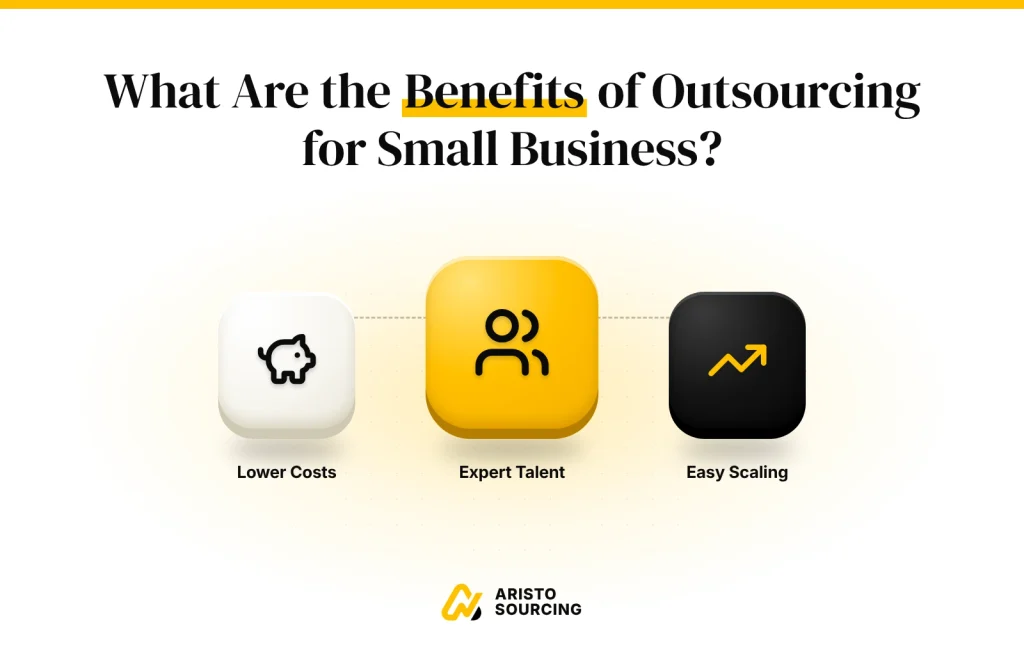
The benefits of outsourcing for small business are lower costs, wider access to talent, more time for the owner, smoother operations, lower risk, and the capacity to grow.
The benefits of outsourcing for small businesses are listed below.
- Lower labor costs
- Lower overhead and equipment costs
- Better cash flow and predictable costs
- Lower hiring and turnover costs
- Access to specialized expertise
- Part-time access to senior talent
- Access to a wider talent pool
- More time to focus on core business
- Faster access to extra capacity
- Easy scalability for busy and slow seasons
- Faster turnaround on projects
- Extended hours and 24/7 coverage
- Proven processes and higher efficiency
- Access to better technology and tools
- Reduced compliance risk
- Stronger cybersecurity
- Less key-person risk and better continuity
- Ability to compete with larger companies
- Test a role before hiring in-house
- Better customer experience
1. Lower Labor Costs
Outsourcing gives a small business lower labor costs by replacing a full-time salary and benefits package with a fee for only the hours or output the business needs. Lower labor costs matter more for a small business than for a large company because payroll is usually its largest expense and one salary is a large share of a small budget. Based on data from the Bureau of Labor Statistics, a US administrative assistant earns a median $48,310 a year, and benefits at 30.0% of private-industry compensation lift the fully loaded cost to about $69,000. Service businesses with heavy administrative workloads and fewer than 20 employees gain the most from lower labor costs.
2. Lower Overhead and Equipment Costs
Outsourcing gives a small business lower overhead and equipment costs by moving desks, computers, software licenses, and office space onto the provider’s or remote worker’s side. Lower overhead matters more for a small business than for a large company because a small firm has no spare office capacity and pays full retail price for every additional seat and license. A remote outsourced worker uses the provider’s workspace and equipment, so adding capacity does not trigger a lease upgrade or a hardware purchase. Businesses close to the limit of their current office or those working fully remote gain the most from lower overhead and equipment costs.
3. Better Cash Flow and Predictable Costs
Outsourcing gives a small business better cash flow and predictable costs by turning irregular spending into a fixed monthly fee. Predictable costs matter more for a small business than for a large company because a small firm has thin cash reserves, and one unplanned expense can delay payroll or supplier payments. A fixed monthly fee replaces lump sums such as recruiting fees, equipment purchases, overtime, and severance with one line item the owner can forecast. Seasonal and project-based businesses with uneven revenue gain the most from better cash flow.
4. Lower Hiring and Turnover Costs
Outsourcing gives a small business lower hiring and turnover costs by shifting recruitment, onboarding, and replacement onto the provider. Hiring and turnover costs matter more for a small business than for a large company because the owner usually runs recruiting personally, and one resignation can leave a function uncovered. SHRM’s 2025 Recruiting Benchmarking Report puts the median nonexecutive cost per hire at $1,200, before counting the hours an owner spends screening and interviewing. Businesses in high-turnover roles, such as customer support and administration, gain the most from lower hiring and turnover costs.
5. Access to Specialized Expertise
Outsourcing gives a small business access to specialized expertise by buying skills such as accounting, IT, and digital marketing from providers who practice them full-time. Specialized expertise matters more for a small business than for a large company because a small firm cannot justify a full-time specialist for each function and has no in-house department to fall back on. Clutch’s 2019 survey of small businesses found that accounting, IT services, and digital marketing were the most commonly outsourced processes, all of them specialist functions. Owner-led businesses whose founder lacks finance, technology, or marketing training gain the most from specialized expertise.
6. Part-Time Access to Senior Talent
Outsourcing gives a small business part-time access to senior talent by buying a set number of hours from a fractional CFO, marketing director, or IT lead. Senior talent matters more for a small business than for a large company because a small firm needs senior judgment at key moments but cannot afford a senior salary year-round. Fractional executives work across several clients, so each client pays for only the leadership hours it uses. Growing businesses preparing for financing, expansion, or a system change gain the most from part-time senior talent.
7. Access to a Wider Talent Pool
Outsourcing gives a small business access to a wider talent pool by recruiting beyond the local labor market, including offshore markets such as the Philippines and South Africa. A wider talent pool matters more for a small business than for a large company because a small firm lacks the employer brand and pay scale that attract applicants locally. The NFIB reports that in June 2026, 32% of small business owners had job openings they could not fill and 51% reported few or no qualified applicants. Businesses in rural areas or tight local labor markets gain the most from a wider talent pool.
8. More Time to Focus on Core Business
Outsourcing gives a small business more time to focus on its core business by moving repetitive and non-core tasks off the owner’s desk. Owner time matters more for a small business than for a large company because the owner is often the main salesperson, the main decision-maker, and the main operator at once. Every hour spent on invoicing, inbox management, or scheduling is an hour taken from customers, product, or sales. Founder-led businesses where the owner still handles administration gain the most from more time to focus on the core business.
9. Faster Access to Extra Capacity
Outsourcing gives a small business faster access to extra capacity by drawing on a provider’s vetted candidate pool instead of running a recruitment process from zero. Speed to capacity matters more for a small business than for a large company because a small firm has no internal bench to absorb a sudden contract or a resignation. SHRM’s 2026 benchmarking data puts the median time to fill a nonexecutive role at 39 days, while staffing providers with pre-vetted pools can place dedicated staff in under a month. Businesses that win a large new client or lose a key employee unexpectedly gain the most from faster access to extra capacity.
10. Easy Scalability for Busy and Slow Seasons
Outsourcing gives a small business easy scalability for busy and slow seasons by adding or reducing outside capacity as demand changes. Scalability matters more for a small business than for a large company because a small firm cannot carry idle staff through slow months or easily hire for a six-week peak. An outsourced arrangement lets an ecommerce store add support capacity for the fourth quarter or a tax practice add bookkeeping capacity from January to April without permanent hires. Retail, ecommerce, tax, and event businesses with sharp seasonal swings gain the most from easy scalability.
11. Faster Turnaround on Projects
Outsourcing gives a small business faster turnaround on projects by assigning work to a provider with dedicated hours and an existing workflow for that type of project. Turnaround matters more for a small business than for a large company because internal staff juggle projects alongside daily operations, so project work slips to the end of the queue. A provider that builds websites, cleans data, or produces content every week finishes a defined project faster than a generalist fitting it between other tasks. Businesses with a backlog of one-off projects, such as a site rebuild or a CRM migration, gain the most from faster turnaround.
12. Extended Hours and 24/7 Coverage
Outsourcing gives a small business extended hours and 24/7 coverage by placing work with staff in other time zones or with providers that run shifts around the clock. Coverage matters more for a small business than for a large company because a small team cannot staff evenings, weekends, and overnight hours without burning out. Manila is 12 hours ahead of New York during US daylight saving time, so a Philippines-based assistant can process orders, answer tickets, and prepare reports while the US team is offline. Ecommerce, software, and service businesses with customers in several time zones gain the most from extended hours and 24/7 coverage.
13. Proven Processes and Higher Efficiency
Outsourcing gives a small business proven processes and higher efficiency by importing the provider’s documented workflows, checklists, and quality controls. Proven processes matter more for a small business than for a large company because most small firms run on habits and the owner’s memory rather than written procedures. A provider that runs bookkeeping or customer support for many clients brings standard operating procedures refined across all of them. Businesses that have grown past the point where informal processes still work gain the most from proven processes.
14. Access to Better Technology and Tools
Outsourcing gives a small business access to better technology and tools by using the software, platforms, and automation the provider already licenses and knows how to run. Technology access matters more for a small business than for a large company because enterprise-grade tools are often priced beyond a small budget and need expertise to configure. A managed IT or marketing provider spreads tool costs across its clients and arrives already trained on the platforms. Businesses still running core functions on spreadsheets and email gain the most from access to better technology and tools.
15. Reduced Compliance Risk
Outsourcing gives a small business reduced compliance risk by placing payroll tax, filing, and regulatory tasks with providers who track rule changes for a living. Compliance risk matters more for a small business than for a large company because a small firm has no in-house legal or compliance team and one penalty can erase a month’s profit. The IRS charges failure-to-deposit penalties of 2% to 15% of the unpaid payroll tax deposit, depending on how late the deposit is. Businesses with employees in several states or in regulated industries gain the most from reduced compliance risk.
16. Stronger Cybersecurity
Outsourcing gives a small business stronger cybersecurity by using managed IT and security providers that run monitoring, patching, backups, and access controls professionally. Cybersecurity matters more for a small business than for a large company because small firms are targeted heavily but rarely employ a security specialist. According to Verizon’s 2025 Data Breach Investigations Report, ransomware was present in 88% of breaches at small and mid-size businesses, compared with 39% at large organizations. Businesses that store customer payment, health, or financial data gain the most from stronger cybersecurity.
17. Less Key-Person Risk and Better Continuity
Outsourcing gives a small business less key-person risk and better continuity by spreading critical knowledge and tasks beyond one employee. Key-person risk matters more for a small business than for a large company because one person often holds an entire function, so an illness, vacation, or resignation stops that function. A provider documents the work and supplies backup coverage, so payroll, bookkeeping, or support continues when one person is unavailable. Businesses where a single employee runs finance, IT, or operations alone gain the most from less key-person risk.
18. Ability to Compete With Larger Companies
Outsourcing gives a small business the ability to compete with larger companies by giving it the same specialist skills, coverage hours, and tools that larger competitors staff internally. Competitive reach matters more for a small business than for a large company because a small firm competes against rivals with full departments for the same customers. A 10-person company with outsourced support, bookkeeping, and marketing can offer response times and service quality that once required a much larger headcount. Small businesses entering markets dominated by larger firms gain the most from this ability to compete.
19. Test a Role Before Hiring In-House
Outsourcing gives a small business a way to test a role before hiring in-house by running the work through an outside provider before committing to a permanent hire. Testing a role matters more for a small business than for a large company because a wrong permanent hire costs a small firm a larger share of its budget and is harder to reverse. Outsourcing a function for three to six months shows the real workload, the skills needed, and the return before the owner writes a job description. Businesses considering their first marketing, sales, or operations hire gain the most from testing a role before hiring in-house.
20. Better Customer Experience
Outsourcing gives a small business a better customer experience by adding response capacity, longer service hours, and trained support staff. Customer experience matters more for a small business than for a large company because a small firm depends on repeat customers and referrals, so a slow reply can lose a customer for good. Dedicated support staff answer emails, chats, and calls quickly while the owner stays focused on delivery. Service businesses, ecommerce stores, and subscription companies with growing ticket volume gain the most from a better customer experience.
What Are the Disadvantages of Outsourcing for Small Business?
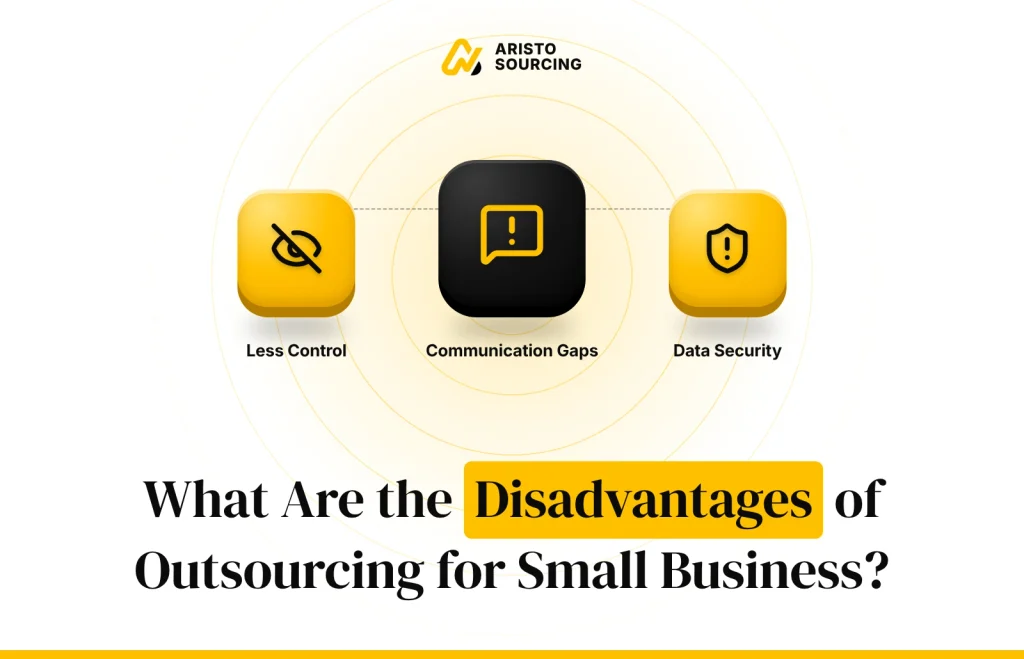
The disadvantages of outsourcing for small business are loss of direct control, data security and privacy risks, communication and time-zone gaps, dependence on an outside provider, hidden and rising costs, inconsistent quality, and the delegation and management time the owner must invest. These trade-offs balance the 20 benefits of outsourcing for small business, and together they form the pros and cons an owner should weigh.
The cost, talent, and time gains above are real, but each one depends on the right setup, and every disadvantage below is manageable with clear scope, vetting, and regular review. Many of these trade-offs mirror the challenges every outsourcing relationship faces but they hit a small business harder because one vendor can run a large share of its operations.
1. Loss of Direct Control
Outsourcing risks loss of direct control for a small business because day-to-day decisions about how the work is done move to the provider. Loss of control hits a small business harder because the owner is used to seeing every task and has no manager layer to oversee the provider. Control slips further when the scope is vague and when the provider assigns work to staff the owner never meets. To reduce loss of control, a small business should define scope and service levels in writing and hold a short weekly check-in.
2. Data Security and Privacy Risks
Outsourcing risks data security and privacy for a small business because customer, financial, and login data become accessible to people outside the company. Data exposure hits a small business harder because a small firm rarely has the legal and technical resources to respond to a breach. Verizon’s 2025 Data Breach Investigations Report found that third-party involvement in breaches doubled from 15% to 30% in one year, and the risk grows when providers share passwords or use personal devices. To reduce data security risks, a small business should require role-based access with multi-factor authentication and check the provider’s security certifications.
3. Communication and Time-Zone Gaps
Outsourcing risks communication and time-zone gaps for a small business because instructions pass between people who do not share an office, a schedule, or sometimes a first language. Communication gaps hit a small business harder because the owner has no spare staff to clarify instructions or catch misunderstandings. Gaps widen when tasks are explained verbally and when the provider works entirely outside the owner’s hours. To reduce communication gaps, a small business should agree on overlap hours and write instructions as step-by-step SOPs.
4. Dependence on an Outside Provider
Outsourcing risks dependence on an outside provider for a small business because the provider accumulates knowledge, credentials, and process ownership over time. Dependence hits a small business harder because one vendor can run a large share of its operations, so switching providers disrupts the whole business. Dependence deepens when the provider holds the only copies of documentation and account access. To reduce dependence, a small business should keep ownership of all accounts and data and require documentation of every recurring process.
5. Hidden and Rising Costs
Outsourcing risks hidden and rising costs for a small business because fees beyond the headline price appear through setup charges, add-ons, overage, and annual increases. Cost surprises hit a small business harder because a small budget feels every unplanned charge. Costs rise further when the contract bills by the hour without a cap or when the scope expands informally. To reduce hidden costs, a small business should request an all-in written quote and agree a cap or approval step for extra work.
6. Inconsistent Quality
Outsourcing risks inconsistent quality for a small business because output depends on which person the provider assigns and how well that person understands the business. Quality variance hits a small business harder because each customer interaction or financial record carries more weight in a small operation. Quality drops when the provider rotates staff often and when no quality standard is written down. To reduce inconsistent quality, a small business should start with a trial period and review sample work against a written checklist.
7. Delegation and Management Time
Outsourcing risks delegation and management time for a small business because the owner must document tasks, onboard the provider, and review output before any time is saved. Management time hits a small business harder because owners often underestimate the setup work of documenting tasks, onboarding, and weekly review. The time cost grows when the owner delegates tasks that were never written down and has to explain them repeatedly. To reduce management time, a small business should document one task at a time and schedule a fixed weekly review instead of ad hoc check-ins.

When Should a Small Business Outsource?
A small business should outsource when the owner is overwhelmed with non-core tasks, the business lacks specialized skills in-house, quality or deadlines are slipping, the workload swings with the seasons, or growth has stalled. These are the signs that outsourcing will pay off now rather than later. Each sign is a diagnostic symptom an owner can check, and the last section of this guide explains how to start once the signs are present.
The 5 signs that a small business should outsource are listed below.
- You’re Overwhelmed With Non-Core Tasks
- You Lack Specialized Skills In-House
- Quality or Deadlines Are Slipping
- Your Workload Swings With the Seasons
- Growth Has Stalled
You’re Overwhelmed With Non-Core Tasks
A small business should outsource when the owner is overwhelmed with non-core tasks that do not grow revenue. This sign looks like evenings spent on invoicing, inbox management, scheduling, and data entry while sales calls and product work wait. The first tasks to outsource are the repetitive ones, which are also the non-core activities worth outsourcing first. This sign corresponds to benefit 8, more time to focus on the core business.
You Lack Specialized Skills In-House
A small business should outsource when it lacks specialized skills in-house for work the business needs done correctly. This sign looks like bookkeeping that runs months behind, a website nobody can update, or marketing that stops whenever the owner gets busy. The first task to outsource is the one where errors cost the most, which is usually bookkeeping or IT. This sign corresponds to benefit 5, access to specialized expertise.
Quality or Deadlines Are Slipping
A small business should outsource when quality or deadlines are slipping because the team is stretched too thin. This sign looks like missed delivery dates, rising customer complaints, rework, and a backlog that grows every week. The first task to outsource is the one creating the backlog, such as customer support tickets or order processing. This sign corresponds to benefit 13, proven processes and higher efficiency.
Your Workload Swings With the Seasons
A small business should outsource when its workload swings with the seasons and permanent staff sit idle in slow months. This sign looks like overtime and turned-down work in peak months followed by quiet periods with too many people on payroll. The first task to outsource is the peak-season task, such as order support or bookkeeping during tax season. This sign corresponds to benefit 10, easy scalability for busy and slow seasons.
Growth Has Stalled
A small business should outsource when growth has stalled because the owner and team have no capacity left to pursue new customers. This sign looks like flat revenue, a stopped sales pipeline, and new opportunities turned down because nobody has time to follow up. The first task to outsource is the one that frees the most owner time for selling, such as administration or lead research. This sign corresponds to benefit 18, the ability to compete with larger companies.
How Do You Start Outsourcing as a Small Business?
You start outsourcing as a small business by tracking where your time goes, picking one task, choosing the right model, vetting the provider, and expanding only after a trial period works. Starting with one task limits the risk and builds the documentation habit that every later handoff needs.
The 5 steps to start outsourcing as a small business are listed below.
- Track your time for one week and list tasks that are repetitive, non-core, or outside your skills.
- Pick one task to start and write a simple SOP or checklist for it.
- Choose the model: a freelancer for one-off work, a managed agency for a full function, or dedicated staff you direct for ongoing daily work.
- Vet for skills, references, and security practices, then agree scope, hours, and communication in writing.
- Run a trial period, review the work weekly, and expand to the next task once the first one runs smoothly.
The budget for the first task depends on the model, and a guide to how much to budget for outsourcing sets realistic ranges by function. The clear next step is the one-week time audit, because it shows which task returns the most hours to the owner.
Small businesses that need ongoing daily support can hire a dedicated virtual assistant through Aristo Sourcing, which places vetted virtual assistants and support staff from the Philippines and South Africa with a ramp time under one month and retention above 93%. <!– EDITOR: confirm whether the $400/mo Aristo fee is on top of salary or all-in before stating any price. –> The owner directs the work day to day, and licensed work such as tax filing or legal advice still needs a credentialed provider.