
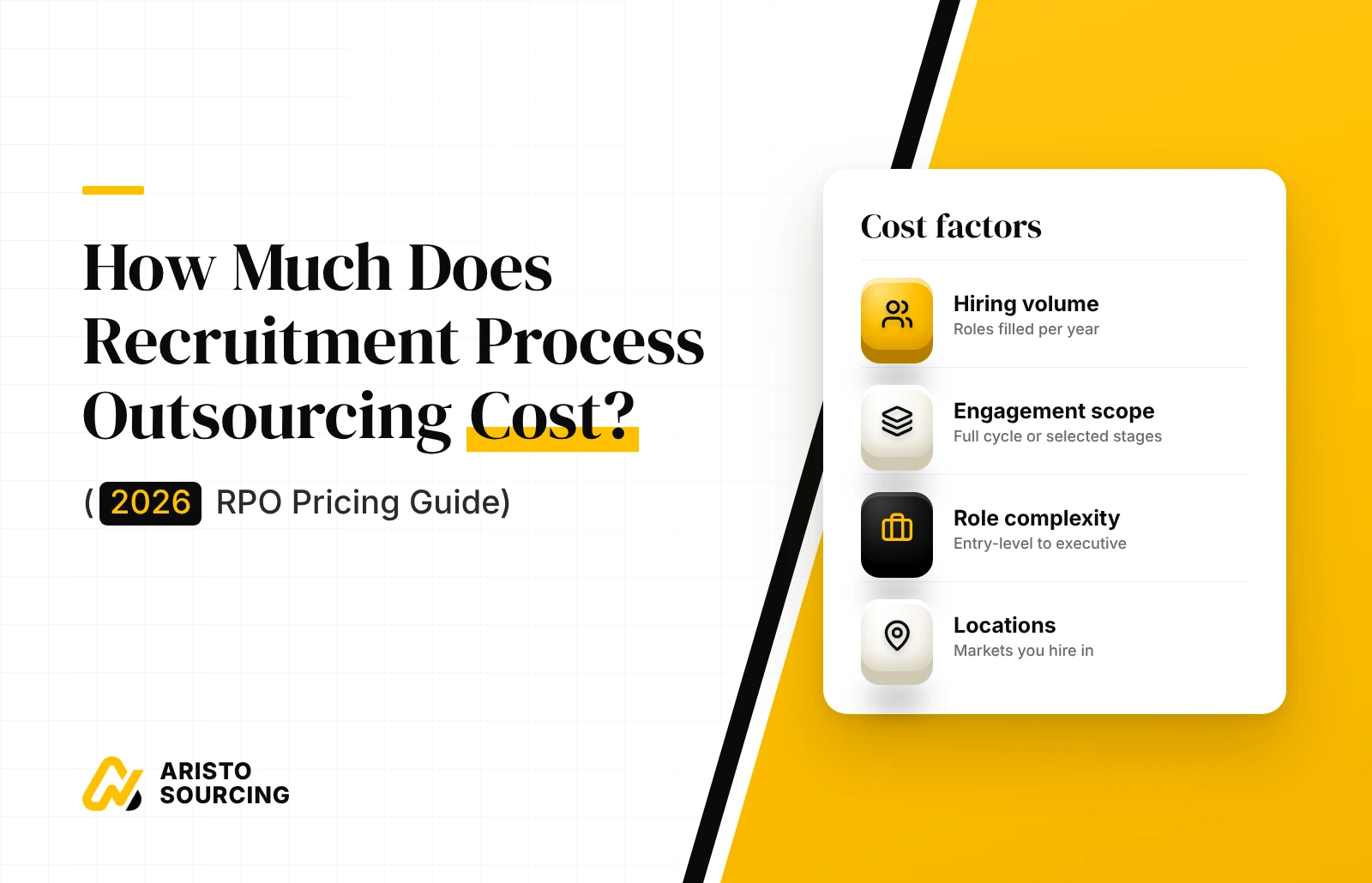
Recruitment process outsourcing costs $3,000 to $10,000 per hire on outcome-based pricing, or $8,000 to $15,000 per month for each embedded recruiter on capacity-based pricing, as of 2026. This RPO pricing guide covers the RPO pricing models, cost by role level and engagement type, cost drivers, hidden costs and contract terms, RPO vs in-house recruiting vs a staffing agency, ROI and break-even, quality of hire, small-company fit, and how to evaluate a proposal.
The guide is written for HR, talent acquisition, and business leaders pricing RPO before an RFP. Teams still deciding whether recruitment process outsourcing as a hiring model fits their organization should confirm the scope first, because scope decides which pricing model a provider will propose. RPO providers do not publish rate cards, so the ranges in this guide reflect typical quoted ranges as of 2026 and need confirming through an RFP.
According to Global Market Insights, the recruitment process outsourcing market is valued at $12.06 billion in 2026 and is projected to reach $27.16 billion by 2035, a compound annual growth rate of 9.44%. Small and mid-size enterprises held 35% of that market in 2025, which shows that RPO buying is no longer limited to large employers.
How Much Does RPO Cost?
Recruitment process outsourcing costs $3,000 to $10,000 per hire under outcome-based pricing and $8,000 to $15,000 per month per embedded recruiter under capacity-based pricing. Monthly management fees for a broader scope run from $4,000 to $15,000 per month, depending on the number of recruiters, sourcers, and tools the provider supplies. The range is wide because four variables change the price: the pricing model, the role level, the engagement type, and the hiring volume. Against a full-time internal recruiter, break-even usually starts at around 15 to 25 or more hires per year. The pricing model has the largest effect, so the breakdown starts there.
What Are the RPO Pricing Models?
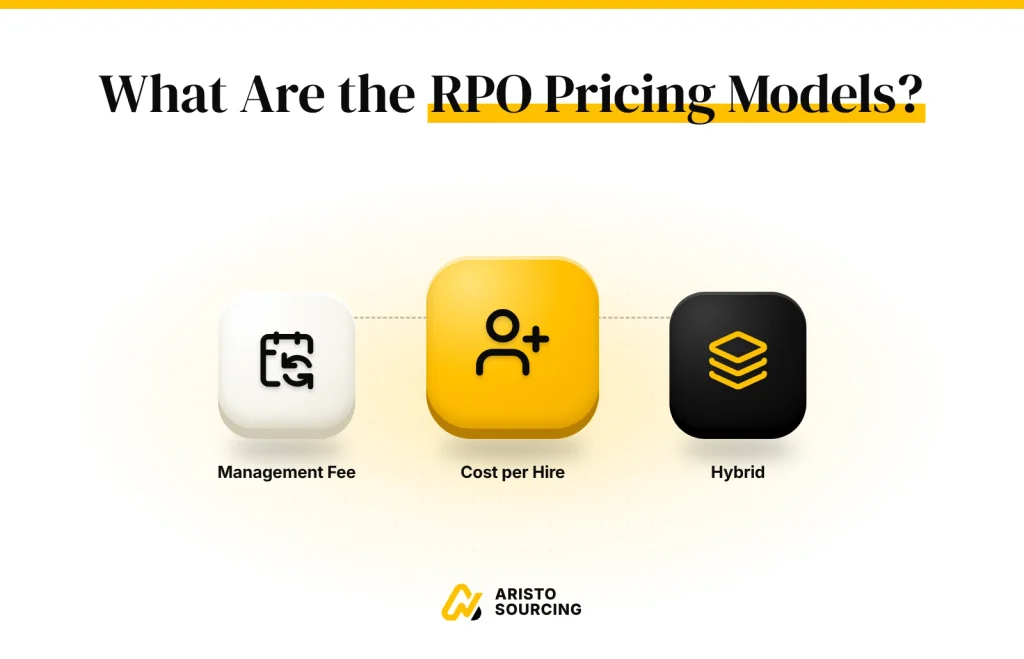
RPO providers price their services in five main ways: a management fee, cost-per-hire, a hybrid of the two, cost-per-slate, and transaction-based pricing. The core split is between capacity-based pricing, where the buyer pays for recruiting effort, and outcome-based pricing, where the buyer pays for results. Hybrid models sit between the two and are among the most common contract structures, because they share volume risk between buyer and provider.
The summary of RPO pricing models is presented in the table below.
| Pricing Model | How It Bills | Typical Range | Best For | Explanation |
| Management Fee | Fixed monthly retainer | 4,000-15,000 per month | Steady, predictable volume | The buyer pays for capacity regardless of hires. |
| Cost-Per-Hire | Fee per successful placement | 3,000-10,000 per hire | Variable or uncertain volume | The buyer pays only for results. |
| Hybrid | Reduced monthly fee + reduced per-hire fee | Below both pure models on each component | Mid-volume programs | Risk is shared between buyer and provider. |
| Cost-Per-Slate | Fee per shortlist of qualified candidates | Quoted per role | Niche or hard-to-fill roles | The buyer pays for qualified candidates, not hires. |
| Transaction-Based | Fee per discrete action | Quoted per action | Single recruiting stages | The buyer pays for tasks such as screening or scheduling. |
The 5 RPO pricing models are listed below.
- Management Fee (Monthly Retainer)
- Cost-Per-Hire (Pay for Performance)
- Hybrid (Management Fee + Per-Hire)
- Cost-Per-Slate
- Transaction-Based Pricing
Management Fee (Monthly Retainer)
With management fee pricing, a business pays a fixed monthly retainer for a dedicated recruiting capacity, regardless of how many hires close. The fee covers recruiters, sourcers, the applicant tracking system and sourcing tools, and reporting, and a true-up clause reconciles the bill when actual hiring volume differs from the forecast the price was built on. Management fees typically run $4,000 to $15,000 per month, depending on team size and scope.
The pros and cons of management fee pricing are listed below.
- Advantage: Monthly cost is predictable and the provider has no incentive to push volume over quality.
- Disadvantage: The business pays the full retainer even in months when hiring slows.
Best for: Organizations with steady, forecastable hiring volume across the year.
Cost-Per-Hire (Pay for Performance)
With cost-per-hire pricing, also called pay for performance or a success fee, a business pays a fee only when a candidate is hired. Payment is triggered by a successful placement and is often split, for example 50% when the requisition opens and 50% when the hire starts. Cost-per-hire fees typically run $3,000 to $10,000 per hire, depending on role level.
The pros and cons of cost-per-hire pricing are listed below.
- Advantage: Spend tracks results, so the business pays nothing for unfilled roles beyond any opening fee.
- Disadvantage: Per-hire incentives can push providers toward fast, easy fills over the best candidates.
Best for: Organizations with variable or uncertain hiring volume.
Hybrid (Management Fee + Per-Hire)
With hybrid pricing, also called blended pricing, a business pays a reduced monthly management fee plus a reduced fee for each hire. The base fee covers the provider’s core team and technology, and a true-up clause reconciles the bill when actual hiring falls short of or exceeds forecast, often charging the higher of a minimum monthly fee or the combined per-requisition fees. Hybrid components typically sit below both a pure management fee and a pure per-hire fee.
The pros and cons of hybrid pricing are listed below.
- Advantage: Risk is shared, so the provider covers its fixed costs while the buyer still pays partly for results.
- Disadvantage: Two fee components and a true-up clause make the total harder to forecast and audit.
Best for: Mid-volume programs with some seasonal or forecast uncertainty.
Cost-Per-Slate
With cost-per-slate pricing, a business pays a fee each time the provider delivers a shortlist of qualified candidates for a role. Payment is triggered by an accepted slate, not a hire, so the business keeps the interview and selection work. Cost-per-slate fees are quoted per role and vary with role difficulty.
The pros and cons of cost-per-slate pricing are listed below.
- Advantage: The business gets qualified pipeline for niche roles without paying full per-hire fees.
- Disadvantage: The business pays for slates that may not produce a hire.
Best for: Niche or hard-to-fill roles where sourcing is the bottleneck.
Transaction-Based Pricing
With transaction-based pricing, a business pays for each discrete recruiting action, such as a phone screen, an interview scheduled, an assessment, or a background check. Payment is triggered by the completed action, which makes the model a fit for buying a single stage of the hiring process. Transaction fees are quoted per action and depend on the task.
The pros and cons of transaction-based pricing are listed below.
- Advantage: The business buys only the stages its internal team cannot cover.
- Disadvantage: Costs rise quickly at high volume, and no single provider owns the hiring outcome.
Best for: Teams that need support for one stage, such as screening or scheduling.
What Does RPO Cost by Role Level?
RPO cost per hire varies by role level: high-volume entry-level roles cost the least, mid-level professional roles cost roughly $3,000 to $10,000, senior roles cost roughly $8,000 to $15,000, and executive or specialized roles cost $15,000 to $25,000 or more per hire. Seniority moves the price because senior searches need deeper sourcing, face greater candidate scarcity, and run more assessment rounds.
The RPO cost by role level as of 2026 is presented in the table below.
| Role Level | Typical RPO Cost per Hire | Internal Benchmark | Explanation |
| High-volume / entry-level | Lowest; programmatic pricing, often 50+ hires per year | SHRM 2025 median nonexecutive cost per hire: $1,200 | Standardized screening and automation spread cost across many hires. |
| Mid-level professional | 3,000-10,000 | – | Targeted sourcing and multi-round interviews add recruiter time. |
| Senior | 8,000-15,000 | – | Passive-candidate sourcing and longer cycles raise effort per hire. |
| Executive / specialized | 15,000-25,000+ | SHRM 2025 median executive cost per hire: $10,625 | Scarce candidates, confidential searches, and assessment depth drive cost. |
SHRM’s 2025 Recruiting Benchmarking Report shows how wide the spread is inside a single employer: the median executive cost per hire of $10,625 is nearly nine times the median nonexecutive figure of $1,200. A single blended RPO range hides that spread, so every quote needs a breakdown by role level.
What Does RPO Cost by Engagement Type?
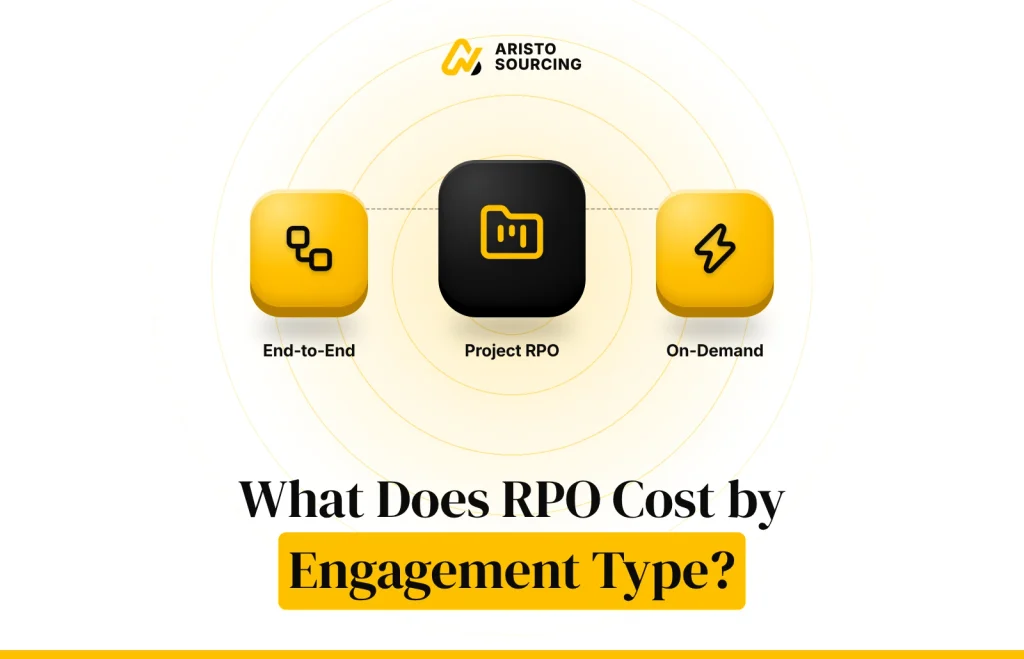
RPO cost depends on the engagement type: project RPO is priced per hire or by milestone, enterprise RPO uses a management fee or hybrid, on-demand RPO bills monthly per recruiter, point-solution RPO costs the least, and an embedded recruiter costs $8,000 to $15,000 per month.
The RPO cost by engagement type is presented in the table below.
| Engagement Type | Pricing Basis | Explanation |
| Project RPO | Per hire or per milestone | A defined hiring push, such as opening a new site. |
| Enterprise / end-to-end RPO | Management fee or hybrid | The full recruiting function, with the largest annual contracts. |
| On-demand RPO | Monthly fee per recruiter | Flexible recruiter capacity for hiring spikes. |
| Point-solution RPO | Per transaction or per stage | One stage only, such as sourcing or screening, with the lowest scope. |
| Embedded recruiter | 8,000-15,000 per month | One dedicated recruiter working inside the client’s team. |
Global Market Insights reports that enterprise RPO generated $6.11 billion of the $11.11 billion market in 2025, while on-demand RPO held 15% of the market. The way each engagement type operates is covered in the guide to RPO engagement models <!– link: RPO models/types page – no target in link inventory; do not use /rpo-pricing/ (planned), which overlaps this page –>, which sits outside the cost scope of this page.
What Drives the Cost of RPO?
Beyond role level and engagement type, the cost of RPO is driven by hiring volume, geography, engagement length and urgency, added services, and the technology stack. Role complexity and scope of service are covered in the two sections above.
The 5 additional cost drivers of RPO are listed below.
- Hiring Volume: Higher requisition volume lowers the per-hire cost because fixed provider costs spread across more hires.
- Geography: Hiring across multiple countries or in high-cost labor markets raises recruiter cost and compliance work.
- Engagement Length and Urgency: Longer contracts lower rates, while rush timelines raise them.
- Added Services: Employer branding, assessments, onboarding, and compliance support add fees on top of core recruiting.
- Technology Stack: Provider-supplied applicant tracking, CRM, and sourcing tools cost more than using the client’s existing systems.
What Hidden Costs and Contract Terms Should You Watch For?
The hidden costs and contract terms to watch for in RPO include implementation fees, pass-through costs, monthly minimums and multi-year lock-ins, true-up clauses, missing internal-hire credits, and reporting and exit fees. These terms rarely appear in the headline rate, and each one changes the real cost per hire.
The hidden costs and contract terms of RPO are listed below.
- Implementation Fees: Setup charges cover process design, system configuration, and employer-brand assets before the first hire.
- Pass-Through Costs: Job board advertising, premium database licenses, sourcing tools, and background checks are often billed at cost on top of fees.
- Minimums and Lock-Ins: Monthly minimum fees and contract terms that commonly run one to three years bind the buyer even if hiring slows.
- True-Up Clauses: Reconciliation terms decide what the buyer owes when hiring volume falls short of or exceeds forecast.
- Internal-Hire Credits: Contracts should exclude per-hire fees on internal mobility, employee referrals, and candidates the company already identified.
- Reporting and Exit Terms: Custom reporting can carry extra fees, and transition clauses decide who owns candidate data when the contract ends.
The buyer’s protection is a contract that itemizes every fee, defines true-up math in writing, and lists the hire types excluded from per-hire charges.
RPO vs In-House Recruiting vs Staffing Agency: Cost Comparison
RPO costs less per hire than a staffing agency at almost any volume and less than an in-house team at low to moderate volume, because RPO fees scale with hiring while agency fees scale with salary and in-house costs stay fixed. Based on data from the Bureau of Labor Statistics, human resources specialists, the occupation that includes recruiters, earned a median annual wage of $75,940 in May 2025. With benefits at 30.0% of private-industry compensation costs, that wage implies a fully loaded recruiter cost of about $108,500 per year before tools. Staffing agencies working on contingency commonly charge 15% to 25% of the hire’s first-year base salary, which equals $10,500 to $17,500 for a $70,000 role.
The cost comparison of RPO, in-house recruiting, and a staffing agency is presented in the table below.
| Factor | In-House Recruiting | Staffing Agency | RPO | Explanation |
| Cost structure | Salary, benefits, and tools | Contingency fee per hire | Per-hire or monthly fee | Only RPO fees are built to scale with volume. |
| Typical cost per hire | Fully loaded cost ÷ hires per year | 15%-25% of first-year salary | 3,000-10,000 mid-level | In-house cost per hire falls as utilization rises. |
| Upfront costs | Recruiting the recruiter, tools, onboarding | None | Implementation fee | Agencies carry the lowest upfront cost. |
| Scalability | Slow; requires new hires | High per role | High; capacity flexes by contract | RPO scales without adding headcount. |
| Expertise and technology | Depends on the team | Role-specific networks | Recruiting specialists plus provider tools | RPO brings a full process and tech stack. |
| Brand control | Full | Low | High; RPO recruits under the client brand | Agencies present candidates under their own brand. |
| Best for | High, steady volume | Occasional or urgent single roles | 15-25+ hires per year with variable demand | The right answer depends on volume. |
The honest comparison sets cost per hire at the buyer’s own volume against each option, never one provider’s headline rate against another’s.
When Does RPO Pay Off? ROI and Break-Even by Hiring Volume
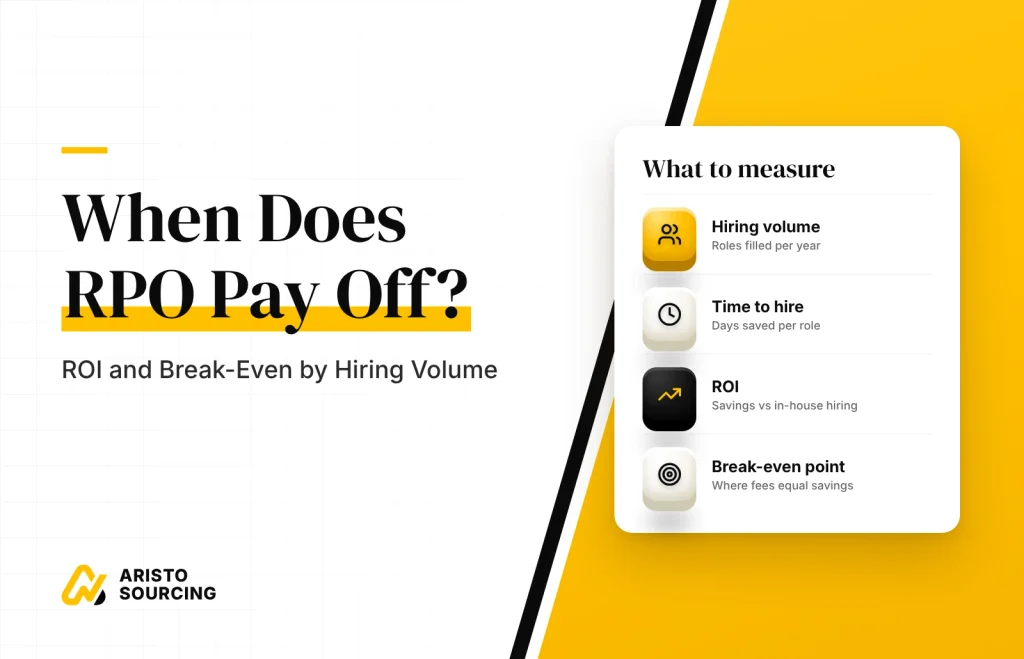
RPO pays off when annual hiring volume is high enough to absorb setup fees and minimums but too variable or too low to keep a full internal recruiting team busy, which usually starts at around 15 to 25 or more hires per year. At very high, steady volume with a fully used internal team, in-house recruiting becomes cheaper again.
The worked scenarios below assume a 70,000mid-levelrole,anagencyfeeof20%(14,000 per hire), an in-house recruiter at $118,500 per year fully loaded including $10,000 of tools with capacity of 40 hires per year, and hybrid RPO pricing of $2,000 per month plus $4,000 per hire. The cost per hire at 20, 50, 100, and 200 hires per year is presented in the table below.
| Hires per Year | In-House Cost per Hire | Agency Cost per Hire | Hybrid RPO Cost per Hire | Explanation |
| 20 | $5,925 (1 recruiter) | $14,000 | $5,200 | RPO is lowest because one internal recruiter is underused. |
| 50 | $4,740 (2 recruiters) | $14,000 | $4,480 | RPO stays lowest while the internal team runs below capacity. |
| 100 | $3,555 (3 recruiters) | $14,000 | $4,240 | In-house wins once recruiters run near full capacity. |
| 200 | $2,963 (5 recruiters) | $14,000 | $4,120 | Steady high volume favors a full internal team. |
ROI also comes from outcomes that never appear on the invoice: shorter time-to-fill, hiring-manager hours saved on screening, and lower agency spend on roles that previously went to contingency firms. Volume decides the model that fits: hybrid or on-demand RPO at low to mid volume, end-to-end RPO at mid volume, and an enterprise management fee at high volume.
Recruitment process outsourcing cost only makes sense when measured against the buyer’s own volume, and the 2026 RPO pricing guide figures above show where each model wins. Cost savings are one part of the return, and the wider advantages RPO brings beyond lower cost per hire complete the ROI picture.

Does RPO Improve Quality of Hire or Just Lower Cost?
RPO can improve quality of hire, but only if the contract measures quality and ties part of the price to it. Cost-per-hire savings alone do not prove value, because a cheaper hire who leaves in six months costs more than a well-matched one. The quality metrics to track are first-year retention, hiring-manager satisfaction, time-to-productivity, and offer-acceptance rate. Contracts tie pricing to quality through service-level agreements, replacement guarantees, and performance-linked fees, while quality usually slips under pure per-hire pricing that rewards volume over fit.
Is RPO Worth It for Small Companies?
RPO is often not worth it for small companies hiring fewer than 15 roles a year, because setup fees, monthly minimums, and lock-ins rarely pay off when hiring managers or an HR generalist can already cover that volume. Project or on-demand RPO can work for a smaller firm with a defined hiring push, such as staffing a new location.
The lower-cost alternative is a dedicated offshore recruiting coordinator or sourcer whom the company directs, handling sourcing, screening, interview scheduling, ATS administration, and candidate communication for a flat monthly cost with no per-hire or setup fees. Aristo Sourcing places this kind of virtual HR assistant for recruiting support from the Philippines and South Africa through a 7-step vetting process, with retention above 93%.
Aristo Sourcing is not an RPO provider, so this alternative does not cover employer-branding strategy, executive search, or enterprise workforce planning, and hiring decisions stay with the company.
How Do You Evaluate an RPO Pricing Proposal?
You evaluate an RPO pricing proposal by checking whether the pricing model fits your volume pattern, converting the proposal to an all-in cost per hire at your forecast volume, and testing every contract term that changes that number. The questions below turn a proposal into a comparable figure.
The 8 questions to ask about an RPO pricing proposal are listed below.
- Does the proposed pricing model fit the company’s hiring volume pattern?
- What is the all-in cost per hire at the forecast volume?
- Which technology is included and which is billed extra?
- Are internal moves, referrals, and pre-identified candidates excluded from per-hire fees?
- Are implementation, reporting, and pass-through fees itemized?
- What are the contract length, minimums, true-up terms, and exit clauses?
- Which quality SLAs and replacement guarantees apply?
- Can the provider supply references from companies with similar volume and role mix?
The next step is to request proposals from three providers using the same volume forecast and role mix, then compare the all-in cost per hire. Shortlists of RPO companies serving mid-sized businesses give a useful starting point. For low-volume hiring, the proposal is worth comparing against a dedicated offshore recruiting specialist from Aristo Sourcing, while enterprise-scale, end-to-end recruiting needs a full RPO provider.