
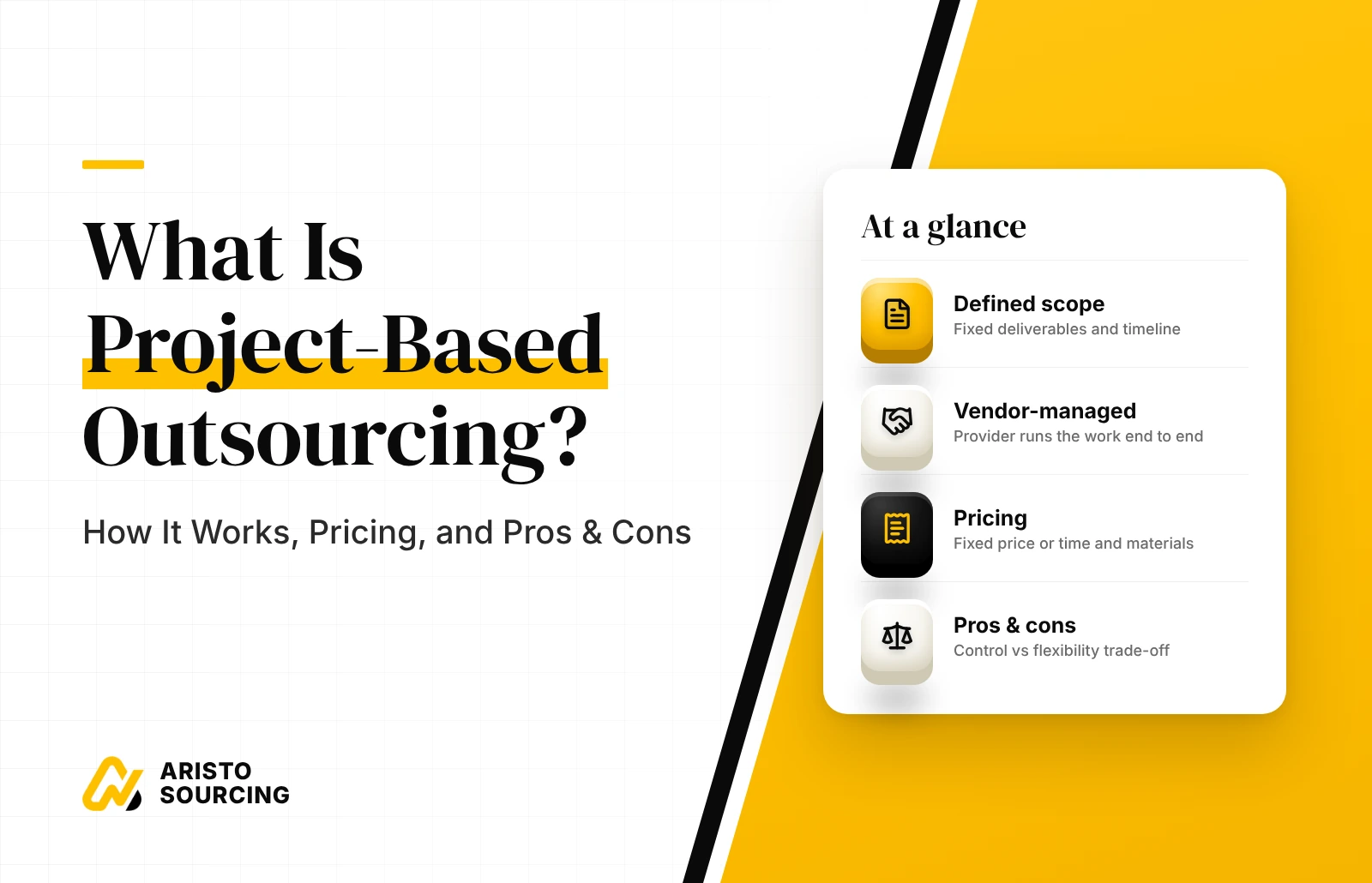
Project-based outsourcing is the contracting of one defined project to an external vendor that owns delivery from start to finish for an agreed scope, timeline, and price. This guide explains what project-based outsourcing is, how the process works step by step, how projects are priced, the benefits and drawbacks, how the model compares with a dedicated team and staff augmentation, when it fits, how to control scope creep, what happens after delivery, and how to choose a partner.
The guide is written for business owners and tech leads choosing an engagement model for a specific project. The choice matters because the engagement model, not the vendor, decides who manages the work, who carries scope risk, and what happens when requirements change.
Project outcomes explain why the choice deserves care. The Standish Group’s CHAOS report classified 29% of software projects as successful, 52% as challenged, and 19% as failed in 2015, and contract structure is one of the few levers a buyer controls before work starts.
What Is Project-Based Outsourcing?
Project-based outsourcing is an engagement model where a company contracts an external vendor to deliver a specific, defined project from start to finish, with the vendor owning the team, process, and execution. It works by fixing the scope, deliverables, and end date in a contract before work begins. The defining trait is ownership of delivery: the vendor runs the work, while the client sets requirements and approves outcomes.
The model is also called project outsourcing, and every engagement shares three features: a fixed scope, defined deliverables, and a hard end date. Project-based outsourcing sits among the engagement models that also include dedicated teams, staff augmentation, and managed services, all of which fall under business outsourcing compared with traditional hiring. Project-based outsourcing is not the same as project management outsourcing, which means hiring an external project manager to run work the company still owns.
What Kinds of Projects Are Outsourced This Way?
The projects most often outsourced on a project basis are IT and software projects, followed by marketing, design, data, and research projects with a clear end point. Project-based outsourcing in IT covers app and website builds, a discrete software module, system migrations, integrations between platforms, and legacy rebuilds with documented requirements. Beyond software, companies outsource marketing campaigns, website redesigns, data cleanup and migration, brand and design projects, audits, and research reports on the same basis. These projects share a clear specification, a measurable deliverable, and a defined end. Ongoing application maintenance follows a different engagement model, because maintenance has no end date to price against.
How Does Project-Based Outsourcing Work?
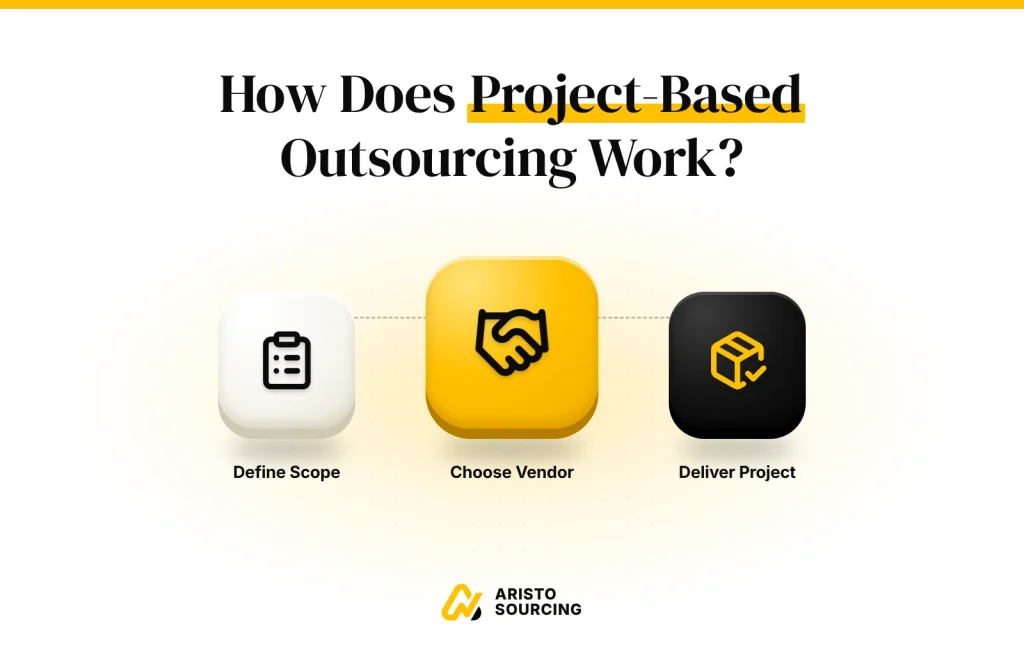
Project-based outsourcing works through six stages: discovery and requirements, scope definition and statement of work, contract and pricing agreement, execution and milestone reviews, quality assurance and acceptance testing, and delivery and handover. The vendor runs execution, while the client owns requirements, approvals, and acceptance at every stage.
The 6 steps of project-based outsourcing are listed below.
- Discovery and Requirements
- Scope Definition and Statement of Work
- Contract and Pricing Agreement
- Execution and Milestone Reviews
- Quality Assurance and Acceptance Testing
- Delivery and Handover
1. Discovery and Requirements
In the discovery and requirements step, the client and vendor establish the business need, users, constraints, and success measures for the project. The client supplies goals, current-state documentation, and access to stakeholders, while the vendor runs workshops, interviews, and a technical assessment. The output of the discovery step is a requirements document that both parties review. The most common failure at this step is a vendor accepting vague requirements to win the deal.
2. Scope Definition and Statement of Work
In the scope definition step, the parties write the agreed requirements into a statement of work (SOW) that lists deliverables, acceptance criteria, assumptions, exclusions, and the timeline. The client confirms priorities and approves what sits in and out of scope, while the vendor drafts the SOW and estimates effort for each deliverable. The output of the scope definition step is a signed SOW. The most common failure at this step is a missing exclusions list, which turns every unstated assumption into a later dispute.
3. Contract and Pricing Agreement
In the contract and pricing step, the parties agree the pricing structure, payment schedule, intellectual property ownership, warranty, and termination terms. The client’s legal and finance teams review liability, IP, and payment terms, while the vendor proposes the commercial model and its rate card. The output of the contract step is a signed project contract or master services agreement with the SOW attached. The most common failure at this step is leaving IP ownership and source-file transfer undefined.
4. Execution and Milestone Reviews
In the execution step, the vendor builds the deliverables and presents progress at each agreed milestone. The client attends milestone reviews, answers questions, and approves or rejects each milestone, while the vendor manages the team, schedule, and day-to-day decisions. The output of the execution step is a working deliverable and a signed-off milestone at each checkpoint. The most common failure at this step is a client that skips reviews and discovers problems only at the end.
5. Quality Assurance and Acceptance Testing
In the quality assurance step, the vendor tests the deliverable internally and the client runs acceptance testing against the criteria written in the SOW. The client executes user acceptance testing and logs defects, while the vendor fixes defects and retests. The output of the quality assurance step is a formal acceptance sign-off. The most common failure at this step is acceptance criteria too loose to decide pass or fail.
6. Delivery and Handover
In the delivery and handover step, the vendor transfers the finished deliverable, source files, credentials, and documentation to the client. The client confirms receipt and takes ownership of systems and accounts, while the vendor runs knowledge-transfer sessions and closes the project. The output of the handover step is a handover checklist signed by both parties and the start of the warranty period. The most common failure at this step is incomplete documentation that leaves the client dependent on the vendor.
How Is Project-Based Outsourcing Priced?
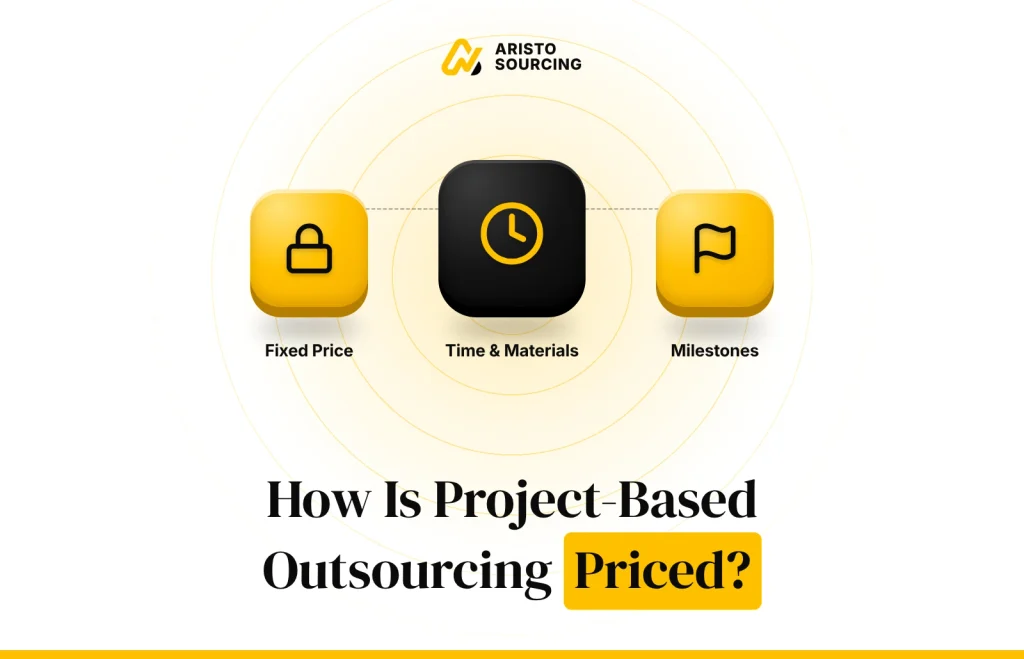
Project-based outsourcing is priced in three ways: fixed-price contracts, time and materials, and milestone-based payments. The pricing structure decides who carries scope risk, with the vendor carrying it under a fixed price, the client carrying it under time and materials, and milestone billing sharing it between them. Vendors price scope risk into fixed bids as a contingency margin, so a fixed price usually costs more than the same work billed on actual hours. Research from Yossi Lichtenstein and Alan McDonnell on 14 software projects at two Irish companies finds that some buyers accept that higher fixed price on risky projects to avoid re-budgeting, while others prefer time and materials on risky work to keep tight control.
The 3 pricing structures of project-based outsourcing are listed below.
- Fixed-Price Contracts
- Time and Materials
- Milestone-Based Payments
Fixed-Price Contracts
With fixed-price pricing, a business pays one agreed amount for the full scope defined in the SOW. The total is split into installments, such as a deposit at signing and payments at delivery, and the amount changes only through an approved change request. The vendor carries scope risk under fixed-price pricing, so the bid includes a margin to cover estimation error. The main downside of fixed-price pricing is rigidity, because every change outside the SOW needs a priced change order.
Best for: Small to mid-size projects with stable, fully documented requirements and a firm budget ceiling.
Time and Materials
With time and materials pricing, a business pays for the actual hours worked at agreed role rates plus direct costs such as licenses or third-party services. The vendor bills monthly or biweekly against timesheets, often under a not-to-exceed cap that limits total spend. The client carries scope risk under time and materials pricing, and unlike staff augmentation billed by the hour, the vendor still manages the team and owns delivery of the project. The main downside of time and materials pricing is budget uncertainty, because the total depends on how long the work takes.
Best for: Projects with evolving requirements, discovery-heavy work, and clients who want to reprioritize during delivery.
Milestone-Based Payments
With milestone-based pricing, a business pays a set amount each time the vendor delivers an accepted milestone. The SOW ties each payment to a defined deliverable and its acceptance criteria, and payment is released only after client sign-off. The vendor and client share scope risk under milestone-based pricing, because the vendor absorbs overruns inside a milestone while the client can adjust later milestones. The main downside of milestone-based pricing is dispute risk, because disagreements over acceptance delay both payment and work.
Best for: Mid-size and large projects that split into phases with testable outputs.
What Are the Benefits of Project-Based Outsourcing?
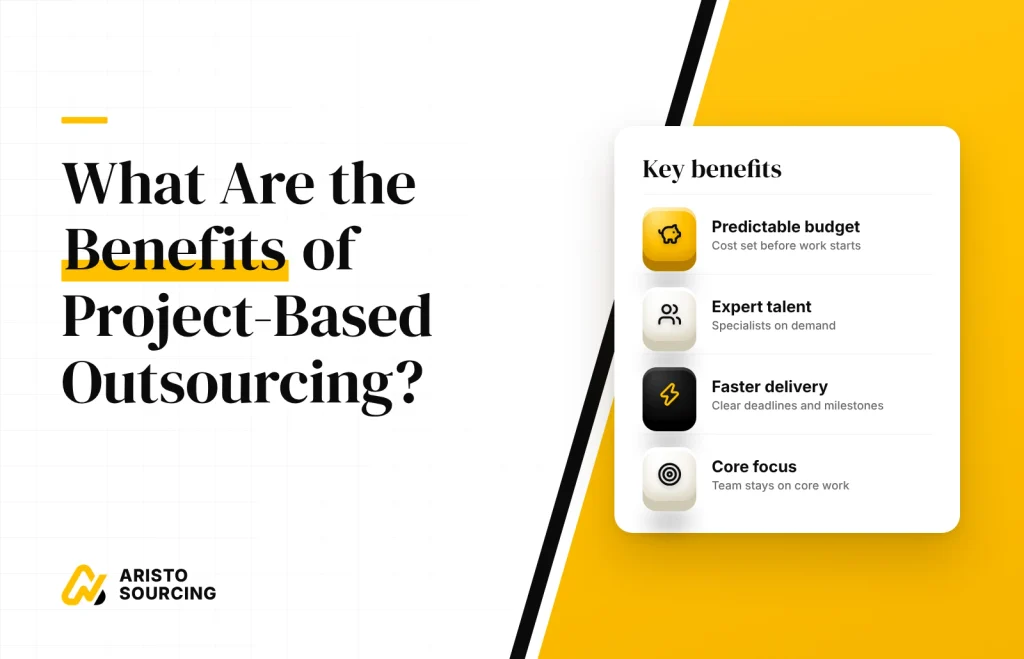
The main benefits of project-based outsourcing are cost predictability, low management overhead, access to specialist skills, a single point of accountability, and no long-term headcount commitment. These benefits come from the vendor owning delivery, which moves both the work and most of the coordination outside the company.
The benefits of project-based outsourcing are listed below.
- Fixes the Budget: A fixed price or capped time and materials contract sets a budget ceiling before work starts.
- Reduces Management Overhead: The vendor supplies the project manager and runs the team, so the client spends time on reviews instead of daily supervision.
- Supplies Specialist Skills: The company gains skills such as mobile development, data migration, or UX design for one project without hiring for them.
- Concentrates Accountability: One vendor is responsible for delivering the agreed scope, which removes finger-pointing between internal and external contributors.
- Avoids Long-Term Headcount: The engagement ends at handover, so the company carries no salary, benefits, or severance after the project.
Academic work supports the access-to-skills benefit in IT projects. Mesfin Alemu, Abel Adane, Bhupesh Kumar Singh, and Durga Prasad Sharma designed a cloud-based outsourcing framework for IT project design, development, and testing in Ethiopia, published in the International Journal of Advanced Computer Science and Applications in 2020, to give projects access to scarce IT skills without relocating staff. The same advantages appear in the benefits of outsourcing across every engagement model but the predictability benefit is specific to a fixed project scope.
What Are the Drawbacks of Project-Based Outsourcing?
The main drawbacks of project-based outsourcing are scope rigidity, change orders priced without competition, weak post-launch maintenance, a slower start, and limited day-to-day visibility. Each drawback comes from the same source as the benefits, because a fixed scope that protects the budget also resists change.
The drawbacks of project-based outsourcing are listed below.
- Locks the Scope: Changes after signing need renegotiation, which delays delivery.
- Inflates Change Orders: Once a vendor is mid-project, change requests are priced without competing bids.
- Weakens Post-Launch Support: The vendor optimizes for finishing the contract, not for maintaining the deliverable afterward.
- Delays the Start: Discovery, scoping, and contracting add weeks before any build work begins.
- Limits Visibility: The client sees progress only at milestones, and technical knowledge stays with the vendor’s team.
One senior manager interviewed by Lichtenstein and McDonnell summed up the change-order problem: “The only thing that is fixed about fixed price contracts is that this is the least you pay.” The scope-creep and after-delivery sections below show how to manage the two largest drawbacks, which sit alongside the challenges every outsourcing arrangement faces.
Project-Based Outsourcing vs Dedicated Team vs Staff Augmentation
The difference between project-based outsourcing, a dedicated team, and staff augmentation involves who manages the work, how the work is priced, how fixed the scope is, and how long the engagement lasts. Project-based outsourcing means the vendor owns delivery of a fixed scope for a fixed or capped price; a dedicated team means the vendor supplies a full-time team that works only on the client’s product under the client’s priorities for a monthly fee; staff augmentation means individual specialists join the client’s own team and take direction from the client’s managers. A company paying a vendor $60,000 to build a booking app is using project-based outsourcing; the same company paying a monthly fee for four developers who build whatever the product owner prioritizes is using a dedicated team.
The comparison of project-based outsourcing, a dedicated team, and staff augmentation is presented in the table below.
| Factor | Project-Based Outsourcing | Dedicated Team | Staff Augmentation | Explanation |
| Who manages | Vendor | Shared: client sets priorities, vendor handles HR and admin | Client | Delivery ownership moves from vendor to client across the three models. |
| Pricing | Fixed price, time and materials, or milestones | Monthly fee per team member | Hourly or monthly rate per person | Fixed pricing exists only in project-based outsourcing. |
| Scope | Fixed in the SOW | Flexible, set by the backlog | Flexible, set by the client | Scope flexibility rises as control shifts to the client. |
| Duration | Ends at handover | Long-term and open-ended | Weeks to years | Only project-based outsourcing has a hard end date. |
| Control | Low day to day, high at milestones | High over priorities | Full | Control follows management responsibility. |
| Start speed | Slower, after discovery and contracting | Moderate, after team assembly | Fastest for single roles | Contracting effort is highest for fixed-scope work. |
| Best for | One-off deliverables with clear specs | Evolving products and ongoing development | Filling skill or capacity gaps in an existing team | The deciding factor is whether the work ends. |
Other engagement models sit beside these three, including build-operate-transfer, out-tasking of individual tasks, and managed services for whole operational functions. The model closest to project-based outsourcing in day-to-day practice is the one buyers confuse most often, which is why how staff augmentation differs from outsourcing deserves a separate comparison.
When Should You Use Project-Based Outsourcing?
Project-based outsourcing is the right choice when the scope is clear and stable enough to price upfront, the deliverable is a one-off with a hard end date, the business lacks in-house capacity or skills for that project, and budget certainty matters more than flexibility. Short projects of a few months fit best, because shorter timelines leave less room for requirements to drift. A well-scoped first engagement is also a low-risk way to test a new vendor before committing to a longer relationship.
The decision comes back to the three questions this guide answers: what project-based outsourcing is, how the work and pricing are structured, and whether the pros and cons match the project. When the scope is fixed, the timeline is short, and the deliverable can be tested against written criteria, project-based outsourcing gives the most predictable result of any engagement model.
When Project-Based Outsourcing Is Not the Right Fit
Project-based outsourcing is not the right fit when requirements are still evolving, the work is ongoing, the business needs daily control and in-house knowledge, or the project is too large to scope in one contract. Exploratory work changes too often to price as a fixed scope, and continuous feature development, support, and operations have no end date. Large, long projects work better split into phases, each with its own scope and price. For ongoing roles, a dedicated team or staff augmentation fits better, and companies that want to hire dedicated remote workers they manage directly can use Aristo Sourcing’s placements from the Philippines and South Africa. Aristo Sourcing does not deliver fixed-price projects, so a project-delivery vendor remains the right choice for a one-off build.
How Do You Prevent Scope Creep and Handle Change Requests?
You prevent scope creep in project-based outsourcing by writing acceptance criteria for every deliverable, agreeing a formal change-request process, pricing change requests upfront, breaking large projects into phases, and reviewing a change log at every milestone. These controls apply after the SOW is signed, when new requests start to arrive.
The ways to prevent scope creep are listed below.
- Write Acceptance Criteria: Define the pass or fail test for each deliverable, not only a feature list.
- Formalize Change Requests: Agree a contract process that moves from request to impact estimate, approval, and re-baselined schedule and budget.
- Price Changes Upfront: Attach a rate card to the contract so change requests are priced at agreed rates instead of without competition.
- Split Large Projects: Break the work into phases or milestones with separate scopes and sign-offs.
- Review the Change Log: Track every approved and rejected change and review the log at each milestone.
Project size has the largest effect on outcomes. According to the Standish Group’s CHAOS report for 2011 to 2015, 61% of small projects succeeded, compared with 24% of moderate projects, 11% of large projects, and 6% of grand projects. Splitting a large project into smaller phases keeps project-based outsourcing inside the size range where most projects succeed.
What Happens After the Project Is Delivered?
After a project is delivered, the vendor fixes defects during a warranty period, the client chooses how to maintain the deliverable once the vendor exits, and both parties close out documentation, ownership, and access. The warranty period covers defects against the accepted specification, commonly for 30 to 90 days, and excludes new features. Maintenance options once the vendor exits include a separate maintenance contract with the same vendor, a monthly support retainer, bringing the work in-house, or a dedicated resource. Continuity depends on complete documentation, confirmed code and asset ownership, knowledge-transfer sessions, and a full handover of accounts and access. These terms belong in the contract before signing, not in a negotiation after launch.
Ongoing maintenance and operations work suits a dedicated offshore resource that the business directs, such as staff placed by Aristo Sourcing, more than another fixed project. <!– EDITOR: confirm whether the $400/mo Aristo management fee is billed on top of salary or all-in before adding a price here. –> That shift marks the point where project-based outsourcing ends and a continuing engagement model begins.
Can You Switch From a Project Contract to a Dedicated Team?
Yes, a business can switch from a project contract to a dedicated team, because many vendors offer both models and a delivered product usually needs ongoing work. The switch works best when the original contract already covers IP transfer, documentation, and the option to retain named team members.
How Do You Choose a Project-Based Outsourcing Partner?
You choose a project-based outsourcing partner by checking the vendor’s relevant portfolio and references, the quality of its discovery and estimate, the clarity of its SOW and pricing, its warranty and IP terms, its communication cadence, and its security compliance. A vague estimate is the earliest warning sign, because unclear estimates turn into change orders later.
The 6 criteria for choosing a project-based outsourcing partner are listed below.
- Portfolio and references from projects similar in type and size
- A detailed discovery process and an itemized estimate
- A clear SOW with acceptance criteria, a change-request process, and a stated pricing structure
- Written warranty, maintenance, and IP or code ownership terms
- A fixed communication cadence and milestone review schedule
- Security and compliance certifications relevant to the project’s data
The next step is to write a one-page project brief, send it to three vendors, and compare their discovery questions and estimates side by side. If the need turns out to be ongoing rather than a one-off project, Aristo Sourcing places dedicated offshore staff from the Philippines and South Africa whom the business manages directly; for a fixed-scope project, a project-delivery vendor is the better choice.
Which Outsourcing Model Is Best for Startups?
The best outsourcing model for a startup depends on whether the product is still being defined. Project-based outsourcing suits a startup building a defined minimum viable product on a fixed budget, while a dedicated team suits a startup iterating on a product after launch.
Is Project Outsourcing Cheaper Than Hiring?
Yes, project outsourcing is usually cheaper than hiring for a one-off deliverable, because the business pays only for the project and avoids recruitment, salary, benefits, and severance costs. For ongoing work, hiring or a dedicated team becomes cheaper, because vendor margins and change orders accumulate over time.
What Are the Four Types of Outsourcing?
The four types of outsourcing most often cited are professional outsourcing, IT outsourcing, manufacturing outsourcing, and process-specific outsourcing. Project-based outsourcing is an engagement model rather than a type, because it describes how work is contracted, not which work is outsourced. The full classification is covered in the types of outsourcing by function and location.
Is Outsourcing a Dying Concept?
No, outsourcing is not a dying concept, because companies continue to expand third-party arrangements. Deloitte’s 2024 Global Outsourcing Survey reports that 80% of executives plan to maintain or increase their investment in third-party outsourcing. The model is changing rather than disappearing, and the comparison of an outsourcing agency versus direct hiring shows where each option now fits.