
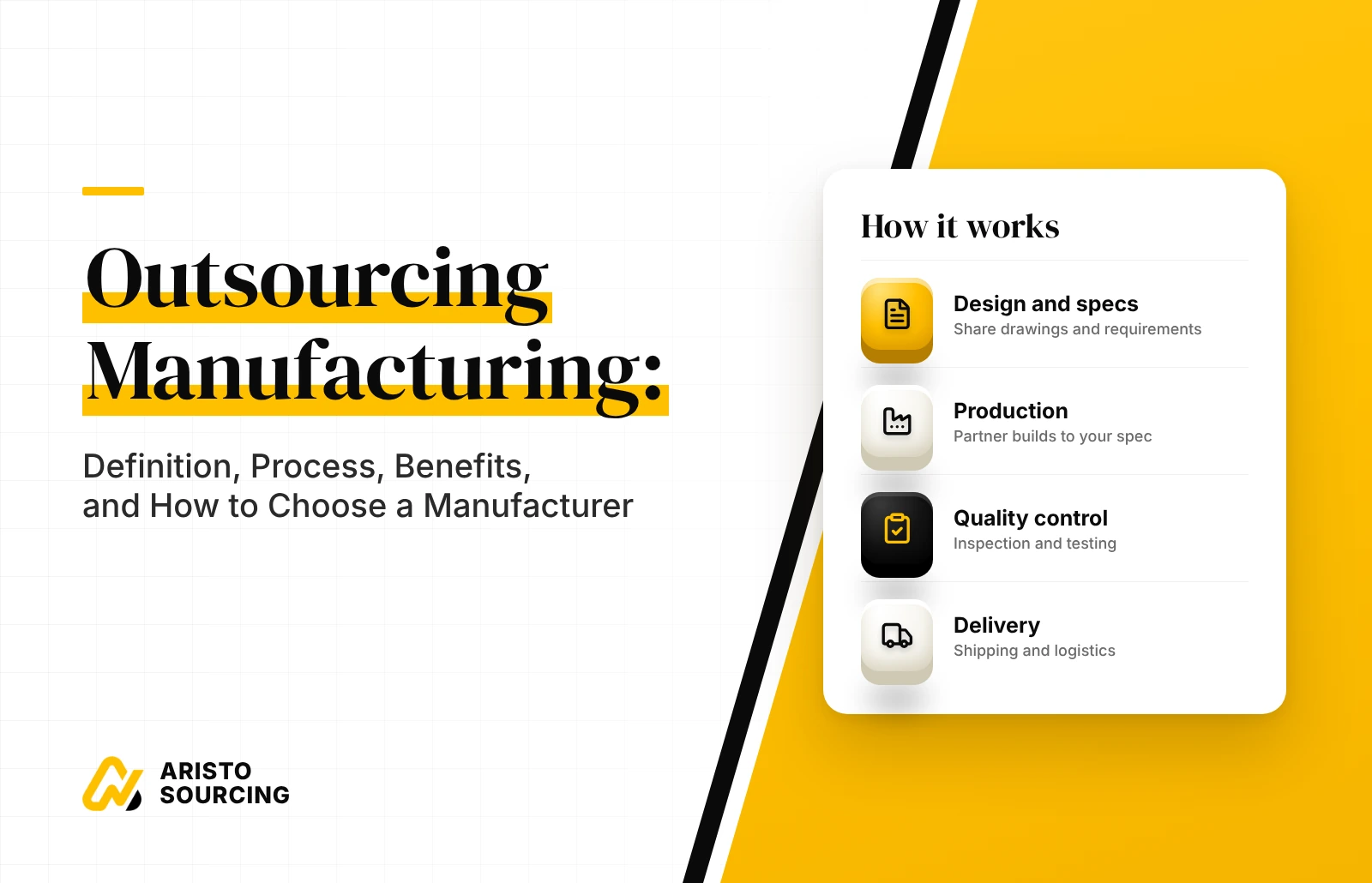
Outsourcing manufacturing refers to hiring an external company to make your products or components instead of producing them yourself. The outsourced manufacturing process starts with supplier selection, moves through quotations and sample approval, and continues into full production and quality control. The main benefits of outsourcing manufacturing are lower capital investment, access to specialized manufacturing expertise, production flexibility and scalability, and a stronger focus on core business activities.
Companies source manufacturing domestically, nearshore, or offshore. A domestic manufacturer operates in the same country as the hiring company, a nearshore manufacturer operates in a neighboring country, and an offshore manufacturer operates in a distant, usually lower-cost region. Each option changes cost, lead time, and communication, so the choice of manufacturer shapes the result of the entire project. Choosing the right contract manufacturer and managing cost, quality, and intellectual property once production moves outside the company is essential.
What Is Outsourcing Manufacturing?
Outsourcing manufacturing is a business strategy in which a company hires an external contract manufacturer to produce components, assemble products, or manufacture finished goods according to the company’s specifications. The contract manufacturer provides the factory, machinery, labor, and production know-how. The hiring company provides the product design, the specifications, and the final approval of every batch. A kitchenware brand, for example, designs a stainless steel pan, and a contract manufacturer forges, polishes, and packages the pan under the brand’s name.
Outsourced manufacturing differs from in-house manufacturing in who owns and runs production. In-house manufacturing means the company operates its own factory, buys its own equipment, and employs its own production workforce. Outsourced manufacturing moves production and assembly to a third party, while the company keeps control of the design, the brand, and the customer relationship. The process of outsourcing manufacturing follows a clear sequence of steps, from the first specification to the final shipment.
How Does Outsourced Manufacturing Work?
Outsourced manufacturing works by sending product specifications to a qualified external manufacturer, which provides a quotation, produces an approval sample, and completes full production under agreed quality standards.
The outsourced manufacturing process starts with product specifications and technical drawings. Specifications define materials, dimensions, tolerances, finishes, and performance requirements, while technical drawings show each part’s geometry. Supplier selection identifies manufacturers with suitable equipment, certifications, and experience. The company sends a request for quotation (RFQ), and suppliers provide unit prices, tooling costs, minimum order quantities, and lead times. After comparing quotations, the company orders a production sample made using the materials and processes planned for full production.
Full production begins after sample approval. The approved sample, known as the golden sample, becomes the quality reference for subsequent units. The purchase order confirms production volume, price, and delivery schedule.
Quality control and supplier management continue throughout production. Quality control includes incoming material checks, in-process inspections, and pre-shipment inspections against the golden sample. Supplier management involves regular communication, performance reviews, and corrective actions when problems arise. Effective quality control and supplier management protect the benefits of outsourced manufacturing, including consistent product quality and reliable production.
What Are the Benefits of Outsourcing Manufacturing?
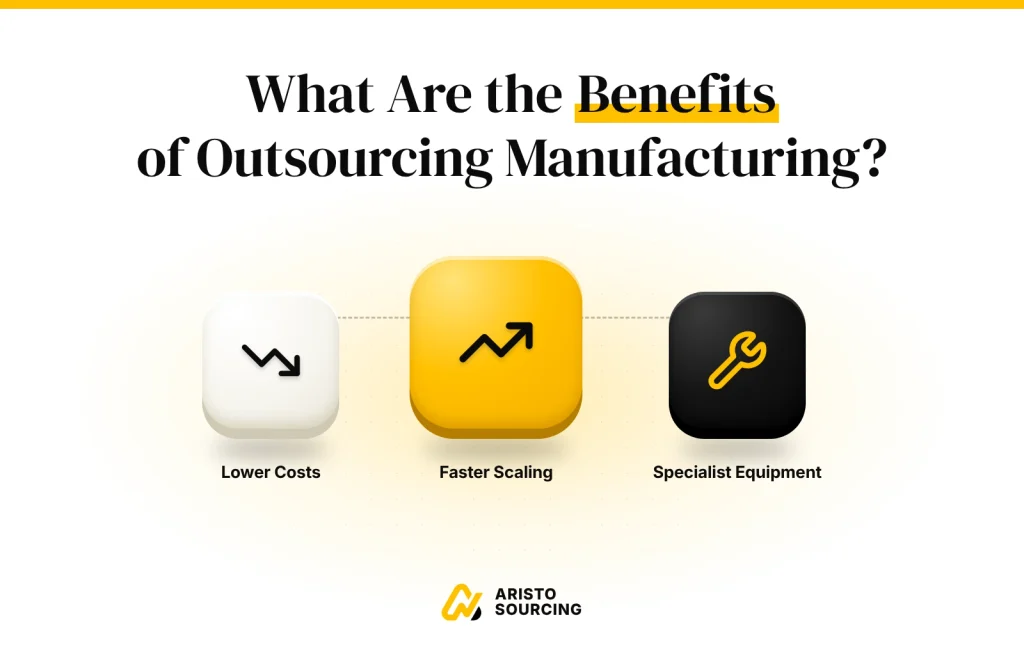
The benefits of outsourcing manufacturing include lower capital investment, access to specialized manufacturing expertise, production flexibility and scalability, and a stronger focus on core business.
The benefits of outsourcing manufacturing are listed below.
- Lower Capital Investment: Lower capital investment refers to the reduced upfront spending a company needs to bring a product to market when an external manufacturer already owns the factory, equipment, and labor. Outsourcing removes the need to build or lease factories, buy machinery, and hire internal production teams. The company pays for finished units instead of fixed assets, which turns a large capital investment into a variable cost tied to actual orders. The resulting cost savings free cash for product development, marketing, and sales.
- Access to Specialized Manufacturing Expertise: Access to specialized manufacturing expertise refers to using a manufacturer’s engineers, technicians, and proven processes for a product type, material, or technology that the hiring company lacks. A contract manufacturer that molds medical-grade plastics or assembles circuit boards every day brings capabilities that take years to build in-house. The manufacturer already holds the required certifications, such as ISO 13485 for medical devices, along with tested process controls and supplier networks. Outside manufacturing expertise shortens development time and reduces the risk of costly production errors.
- Production Flexibility and Scalability: Production flexibility and scalability refer to a company’s ability to increase or decrease output through an external manufacturer without adding or idling its own equipment, facilities, or production staff. A contract manufacturer serves many clients, so the manufacturer holds more production capacity than a single company usually needs. A company adds volume for a seasonal peak or a product launch and scales back when demand drops. Large manufacturers also buy raw materials in bulk and spread fixed costs across many orders, so the hiring company benefits from economies of scale that lower its unit cost.
- Focus on Core Business: Focus on core business refers to a company’s ability to concentrate internal teams on design, marketing, sales, and customer service after handing production to an external manufacturer. Running a factory demands constant attention to staffing, maintenance, safety, and raw material purchasing. Outsourcing production removes those daily operational demands from the management team. Outsourcing also helps the company avoid risky long-term commitments, such as a factory lease or a machinery loan, for a product whose demand is still unproven.
What Are the Risks and Disadvantages of Outsourcing Manufacturing?
The risks and disadvantages of outsourcing manufacturing include reduced control over production, quality and consistency risks, intellectual property exposure, communication challenges, logistics challenges, and supplier dependency.
The risks and disadvantages of outsourcing manufacturing are listed below.
- Reduced Control Over Production: Outsourcing reduces direct oversight of factory operations, including schedules, workforce, machine settings, and production priorities. Manufacturers balance orders from multiple clients, which can shift priorities unexpectedly. Regular status reports, factory visits, and clear contract terms help restore control.
- Quality and Consistency Risks: External manufacturing can cause variations in materials, dimensions, finish, and product performance across batches. Untrained operators, worn tooling, and unapproved material substitutions can lead to defects, customer returns, warranty claims, and brand damage. Documented quality control plans and independent inspections reduce these risks.
- Intellectual Property Exposure: Sharing product designs, technical drawings, formulas, and manufacturing know-how exposes intellectual property to copying, leaks, and unauthorized use. Risks increase where intellectual property enforcement is weak. Potential consequences include counterfeit products, unauthorized production overruns, and competing products launched by former manufacturers.
- Communication Challenges: Differences in languages, time zones, business cultures, and documentation standards can cause misunderstandings and delays. Time zone gaps slow responses, translation errors lead to incorrect materials or dimensions, and different approval practices delay samples, design changes, and shipments. Clear written communication helps prevent these issues.
- Logistics Challenges: Moving finished goods from external manufacturers involves freight booking, shipping costs, customs clearance, duties, and transit delays. Ocean freight and port congestion extend lead times, requiring more safety stock and earlier demand forecasts. Tariff changes and fluctuating freight rates also increase landed costs and complicate logistics planning.
- Supplier Dependency: Supplier dependency refers to a company’s reliance on a single contract manufacturer for a product, which leaves the company exposed if that manufacturer raises prices, fails, or stops production. Switching manufacturers takes months because new tooling, samples, and approvals are required. A company that outsources all production has no in-house equipment or staff to fall back on. Qualifying a second manufacturer and owning the production tooling reduce supplier dependency.
What Is the Difference Between In-House Manufacturing and Outsourcing Manufacturing?
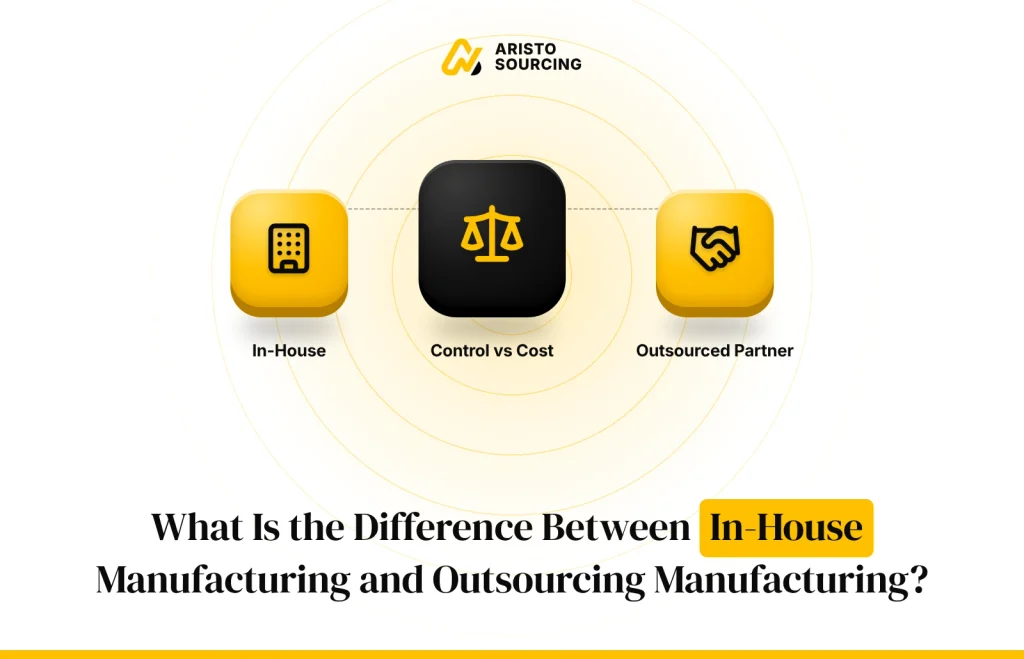
The difference between in-house manufacturing and outsourcing manufacturing is who owns and runs production, with in-house manufacturing relying on the company’s own resources and outsourcing manufacturing handing all or part of production to a third-party contract manufacturer.
The key differences fall into five areas, including control, resource ownership, workforce, production responsibility, and reliance on external manufacturers. In-house manufacturing gives direct control over every step, while outsourcing manufacturing gives control through contracts, specifications, and inspections. The company owns the facilities and equipment in-house, while the contract manufacturer owns them in an outsourcing arrangement.
The production workforce works for the company in-house and for the manufacturer under outsourcing. Production responsibility sits with internal managers in-house and is shared through contracts and quality agreements under outsourcing. Reliance on external manufacturers is minimal for in-house production and central for outsourced production. Most companies land between the two models and outsource only specific manufacturing processes.
What Manufacturing Processes Can Be Outsourced?
The manufacturing processes that can be outsourced include component manufacturing, product assembly, contract assembly, and electronics manufacturing.
The manufacturing processes that can be outsourced are listed below.
- Component Manufacturing: Component manufacturing is the production of individual parts, such as machined metal brackets, injection-molded plastic housings, castings, or springs, that a company later uses in its own finished product.
- Product Assembly: Product assembly is the process of joining finished components into a complete, working product, including fastening, wiring, testing, labeling, and packaging, before the product ships to distributors or customers.
- Contract Assembly: Contract assembly is an arrangement in which an external partner assembles subassemblies or finished units from components the hiring company supplies or approves, including kitting, light assembly, and packaging.
- Electronics Manufacturing: Electronics manufacturing is the outsourced production of printed circuit board assemblies, wire harnesses, and complete electronic devices, a service the industry calls electronics manufacturing services (EMS).
Each process represents one of the different types of outsourced manufacturing, and many companies combine two or more processes in a single supply chain.
What Are the Main Types of Manufacturing Outsourcing?
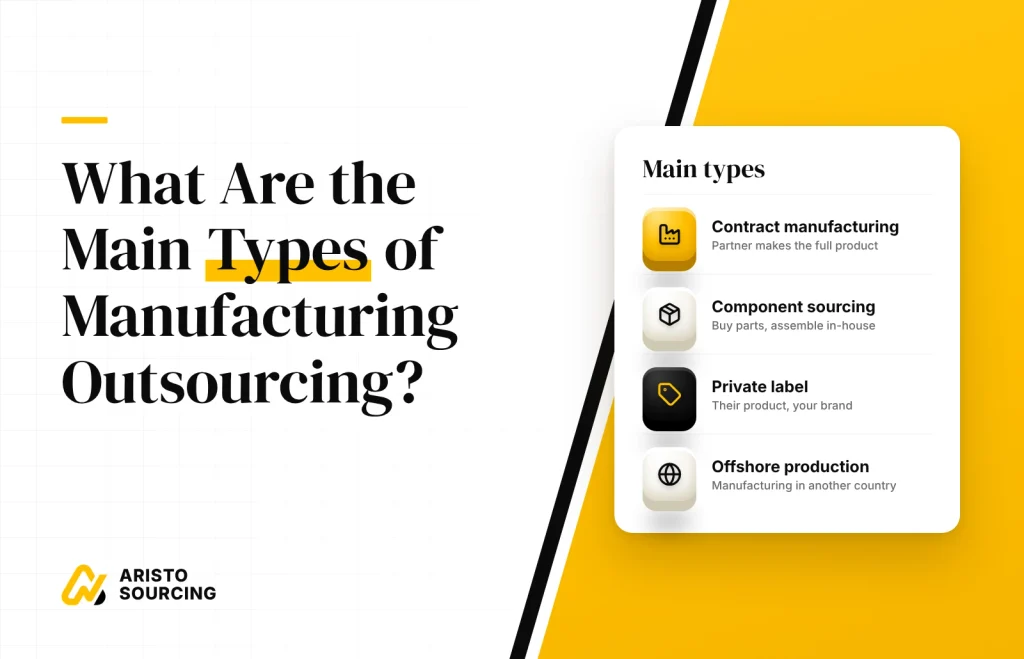
The main types of manufacturing outsourcing include contract manufacturing, OEM (Original Equipment Manufacturer) production, and ODM (Original Design Manufacturer) production, which differ mainly in who owns the product design.
The types of manufacturing outsourcing are listed below.
- Contract Manufacturing: Contract manufacturing refers to an outsourcing arrangement in which a contract manufacturer produces goods based on the hiring company’s own designs, specifications, bills of materials, and quality standards. The hiring company owns the design and the related intellectual property. The contract manufacturer supplies the equipment, labor, and production expertise. Contract manufacturing suits companies that already have a finished design and want full control over the product.
- OEM (Original Equipment Manufacturer): An OEM, or Original Equipment Manufacturer, refers to a manufacturer that produces components or complete products that another company then brands, integrates, and sells under its own name. A laptop brand, for example, buys batteries, displays, and power adapters from OEM suppliers and sells the finished laptop under its own brand. The meaning of OEM varies by industry, so the manufacturing contract states who owns the design and the tooling.
- ODM (Original Design Manufacturer): An ODM, or Original Design Manufacturer, refers to a manufacturer that designs and produces a ready-made product, which the hiring company then brands, packages, and sells as its own. ODM production shortens time to market because the design, tooling, and testing already exist. The trade-off is ownership, since the ODM usually keeps the design rights and sells similar products to other brands. ODM costing is usually lower upfront than contract manufacturing because the ODM spreads design and tooling costs across many buyers.
How Much Does Outsourcing Manufacturing Cost?
Outsourcing manufacturing costs range from $6 per hour to over $120 per hour, depending on location, product complexity, production volume, and supplier capabilities. These rates reflect typical labor and machine costs, not the final product price.
Manufacturing costs vary by location, product, and supplier. Labor costs create significant regional differences. Manufacturers in lower-wage regions of Asia, Latin America, and Eastern Europe typically quote lower rates, while those in the United States, Western Europe, and Japan typically charge higher rates.
Product complexity also affects costs. Simple molded parts require less labor per unit, while precision medical devices need skilled technicians, clean rooms, and extensive testing. Supplier factors, including certifications, automation, minimum order quantities, and available capacity, further influence quotations.
Lower offshore unit prices can result in higher total costs after freight and duties. Comparing the total landed cost of each request for quotation (RFQ) provides a more accurate estimate of manufacturing costs than comparing unit prices alone. Accurate comparisons require a complete RFQ.
What Should You Include in a Manufacturing RFQ?
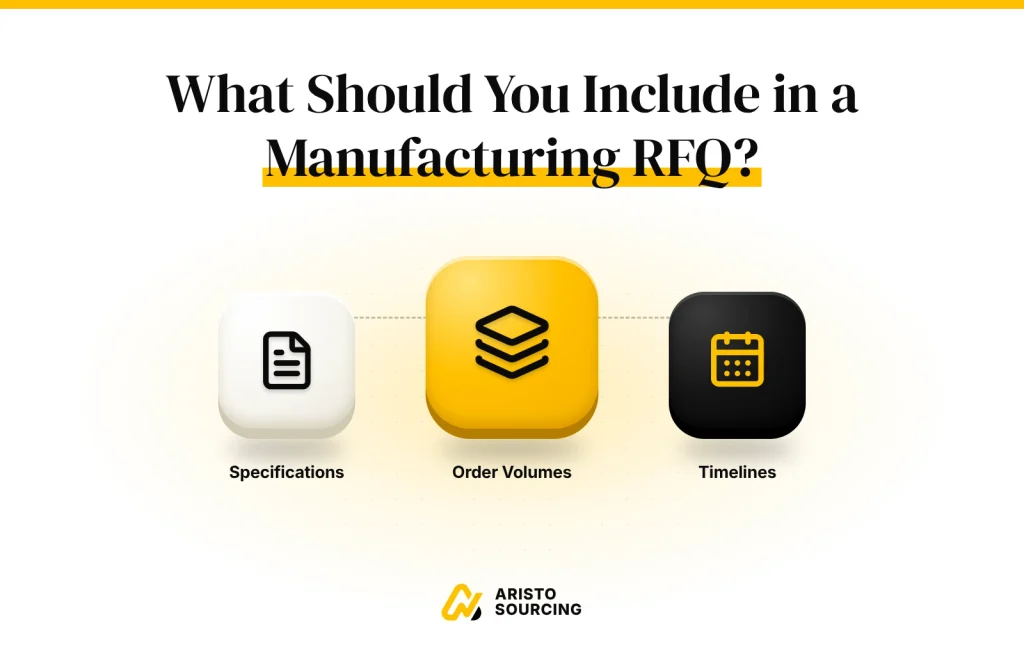
A manufacturing RFQ should include product specifications, technical drawings, materials, production volume, quality requirements, and delivery lead time, so every manufacturer quotes the same job on equal terms.
Everything a manufacturing RFQ should include is listed below.
- Product Specifications: Product specifications describe dimensions, tolerances, finishes, colors, functions, and performance requirements, giving the manufacturer a written standard for what the finished product must do.
- Technical Drawings: Technical drawings are CAD files or dimensioned PDFs showing each part’s geometry and tolerances, and they contain IP that needs NDA protection before sharing.
- Materials: Materials define the exact grades, alloys, resins, or fabrics required, including approved brands and acceptable substitutes, because material choice drives both unit cost and performance.
- Production Volume: Production volume states the first-order quantity and expected annual demand, which helps the manufacturer price tooling, set minimum order quantities, and plan capacity.
- Quality Requirements: Quality requirements define inspection methods, acceptable defect levels, testing procedures, required certifications, and compliance standards, such as ISO 9001 or market-specific safety rules.
- Delivery Lead Time: Delivery lead time sets the required dates for samples and first shipment, plus shipping terms (Incoterms), so manufacturers quote realistic schedules instead of optimistic guesses.
A complete RFQ also exposes sensitive design data, so intellectual property protection has to start before the first file leaves the company.
How to Protect Intellectual Property When Outsourcing Manufacturing?
Protecting intellectual property (IP) when outsourcing manufacturing involves signing a non-disclosure agreement (NDA), registering patents and trademarks, limiting shared data, and defining design ownership in the manufacturing contract.
Sharing product designs, technical drawings, CAD files, material formulas, and software code exposes confidential information. Manufacturers need these details to reproduce products, making legal agreements and reliable partners essential for protecting IP.
Confidentiality and ownership are the two core issues in outsourcing agreements. Confidentiality defines what manufacturers can disclose, to whom, and for how long, including disclosures to employees and subcontractors. Ownership establishes rights to designs, design improvements, molds, tooling, and test data. Strong manufacturing contracts confirm that the hiring company owns product designs, design changes, and custom tooling, including manufacturer-developed improvements.
Choosing a trustworthy manufacturer provides another layer of IP protection. A supplier with a proven record of respecting client intellectual property reduces the risk of unauthorized use and costly legal disputes.
How to Choose a Contract Manufacturer for Outsourcing?
The main criteria for choosing a contract manufacturer include production capacity, manufacturing experience, quality control, references, and supplier reliability. Strong supplier selection scores every shortlisted manufacturer against the same criteria instead of choosing on unit price alone.
The criteria for choosing a contract manufacturer are listed below.
- Production Capacity: Production capacity is the maximum output a contract manufacturer delivers in a set period, showing whether its lines, shifts, and manufacturing capabilities handle your first order and future growth.
- Manufacturing Experience: Manufacturing experience is the manufacturer’s track record with products, materials, and processes similar to yours, including years in operation, industries served, and certifications earned for comparable work.
- Quality Control: Quality control is the manufacturer’s documented system for inspecting materials, monitoring production, and testing finished goods, often backed by certifications such as ISO 9001 and written inspection reports.
- References: References are current or past clients who confirm a manufacturer’s performance on quality, communication, deadlines, and problem-solving, giving you first-hand evidence beyond the manufacturer’s own sales claims.
- Supplier Reliability: Supplier reliability is a manufacturer’s consistency in meeting delivery dates, holding quoted prices, communicating problems early, and maintaining financial stability from the first order through long-term production.
Verifying these criteria takes more than a sales call. A factory audit, conducted in person or through a third-party inspection firm, confirms the equipment, capacity, and quality systems. A paid trial order then tests the manufacturer’s real performance before a large commitment. Choosing a manufacturing supplier this way turns supplier selection into an evidence-based decision rather than a gamble on the lowest quote.
What Comes After Choosing a Manufacturing Supplier?
Supplier management follows supplier selection because every order requires clear communication, accurate specifications, and consistent follow-up.
Supplier selection is one step in the procurement process, which continues with supplier communication, quotation comparison, specification updates, sample reviews, negotiations, order coordination, and relationship management. These activities keep design changes, delivery dates, and quality expectations aligned.
Quotation comparisons assess costs for new products, packaging changes, and volume increases. Updated specifications require approved samples before production. Reorder negotiations address changes in material prices, exchange rates, and freight costs. Order coordination tracks purchase orders, production status, inspections, and shipments. Strong supplier relationships can secure priority scheduling during peak seasons.
Sourcing support coordinates information, follow-ups, and paperwork between companies and manufacturers. However, sourcing partners do not operate machines or own factories. They manage supplier coordination, allowing manufacturers to focus on production and companies to focus on their core business.
How Does Aristo Sourcing Help Businesses Keep Up with Suppliers?
Aristo Sourcing helps businesses keep up with suppliers by providing dedicated virtual assistants who handle supplier communication, quotation collection and comparison, negotiation support, and order coordination.
Aristo Sourcing is a remote staffing company that places trained virtual assistants (VAs) from South Africa and the Philippines with growing businesses. The VA model applies the logic of outsourcing to procurement administration, since the company delegates repeatable supplier tasks to a trained specialist and keeps strategic decisions in-house.
A supply management virtual assistant handles routine supplier communication and escalates issues before they turn into missed shipments. The VA requests quotations from manufacturers and compares the quotations on price, lead time, and terms. For negotiations, the VA prepares comparison documents, tracks contract renewal dates, and flags pricing deviations, while the business owner makes the final call. The VA also coordinates orders by managing purchase orders, tracking shipments, and working with freight providers on delays.
Aristo Sourcing does not manufacture products. Aristo Sourcing supports the business side of outsourcing manufacturing, so a company keeps the benefits of an external manufacturer without losing track of orders, costs, and supplier performance. For companies still choosing the right manufacturer for outsourcing, an Aristo Sourcing VA also researches suppliers, requests quotes, and prepares a shortlist for the owner’s review. Book a free consultation with Aristo Sourcing to match a supply management VA to your suppliers, tools, and time zone.