
Finance and accounting outsourcing basically refers to hiring an external firm to handle some or all of a company’s finance functions, from routine bookkeeping through senior-level financial strategy. The cost of finance and accounting outsourcing typically runs from $500 to over $5,000 a month, or from $25 to over $150 an hour, depending on how much of the finance function is handed off and how complex the business is. The main risks of finance and accounting outsourcing are data security exposure, reduced day-to-day visibility, and ambiguous scope, though each of these is manageable with the right contract and provider vetting, covered later in this article.
The best situations to outsource finance and accounting are when leadership is spending more time on financials than on the business itself, when growth is outpacing current finance capacity, or when a senior finance role has stayed open for months. When choosing finance and accounting outsourcing providers, the main tips are to define the scope you’re buying before you shortlist, vet the technology behind the engagement, and test responsiveness with a small pilot before committing fully. AI is playing a growing role too, automating the transactional layer of the work while leaving judgment, exceptions, and client relationships firmly in human hands.
What Is Finance and Accounting Outsourcing?
Finance and accounting outsourcing (FAO) is the practice of hiring an external firm to manage part or all of a business’s finance functions, rather than building and staffing that capability entirely in-house. FAO sits under the broader umbrella of back-office outsourcing, alongside functions like HR administration and IT support, and it’s typically classified as a subset of business process outsourcing (BPO) more generally.
Depending on how the engagement is structured, the finance and accounting outsourcing provider can act as a full extension of the in-house accounting department, handling the same day-to-day work an internal team would, or it can supplement an existing team on specific functions where extra capacity or expertise is needed. The scope of what falls under FAO is wide. It ranges from transactional bookkeeping tasks that any trained accountant could perform, all the way up to CFO-level advisory work like capital raise support and investor reporting, which is why the specific functions a business chooses to outsource matter as much as the decision to outsource at all.
Which Finance and Accounting Functions Can You Outsource?
Finance and accounting functions you can outsource are listed below.
- Transactional Functions: Transactional functions cover the highest-volume, most routine parts of the finance function, including bookkeeping, accounts payable, accounts receivable, payroll, reconciliations, and general ledger maintenance. It’s the most commonly outsourced tier because the work is well-defined and repeatable, which makes it easy for an external provider to take over without deep institutional knowledge of the business.
- Controller Functions: Controller functions cover the month-end close process, financial reporting, internal controls, and audit support. It requires more judgment than transactional work, since a controller-level provider needs to catch errors, apply accounting standards correctly, and manage the record-to-report cycle that turns raw transactions into finished financials.
- FP&A Functions: FP&A (Financial Planning & Analysis) means the tier of finance functions that covers budgeting, forecasting, KPI dashboards, and board reporting. It’s forward-looking rather than historical, which means the provider needs enough context about the business to build assumptions that actually hold up, not just report on what already happened.
- CFO Advisory Functions: CFO advisory functions cover capital raises, M&A support, and investor reporting. It’s the most strategic and highest-trust tier of FAO, typically reserved for businesses that need senior-level financial guidance without the cost of a full-time CFO.
Companies rarely outsource all four tiers at once. Most start with transactional work, prove out the relationship, and expand into controller or FP&A functions once trust and process fit are established, often keeping the highest-trust CFO advisory work for last or handling it separately by location, since companies sometimes prefer to keep that specific function closer to home even after outsourcing everything else.
What Are the Four Types of Outsourcing?
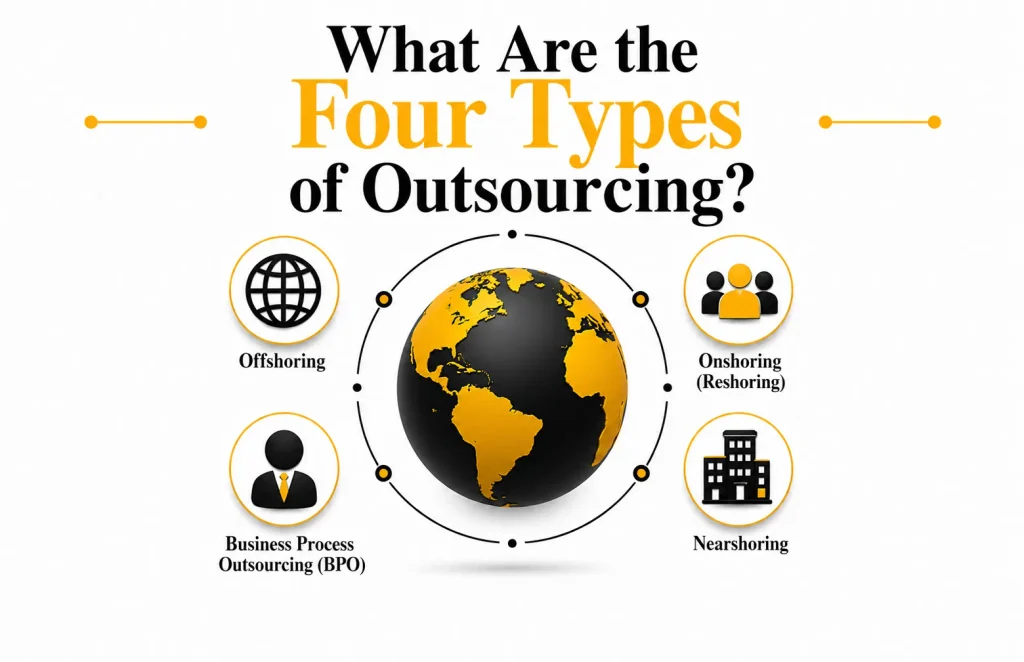
The types of outsourcing based on location include onshore, nearshore, offshore, and cloud or farshore delivery, and the types of outsourcing based on engagement include full outsourcing, co-sourcing, staff augmentation, and managed finance function models.
The 4 types of outsourcing based on location are listed below.
- Onshore: Onshore outsourcing means hiring a provider based in the same country as the business. It typically costs more than nearshore or offshore options, but it removes language and cultural friction almost entirely.
- Nearshore: Nearshore outsourcing means hiring a provider in a nearby country, usually one with overlapping working hours. It’s a common middle ground for businesses that want cost savings without the communication lag that comes with a large time-zone gap.
- Offshore: Offshore outsourcing means hiring a provider in a distant country, typically where labor costs are substantially lower. It usually represents the largest cost gap against a domestic hire, though that gap comes with a bigger time-zone difference to manage.
- Cloud or Farshore: This model relies on a cloud-based platform to coordinate work across a distributed, often fully remote provider team, regardless of exact location. It’s less about geography specifically and more about the technology stack making distance close to irrelevant for day-to-day collaboration.
The 4 types of outsourcing based on engagement are listed below.
- Full Outsourcing: The provider takes complete ownership of a finance function, end-to-end, with minimal day-to-day involvement from the client beyond approvals and oversight.
- Co-Sourcing: The provider and the client’s internal team work side by side on the same function, splitting responsibilities rather than handing the whole thing off.
- Staff Augmentation: The provider supplies individual staff who work under the client’s own processes and management, essentially extending the internal team’s headcount.
- Managed Finance Function: The provider runs an entire finance function as a managed service, with defined outcomes and KPIs rather than a simple staffing arrangement.
How Much Does It Cost to Outsource an Accountant?
The cost to outsource an accountant ranges from $500 to over $5,000 per month, or from $25 to over $150 per hour, depending on the scope of work, transaction volume, and how senior the tier of service is. Outsourced finance and accounting providers typically use one of four pricing models. Hourly billing charges the client based on actual work performed, which suits one-off projects like a financial cleanup or a historical audit better than ongoing monthly work. A fixed monthly package tied to a defined scope is the most common model for ongoing engagements, since it gives both sides a predictable number to budget against. Outcome- or tier-based pricing applies to full-function engagements, where the fee reflects the level of service (transactional, controller, FP&A, or CFO advisory) rather than hours logged.
Extra fees for services added mid-contract are common across all three models, which is why scope definition matters so much before signing anything. Comparing this against the fully loaded cost of an in-house hire changes the picture considerably. A base salary is typically only 60 to 75% of what an employee actually costs once benefits, payroll tax, recruiting, and software are added on top, which means outsourcing is fundamentally different from hiring a finance team in how the cost shows up. Outsourcing bundles all of that overhead into a single line item, while an in-house hire spreads it across payroll, HR, IT, and benefits administration in ways that are easy to underestimate when comparing a job offer’s salary line directly against a provider’s monthly invoice.
What Drives the Price of an Outsourced Finance Team?
Variables that drive the price of an outsourced finance team are listed below.
- Service tier purchased: Whether you’re buying transactional-only support or a full-function engagement spanning controller and FP&A work changes the price substantially.
- Transaction volume and entity count: More transactions and more legal entities both add directly to the workload a provider has to staff for.
- Industry and compliance complexity: Regulated industries with heavier reporting requirements cost more to serve than straightforward, low-compliance businesses.
- Delivery location: Onshore, nearshore, and offshore providers all sit at different price points, reflecting labor cost differences in each region.
- Onboarding and setup in the first months: Data migration and system setup at the start of an engagement typically carry a one-time cost on top of the ongoing rate.
Understanding these variables upfront is one of the more effective ways of avoiding risks tied to budget surprises later in the engagement, since a provider that can’t explain clearly what’s driving your specific price is harder to hold accountable if costs creep.
What Are the Risks of Outsourcing Your Finance Function?
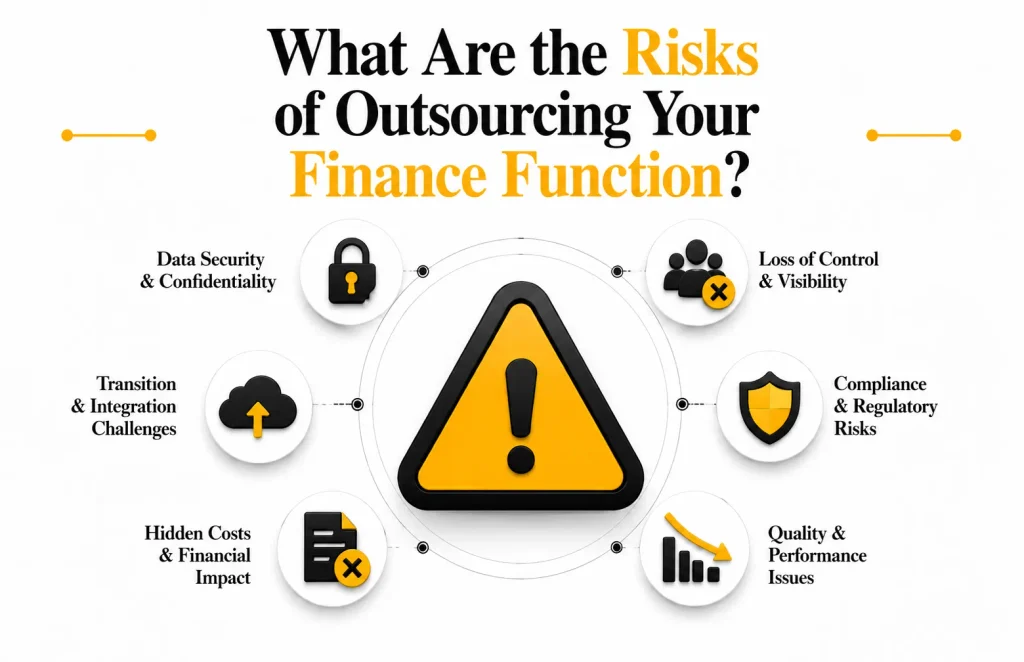
The risks of outsourcing finance functions include data security exposure, communication friction, reduced visibility, overreliance, ambiguous scope, hidden transition costs, and unclear regulatory ownership.
The risks of outsourcing finance functions are listed below.
- Data security and confidentiality: External access to financial systems widens the surface area for a potential breach, since more people and more systems now touch sensitive data. Reduce this risk by requiring a current SOC 2 report and written data-handling terms before granting any system access.
- Communication gaps and time-zone friction: Working across time zones and cultural norms can slow down urgent requests and occasionally lead to misunderstandings about what was actually asked for. Reduce this risk by defining required overlap hours and a clear escalation path in the contract itself.
- Reduced day-to-day visibility and control: Once work moves offsite, it’s easy to lose the informal, in-hallway visibility a business has into how its own finances are being handled. Reduce this risk by using a shared platform where both sides see the same live data, rather than relying on periodic reports.
- Overreliance on the provider: Leaning too heavily on one outsourced provider makes repatriating the function later slow and costly, since institutional knowledge has been built entirely on the provider’s side. Reduce this risk by keeping documented processes and key credentials accessible to the business, not locked inside the provider’s own systems.
- Ambiguous scope across multiple entities: Scope that isn’t clearly defined per legal entity can lead to disputes over what’s covered and what triggers an extra fee, especially for businesses with several subsidiaries. Reduce this risk by listing every entity and function explicitly in the contract rather than describing scope in general terms.
- Hidden transition costs in the first months: Onboarding, data migration, and system setup often cost more than expected in the early weeks of an engagement, even with a provider that quoted a clear ongoing rate. Reduce this risk by asking for a detailed transition cost estimate, not just the steady-state monthly fee, before signing.
- Unclear ownership of regulatory risk: Under frameworks like SOX, HIPAA, or ERISA, it’s not always clear who’s accountable if a compliance failure happens on the provider’s side. Reduce this risk by naming regulatory ownership explicitly in the contract, rather than assuming it defaults to the provider simply because they’re doing the work.
Keeping the control that matters most, meaning approval authority, bank access, and final sign-off, in-house is one of the most effective ways to manage every risk on this list at once.
How Do You Protect Financial Data and Keep Control?
To protect your financial data and keep control, follow the tips listed below.
- Require a current SOC 2 report: Get written data-handling terms alongside it, not just a verbal assurance.
- Define named points of contact: Set expected response times up front so both sides know what “urgent” actually means.
- Use a shared platform: Make sure both sides see the same live data rather than working from separate, potentially outdated copies.
- Keep approval authority and bank access in-house: Never hand over final sign-off on payments to an external provider.
- Preserve separation of duties: Structure the relationship so that separation of duties is strictly enforced across every part of your finance function; no single person, on either the client or provider side, should control an entire transaction end-to-end.
When Should a Business Outsource Its Finance Function?
A business should outsource its finance functions when internal capacity, visibility, or hiring can’t keep pace with what the business actually needs.
Signals when a business should outsource its finance functions are listed below.
- Leadership spends more time on financials than on the business: When founders or executives are pulled into bookkeeping or reconciliation instead of running the company, that’s a clear signal the finance function needs dedicated support. It’s a sign the internal setup has outgrown what informal, part-time attention can sustain.
- Growth is outpacing current finance capacity: A finance team sized for last year’s transaction volume often can’t keep up once the business scales. Outsourcing gives a fast way to add capacity without a lengthy hiring cycle.
- A senior finance role has stayed open for months: Given the accountant shortage covered later in this article, this signal has become increasingly common across businesses of every size. Outsourcing fills the gap while the search continues, rather than leaving the function unstaffed.
- No reliable real-time visibility for decisions: If leadership can’t get an accurate financial picture without waiting weeks for a report, that’s a functional problem, not just an inconvenience. A well-run outsourced engagement, on a shared platform, often improves this rather than worsening it.
- Investor or board reporting is slipping: Missed or late reporting deadlines put pressure on external relationships that matter for future fundraising or governance. A provider with defined KPIs and turnaround times can restore that reliability quickly.
- Systems are disconnected, and reconciliation is manual: When data lives in disconnected spreadsheets and systems, closing the books becomes a slow, error-prone process every month. Outsourced providers often bring standardized, integrated tooling that fixes this as part of onboarding.
- One person handles most transactions with no separation of duties: This is both an operational risk and a fraud risk, since a single point of failure controls too much of the process. Bringing in an outsourced team naturally distributes responsibilities across more people.
There are situations where hiring in-house still makes more sense than outsourcing, such as highly specialized or inventory-heavy operations where day-to-day, on-the-ground judgment matters, or businesses where finance itself is a genuine competitive differentiator rather than a support function. In those cases, the priority shifts from cost savings to choosing the best provider of internal talent instead.
How Do You Choose a Finance and Accounting Outsourcing Provider?
To choose a finance and accounting outsourcing provider, you should define what you’re buying clearly, then evaluate each candidate against the same criteria before signing the contract.
To choose a finance and accounting outsourcing provider, follow the tips listed below.
- Define the scope and the outcome you’re buying: Write down exactly which functions, entities, and deliverables are in scope before you start shortlisting providers. This keeps every proposal you receive comparable on the same basis, rather than comparing apples to oranges across different scopes.
- Vet the technology: Look for an integrated cloud platform and real automation, not just staff working manually on your existing spreadsheets. A provider whose value is only cheaper labor, without better tooling, is missing much of what makes modern outsourcing worthwhile.
- Check documented workflows, KPIs, and team credentials: Ask to see how the provider actually runs an engagement day-to-day, not just a sales deck describing capabilities. Defined KPIs and named team credentials tell you far more about what to expect than a general capabilities pitch.
- Confirm SOC 2 and data-handling practices: Ask for the actual current report, not just a claim of compliance on the website. This is one of the clearest, most objective signals of whether a provider takes security seriously.
- Test with a small pilot before full commitment: Run a limited-scope trial to see how onboarding and responsiveness actually feel in practice before signing a broader contract. A pilot surfaces communication and process issues early, when they’re still cheap to fix.
What Should You Ask Before You Sign a Finance and Accounting Outsourcing Contract?
Questions to ask before signing a finance and accounting outsourcing agreement are listed below.
- Which functions and which entities are in scope?
- What triggers an out-of-scope fee?
- Who is on the team, and what are their credentials?
- Can we see a current SOC 2 report?
- How long is the transition, and what moves first?
- What KPIs and turnaround times are committed to in writing?
- How do we exit, and how is our accounting data returned?
Is Accounting Going to Be Outsourced?
Yes, accounting is going to be outsourced increasingly, because the highest-volume, most transactional parts of the work are the parts that translate most cleanly into a standardized outsourced or automated process. High‑volume transactional work, such as bookkeeping, accounts payable, accounts receivable, and payroll processing, is genuinely shifting to external providers.
The functions easiest to hand off without deep, ongoing institutional context are those routine tasks, whereas judgment, internal controls, strategic financial planning, and stakeholder relationships stay in‑house since these demand intimate business knowledge and trust that no outsourced team can fully replicate.
The accountant shortage, alongside the growing capabilities of AI, is reshaping finance teams as much as cost is, arguably more so. CPA exam candidates have declined by roughly a quarter to a third over the past decade, accounting degree completions recently hit a 20-year low (according to the 2025 Trends Report published by the American Institute of Certified Public Accountants (AICPA)), and a large share of the existing workforce is approaching retirement age, all of which is pushing businesses toward outsourcing simply because qualified people aren’t available to hire, not only because outsourcing is cheaper. The framing of “fully outsourced” accounting overstates the trend, though, since the functions that require deep business context, like strategic decisions, internal control ownership, and direct stakeholder relationships, remain hard to hand off completely, and most businesses that outsource still keep a thin internal layer overseeing the relationship rather than eliminating the finance function from their org chart entirely.
How Is AI Changing Finance and Accounting Outsourcing?
AI is changing finance and accounting outsourcing by automating the mechanical middle of the work while shifting how outsourcing contracts are structured and priced. Automated invoice coding, cash application, and data extraction now handle much of what used to be manual, repetitive data entry, freeing up staff time on both the client and provider side.
A continuous close process, enabled by that same automation, is starting to replace the traditional month-end scramble, where reconciliation work used to pile up right before reporting deadlines. As a result, automation is reshaping outsourced finance work at the pricing level too, pushing contracts away from pure labor arbitrage, where the value was simply cheaper headcount in a different country, and toward outcome-based pricing, where the client pays for a completed result rather than hours logged. Human review is still required for judgment calls and exceptions, since AI tools are reliable at pattern-matching routine transactions but still struggle with ambiguous cases that need a person to make a call.
That balance, between what AI now handles and what still needs a human, is also reshaping where in different countries outsourced work actually gets delivered from, since providers increasingly need fewer junior staff doing pure data entry and more mid-level staff who can review AI output and catch exceptions.
Which Countries Do Companies Outsource Accounting To?
Countries companies outsource accounting to are listed below.
- India: The largest and most established destination for finance and accounting outsourcing, offering deep certified talent depth and strong cost savings, though with less time-zone overlap for US-based clients than nearer options.
- Philippines: A major hub for finance and accounting BPO with a large English-speaking market workforce, offering strong cost savings and a well-established outsourcing industry infrastructure.
- Latin America (Mexico and Colombia): A fast-growing nearshore option for US clients, offering meaningful time-zone overlap and a smaller cost gap than farther offshore markets, in exchange for closer real-time collaboration.
- Eastern Europe: A strong choice for European clients specifically, offering solid time-zone overlap and deep technical talent, though generally at a higher cost than the Asia-Pacific or Latin American markets.
Businesses generally choose between these regions based on time-zone overlap, cost, the depth of certified accounting talent available locally, and data-residency rules that may restrict where certain financial data is legally allowed to be processed or stored.
How Big Is the Finance and Accounting Outsourcing Market?
The finance and accounting outsourcing market is currently ranging from roughly $55 billion to over $75 billion depending on the source and how the market is scoped, and it’s bigger than it has ever been. Grand View Research, one of the more established named research firms tracking this space, estimated the global finance and accounting business process outsourcing (F&A BPO) market at $70.2 billion in 2025, growing to $76.5 billion in 2026, on its way to $142.7 billion by 2033.
North America holds the largest regional share of the market currently, while Asia-Pacific is consistently identified across research firms as the fastest-growing region, driven largely by multinational companies expanding their own offshore delivery centers there. Published estimates for the cost of finance and accounting outsourcing differ quite widely across research firms, and the main reason is scope. Some reports measure “FAO” narrowly, covering only outsourced finance and accounting services purchased directly by businesses, while others measure “F&A BPO” more broadly, folding in adjacent categories or counting revenue differently across service lines.
This is why figures for the same year can be seen as not identical. Whichever figure you use, the direction is the same. The outsourcing market is heading toward continued growth well past 2026, driven by the same structural forces covered throughout this article, from the accountant shortage to AI-enabled automation to businesses simply choosing the right finance and accounting outsourcing provider over the cost and risk of building an equivalent function from scratch.