
Two paths exist for getting work done without hiring an employee: Upwork, a freelance marketplace where a business finds and manages individual freelancers directly, and an outsourcing agency, a managed provider that runs the work on the client’s behalf.
This guide covers a quick comparison, what each option actually is, real cost, quality and vetting reliability, pros and cons, when each fits, and a decision framework. Business owners choosing how to get work done are the audience here, not freelancers looking for platforms to find clients themselves.
According to Upwork’s own 2024 Annual Shareholder Report, the platform processed $4.0 billion in gross services volume that year alone. For the related question of hiring an employee versus using an agency, see the Outsourcing Agency vs Hiring Directly guide.
Upwork vs Outsourcing Agency: Quick Comparison
The main difference between Upwork and an outsourcing agency is DIY flexibility and lower headline cost versus managed reliability and predictable delivery.
| Dimension | Upwork (Freelancer Marketplace) | Outsourcing Agency |
| Control/management | Client manages each freelancer directly | Agency manages the work and the people |
| Cost | Lower headline rate, billed per freelancer | Flat or scoped fee, often bundled |
| Hiring speed | Fast to post, slower to vet and select | Fast, provider already has vetted talent |
| Quality consistency | Varies by individual freelancer | Standardized through agency oversight |
| Reliability (turnover/replacement) | Client re-sources if a freelancer leaves | Agency replaces and absorbs the gap |
| Best for | Short-term, well-defined, single-skill tasks | Ongoing, managed, or multi-skill work |
Upwork wins on flexibility and control over who does the work, at a lower starting price. An outsourcing agency wins on consistency and reliability, since the agency, not the client, carries the vetting and replacement burden.
What Is Upwork? (The Freelancer Marketplace Model)
Upwork is the largest freelance marketplace, connecting businesses directly with individual freelancers across more than 125 skill categories from a pool of over 18 million registered professionals worldwide. The client posts a job, reviews proposals, interviews candidates, hires directly, and then manages that freelancer’s work personally from start to finish.
Upwork represents the marketplace model broadly; the same core logic applies to platforms like Fiverr, Freelancer.com, and Toptal, where the client picks and manages individuals rather than handing work to a managed team. The model runs pay-as-you-go, with no long-term commitment required beyond the specific project or task at hand.
What Is an Outsourcing Agency? (The Managed Team Model)
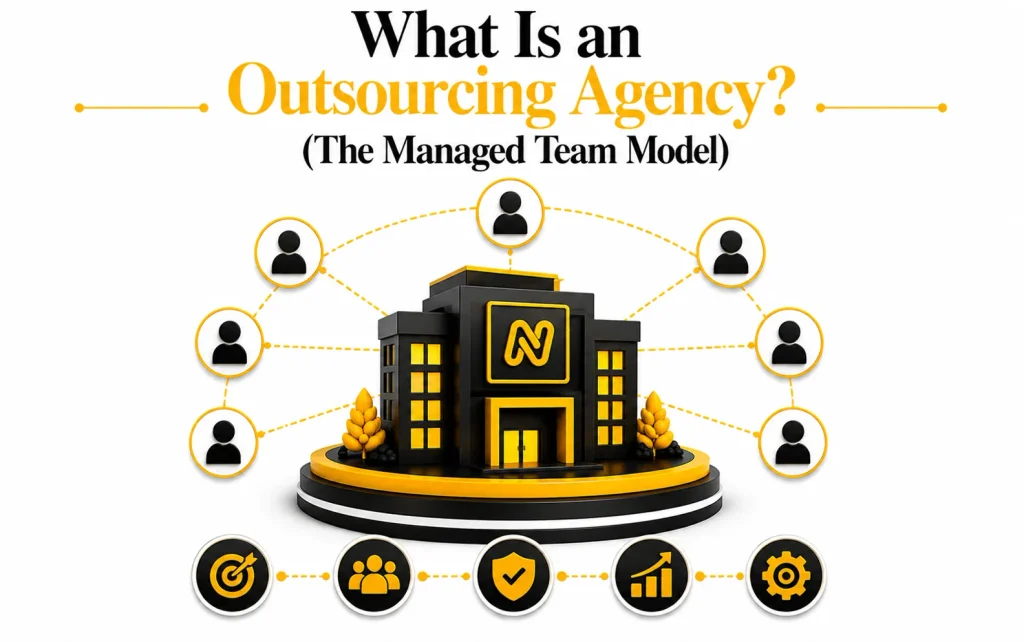
An outsourcing agency is a provider that supplies vetted talent and manages the work itself, layering in an account or project manager, quality assurance, and staffing redundancy on top of the individuals doing the work. The client oversees the big picture, while the agency handles vetting, day-to-day management, and replacement if someone leaves.
This model fits ongoing or complex work best, where team cohesion, consistent quality, and long-term reliability matter more than picking each individual personally. For the broader concept this sits within, see the outsourcing pillar page.
What Is an Outsourcing Agency? (The Managed Team Model)
An outsourcing agency is a provider that supplies vetted talent and manages the work itself, layering in an account or project manager, quality assurance, and staffing redundancy on top of the individuals doing the work. The client oversees the big picture, while the agency handles vetting, day-to-day management, and replacement if someone leaves.
This model fits ongoing or complex work best, where team cohesion, consistent quality, and long-term reliability matter more than picking each individual personally. For the broader concept this sits within, see What Outsourcing Is.
Upwork vs Outsourcing Agency: The Real Cost Comparison
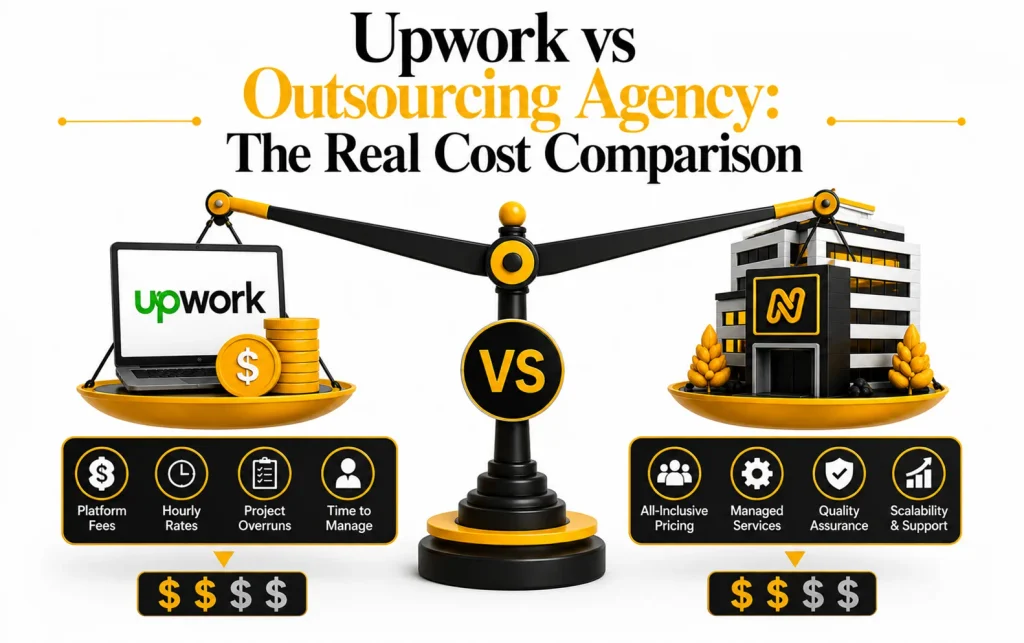
Everyone assumes Upwork is cheaper than an outsourcing agency, but the freelancer’s quoted rate isn’t the real cost on either side. The math below breaks down what each option actually costs once every fee, and every uncounted hour, is included.
What Upwork Actually Costs (Fees Explained)
Upwork costs more than the freelancer’s quoted rate because clients pay several layered fees on top of it. Per Upwork’s own pricing page, the client marketplace fee runs 3-5% on the Basic plan (3% for eligible US clients paying by bank transfer, up to 7.99% by card), and 8-10% on Business Plus. A separate contract initiation fee of $0.99 to $14.99 applies per new contract, even with a freelancer hired before, and can add up quickly for businesses cycling through multiple freelancers.
Freelancers separately pay a variable 0-15% service fee, which gets priced into the rate a client sees rather than added visibly on top. Combined, these layers push the effective “Upwork tax” toward roughly 13-22% above the freelancer’s base rate, higher for businesses hiring frequently across many contracts.
Beyond the platform’s own fees, the uncounted cost is the client’s own time: screening proposals from a pool of over 18 million freelancers, managing the work directly, and covering the gap personally if a freelancer disappears mid-project. All figures reflect Upwork’s fee structure as of 2026 and are worth re-verifying periodically, since Upwork changed its fee model in May 2025 and could adjust it again.
What an Outsourcing Agency Costs
An outsourcing agency costs more upfront on the headline number, but that number is a flat, predictable retainer rather than a rate stacked with per-contract fees and a variable platform tax. The fee includes work Upwork’s fee doesn’t cover: vetting, day-to-day management, quality assurance, and replacement coverage if someone leaves.
Offshore staffing agencies sit at the cost-competitive end of this tier, offering dedicated staff at a fixed monthly rate rather than a project-by-project spend. Aristo Sourcing’s managed placements start around $400 per month for a dedicated offshore VA, a predictable number against Upwork’s variable per-contract spend once fees and time are included.
The honest comparison is an agency’s flat fee against Upwork’s true all-in cost, the freelancer’s rate plus every platform fee plus the client’s own management time, not an agency’s fee against Upwork’s advertised headline rate alone.
Quality, Vetting, and Reliability: The Real Difference
The real difference between Upwork and an agency is quality control and reliability, because the two models put screening responsibility in different hands entirely. On Upwork, the client does the vetting: screening proposals, conducting interviews, and often running test tasks across a pool of millions of freelancers with wildly varying skill levels. An agency reverses this, pre-vetting candidates before ever presenting them to a client, so the matching work happens upfront rather than falling on the business.
Quality consistency follows the same split. Marketplace quality on Upwork varies widely from one freelancer to the next, since anyone can create a profile and bid on work, a gap covered in more depth under BPO disadvantages. A managed agency enforces standards across its placements, backed by ongoing quality assurance rather than a one-time hiring decision.
Reliability is where the gap widens most. If an Upwork freelancer quits mid-project or underperforms, the client restarts the search from scratch, screening, interviewing, and onboarding all over again. An agency instead swaps in a replacement with minimal disruption, since it already carries a vetted bench and owns the continuity of the work, not just the initial placement.
Management load closes the comparison: Upwork puts the client in the project manager’s seat, directing day-to-day work personally, while an agency assigns an account manager to run that layer instead. Aristo Sourcing applies this model through a structured seven-step vetting process before any candidate is placed, backed by dedicated staff and built-in replacement coverage if a placement doesn’t work out.
Pros and Cons of Using Upwork
The main advantages of Upwork, compared to using an agency, are direct access to a massive talent pool, fast turnaround, and a lower headline cost. The trade-offs are that vetting, management, and reliability all fall on the client instead of a provider.
Pros (vs. using an agency)
- Huge talent pool: access to millions of freelancers across niche skills an agency’s smaller bench may not cover
- Fast to post and hire: a job can go live and receive proposals within hours, without an agency’s intake or matching process
- Lower headline cost: the freelancer’s quoted rate is typically lower than an agency’s bundled fee, before platform fees are added
- Flexible, pay-as-you-go: no ongoing retainer or commitment beyond the specific project, unlike an agency relationship
- Direct control: the client works with the freelancer one-on-one, without an account manager as an intermediary
- Strong fit for one-off or niche work: short, well-defined tasks suit the marketplace model better than a managed engagement
Cons (vs. using an agency)
- All vetting and management on the client: screening, interviewing, and testing candidates is the client’s job, not a provider’s
- Quality varies widely: freelancer skill and reliability differ project to project, without an agency’s standardized vetting behind it
- Turnover risk on the client: if a freelancer quits or underperforms, the client restarts the search, rather than an agency swapping in a replacement
- Platform fees add up: marketplace fees and per-contract initiation charges layer on top of the freelancer’s rate in ways an agency’s flat fee avoids
- Hard to embed long-term: freelancers typically stay looser and less integrated into a team than a dedicated agency placement built for ongoing work
Pros and Cons of Using an Outsourcing Agency
The main advantages of an outsourcing agency, compared to Upwork, are pre-vetted talent, managed quality control, and reliability the client doesn’t have to build themselves. The trade-offs are a higher headline cost and less direct, hands-on control over daily work.
Pros (vs. using Upwork)
- Vetted talent: candidates are screened before ever reaching the client, rather than the client vetting from scratch, covered in full under benefits of outsourcing
- Managed and QA’d: an account manager and quality assurance process run in the background, something Upwork’s marketplace model doesn’t provide
- Reliability and replacement cover: if someone leaves, the agency swaps in a replacement, rather than the client restarting the search
- Predictable cost: a flat or scoped fee replaces Upwork’s stack of platform fees and per-contract charges
- Dedicated and embedded: agency placements are built for ongoing integration into a team, not a one-off transactional engagement
- Scales as a team: an agency can grow a working group cohesively, rather than the client sourcing and coordinating each new freelancer individually
Cons (vs. using Upwork)
- Higher headline cost: the bundled fee typically runs above a freelancer’s quoted rate before Upwork’s platform fees are added in
- Less direct day-to-day control: work runs through the agency relationship rather than one-on-one with the person doing it, a trade-off explored further under BPO disadvantages
- Minimum commitments: agencies often expect an ongoing relationship rather than Upwork’s pure pay-as-you-go flexibility
- Less suited to tiny one-off tasks: the managed overhead built into an agency relationship isn’t worth it for small, single-use jobs Upwork handles easily
When Should You Use Upwork vs an Agency?
The right choice depends on whether the work is one-off or ongoing, how much management the client wants to take on, and how much reliability actually matters for that specific task. There’s also a rough spend threshold where the math flips: below a certain monthly commitment, Upwork’s lower headline cost wins even after fees; past it, an agency’s predictable fee and reduced management time start beating the do-it-yourself math, once the client’s own vetting and oversight hours are counted as a real cost.
When Upwork (or a Freelancer) Makes Sense
Upwork makes sense when the work is a one-off or short project with a clearly defined deliverable, rather than an ongoing role. It also fits well for a niche or specialist skill needed only once, where the marketplace’s sheer breadth outweighs an agency’s narrower bench.
Upwork suits a small budget or occasional need too, especially when a business wants to test an idea or a working relationship before committing further. It’s the right call specifically when the client has the time to vet candidates and manage the work directly, and can absorb the risk of a freelancer disappearing mid-project without major disruption.
When an Outsourcing Agency Makes Sense
An outsourcing agency makes sense when the work is ongoing and needs a dedicated, reliable person or team rather than a rotating cast of freelancers. It fits when a business wants vetting, management, and replacement handled by someone else, rather than absorbing that time cost itself.
Agencies make the most sense when quality, consistency, and continuity matter more than shaving the lowest possible headline rate, and when a business needs to scale capacity without running its own marketplace search each time. The economics typically favor an agency once ongoing spend and management time cross a threshold where DIY oversight starts eating into the savings Upwork’s lower rate promised in the first place.
A provider such as Aristo Sourcing typically fits within this segment of the decision, offering dedicated offshore support roles for businesses that prefer not to vet and manage that hiring internally.

Is Upwork Worth It? (And When to Look at Alternatives)
Upwork is worth it for project-based work, niche or one-off skills, and the sheer breadth its marketplace offers over a smaller agency bench. For businesses testing an idea or hiring occasionally, the platform’s flexibility genuinely outweighs its fees.
The honest disadvantages surface with ongoing need: constant vetting, no built-in replacement if a freelancer leaves, and platform fees that add up once management time is counted. Alternatives, particularly a managed agency or dedicated-staffing model, are worth a look once reliability matters more than the lowest headline rate, or once turnover management starts costing more time than it saves.
This isn’t a case against Upwork; it’s reliability-first positioning for a different need, distinct from the related Outsourcing Agency vs Hiring Directly decision, which weighs an agency against a full-time employee rather than against a freelance marketplace. A managed agency earns its place specifically where ongoing continuity outweighs marketplace flexibility, not as a blanket replacement.
Can You Use Both? A Hybrid Approach
Yes, many businesses use both, which means running Upwork for one-off, experimental, or niche tasks while relying on an agency for ongoing core support. In practice, the blend often starts with testing a role on Upwork, then moving it to a dedicated agency placement once the need proves ongoing rather than occasional.
This wins because it puts flexibility where it’s needed, on unproven or short-term work, and reliability where it counts, on roles a business depends on continuing without interruption.
How Do You Decide? A Simple Framework
Deciding between Upwork, an agency, or a hybrid approach comes down to five questions. First, is the work one-off or ongoing? Second, is there time internally to vet and manage a hire directly? Third, how much do reliability and continuity matter for this role? Fourth, what does Upwork’s all-in cost look like against an agency’s flat fee, once fees and management time are counted? Fifth, how niche is the skill required?
One-off, niche work with time to manage it points toward Upwork. Ongoing, core support work points toward an agency. A mix of both points toward the hybrid approach.
Businesses landing on the managed side of this decision, needing ongoing dedicated support without vetting and managing it themselves, can explore Aristo Sourcing, offering vetted offshore VAs from the Philippines and South Africa at a predictable rate with replacement coverage included. For a one-off project, Upwork remains the better tool.
Frequently Asked Questions
Is Upwork Cheaper Than an Outsourcing Agency?
Not always, once every fee is counted. Upwork’s headline rate looks lower, but client marketplace fees, contract initiation fees, and the freelancer’s own service fee push the effective cost up roughly 13-22% above the quoted rate, detailed in full under the real cost comparison. An agency’s flat fee often ends up close to or below that all-in number once management time is factored in.
What Are the Disadvantages of Upwork?
The main disadvantages are that vetting, management, and turnover risk all fall on the client, and quality varies widely from one freelancer to the next since anyone can create a profile, covered further under quality, vetting, and reliability. Platform fees also stack in ways that aren’t obvious from the quoted rate alone.
Is an Agency More Reliable Than a Freelancer?
Generally yes, since an agency pre-vets candidates and swaps in a replacement if someone leaves, while a freelancer leaving mid-project means the client restarts the search from scratch. That reliability comes at a higher headline cost, a trade-off explained under the real difference.
Who Is Upwork’s Biggest Competitor?
Fiverr and Freelancer.com are Upwork’s closest competitors within the marketplace model itself, while Toptal competes at the higher-vetted end. Outside the marketplace category entirely, outsourcing agencies and staffing providers compete for the same budget by offering a managed alternative, covered under what an outsourcing agency is.
Can I Move a Freelancer From Upwork to a Dedicated Arrangement?
Yes, and it’s a common path once a role proves ongoing rather than one-off. A business often tests a role on Upwork first, then transitions it to a dedicated agency placement for continuity and reliability, the exact pattern covered under the hybrid approach.