
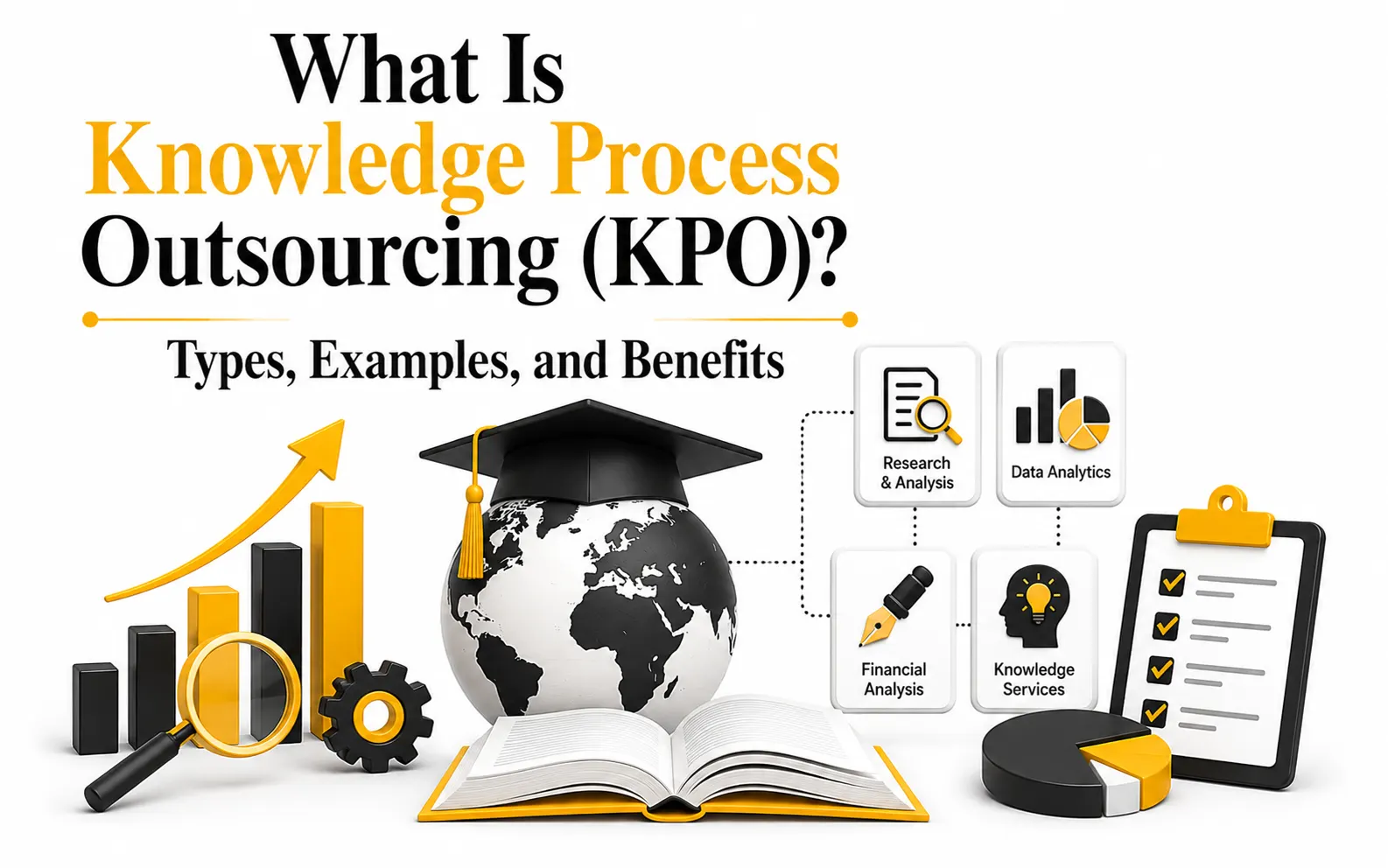
KPO basically refers to outsourcing high-skill, judgment-based work, such as research, analysis, and expert-level insight, to an external provider instead of an in-house team. The main types are data analytics and insights, market and business research, global reporting and performance management, and data management.
Where BPO hands off a rules-based process, KPO hands off a decision that requires domain expertise. A business should turn to KPO when it lacks specialist expertise in-house, when its existing team is overloaded, or when hiring a full-time senior specialist isn’t practical. Converting to KPO brings real benefits, from lower operating costs to faster access to hard-to-hire skills. Those benefits come with some risks too, mainly around data security, IP protection, and quality control, all of which are manageable with the right contract terms and provider vetting, covered later in this article.
What Is KPO?
Knowledge process outsourcing, or KPO, is the practice of delegating high-value, expertise-driven business functions, such as research, analysis, and strategic insight, to an external specialist provider rather than routine task execution. The distinction between a “knowledge process” and a routine business process comes down to the output. A routine process produces a completed transaction, like a processed invoice or a resolved ticket, while a knowledge process produces an interpretation such as an insight, a model, or a recommendation that required judgment to create.
That work typically follows a four-step chain. The provider gathers the relevant data, manages and structures it, analyzes it against the client’s specific question, and delivers the resulting insight in a form the client can act on. Because that insight often feeds directly into a client’s strategic or financial decisions, the work sits much closer to the company’s core value chain than a back-office task would, which is part of why KPO engagements tend to involve tighter collaboration between provider and client than a typical outsourcing arrangement.
Ashish Gupta, former COO of Evalueserve, is widely credited with coining the term KPO in the early 2000s, though the credit isn’t universally confirmed as sole origination. Several accounts describe it as emerging from discussions between Gupta and Evalueserve’s other co-founders as they looked for a way to distinguish their research and analytics work from standard BPO. Since then, the field has expanded into several different types of KPO, covered next.
What Are the Types of KPO?
The 4 main types of KPO include data analytics and insights, market and business research, global reporting and performance management, and data management.
The 4 main types of KPO are listed below.
- Data analytics and insights: Data analytics and insights means turning raw business data into decision-ready findings, using predictive modeling, business intelligence dashboards, and statistical analysis. It helps a client understand patterns and trends in its own data that wouldn’t be obvious from looking at raw numbers alone, and it’s often the type of KPO work that gets folded directly into a company’s internal reporting cadence.
- Market and business research: Market and business research means competitive intelligence, industry analysis, and strategic research that inform decisions like market entry, pricing, or product positioning. It’s typically delivered as a structured report rather than raw data, since the client is usually trying to decide something, not just collect information. A strong market research engagement often blends public data with the provider’s own analyst judgment about what that data actually means for the client’s situation.
- Global reporting and performance management: Global reporting and performance management means consolidating financial and operational data from multiple regions or business units into standardized reports. It lets leadership track performance against targets across a global footprint without manually reconciling numbers that arrive in different formats, currencies, or reporting cadences from each region. This type of KPO work tends to be ongoing and recurring rather than project-based, since global reporting is needed every quarter, not just once.
- Data management: Data management refers to the ongoing cleaning, structuring, and governance of a client’s data assets. It’s less visible than the other three types, but it’s often the foundation that makes accurate analytics possible in the first place, since flawed or messy underlying data undermines every report or model built on top of it. Providers offering this type of KPO usually also handle data quality monitoring so problems get caught before they reach a client-facing deliverable.
A good example of how these types apply in practice is a finance company outsourcing its regional claims data into a single global reporting function, rather than reconciling spreadsheets from a dozen local offices by hand. Beyond these four types, KPO’s scope extends further still, into accounts and tax return preparation, CAD simulation and engineering design, and specialized financial services work like equity research and risk modeling.

What Are Examples of KPO?
Examples of KPO include finance, legal, healthcare and pharma, market research, and engineering work.
The examples of KPO are listed below.
- Finance: Investment research, risk analytics, and financial modeling are among the most established KPO services, typically supporting asset managers and private equity firms. These firms need deep analytical bandwidth to cover more securities, markets, or deals than their in-house teams could handle alone, without permanently expanding headcount for work that can fluctuate with market conditions.
- Legal: Contract review, patent analytics, and case law research make up legal process outsourcing, or LPO, a KPO sub-category. It lets law firms and corporate legal departments hand off research-heavy work to specialized reviewers who are trained specifically for high-volume document review and legal research, freeing up attorneys for higher-value strategic work.
- Healthcare and pharma: Clinical trial data analysis and medical research support are increasingly outsourced as pharmaceutical companies manage growing volumes of trial data across global studies. A KPO partner in this space often needs specific regulatory knowledge, since clinical data handling is governed by strict compliance requirements that vary by country.
- Market research: Strategy consulting and business intelligence work, including competitive benchmarking, customer segmentation, and industry forecasting, is a core KPO service for companies planning market entry or repositioning. This work often combines quantitative data analysis with qualitative judgment about competitive dynamics, which is why it tends to be staffed by senior analysts rather than junior researchers.
- Engineering: Design work, simulation, and R&D support let manufacturers tap specialized engineering talent for CAD modeling and product development without building that capacity internally. This is especially useful for companies that only need heavy engineering support intermittently, such as during a new product launch, rather than year-round.
Unlike BPO, where the same five categories above would instead involve executing a standardized process. Every one of the above KPO examples requires the provider’s team to exercise judgment specific to the client’s situation, not just follow a script.
What Is the Difference Between BPO and KPO?
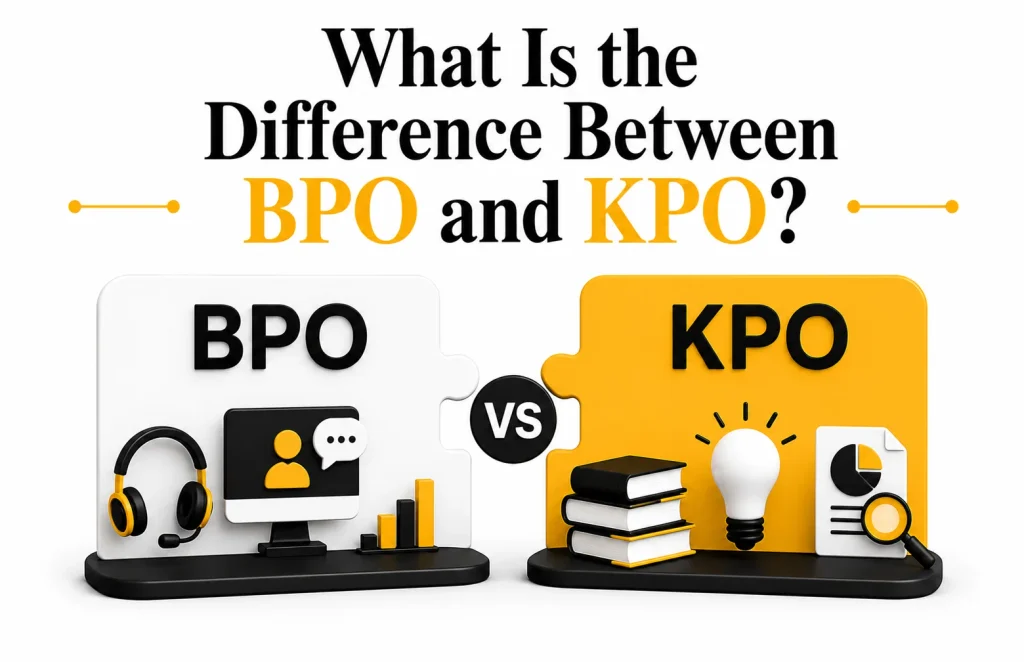
The main difference between BPO and KPO is that BPO executes rules-based, repeatable tasks, while KPO applies expert judgment to produce insights and recommendations.
The difference between BPO and KPO is presented in the table below.
| Axis | BPO | KPO |
|---|---|---|
| Task type | Rules-based execution of a defined process | Expert judgment applied to an ambiguous or complex question |
| Workforce | Trained agents following documented procedures | Professionals with advanced degrees and sector certifications |
| Output | Completed transactions, such as processed forms or resolved tickets | Insights and recommendations that inform a decision |
| Cost driver | Volume, since more transactions require more staff hours | Expertise, since deeper domain knowledge commands a higher rate |
| Automation exposure | High, since repetitive, rules-based work is the first target for AI and RPA | Lower but rising; automation handles data prep and pattern detection, while experts focus on interpretation and strategy. |
In BPO, the client hands off a defined process and expects consistent execution, that’s how business process outsourcing works. KPO builds on that foundation by adding interpretation, analysis, and domain expertise to the same delivery framework.
It’s worth mentioning that KPO is a continuation of BPO, not a competitor to it. Many providers and articles frame the two as rivals, but that’s a misleading way to think about the relationship, since KPO grew out of BPO as clients started asking the same offshore providers to take on higher-complexity, judgment-based work alongside their existing transactional processes.
A single provider relationship can span both. A client might outsource routine data entry to the BPO side of a contract while running its investment research through the same firm’s KPO practice. The two models share infrastructure and delivery geography; they differ in what the client is actually asking for.
Does the Client Stay Involved in KPO?
Yes, the client stays involved in KPO because the work requires ongoing context that only the client can provide. A KPO analyst can’t produce a useful risk model or market analysis without understanding the client’s specific business situation, prior decisions, and evolving questions. That’s different from BPO, where a client typically hands off a well-defined process and steps out of the day-to-day delivery loop entirely, checking in only against SLAs.
For the buyer, staying involved in KPO means real, ongoing effort. It means briefing the provider thoroughly at the start of an engagement, participating in structured review cycles as deliverables come back, and, critically, designating an internal owner who has the authority and time to answer the provider’s questions as they come up. Buyers who treat a KPO engagement like a BPO handoff, briefing once and then disappearing, tend to get generic output that doesn’t reflect their actual situation. This ongoing collaboration is also what makes KPO different from LPO and RPO, both narrower outsourcing models focused on specific domains like legal documentation or recruitment pipelines, whereas KPO spans broader analytical and strategic functions that depend on continuous client input.
How Is KPO Different From LPO and RPO?
KPO is different from LPO and RPO in that LPO is a narrower KPO sub-model, while RPO is a genuine acronym collision that means two different things depending on context. Legal process outsourcing, or LPO, sits inside KPO as a specialized branch focused specifically on legal research, contract review, and litigation support, and it uses the same judgment-based delivery model as the rest of KPO, just scoped to legal work. RPO is trickier. In the staffing and HR world, RPO almost always means recruitment process outsourcing, where a company hands off its hiring pipeline, including sourcing, screening, and candidate management, to an external partner.
Inside KPO frameworks specifically, though, RPO instead refers to research process outsourcing, a category covering dedicated research support similar to the market research examples covered earlier in this article. To be clear about which one this article means, everywhere RPO appears in the context of KPO here, it refers to research process outsourcing, not recruitment. That distinction matters for any business researching outsourcing options online, since search results for “RPO” mix both meanings freely.
When Should a Business Use KPO?
A business should use KPO in 3 main conditions, including when it lacks specialist expertise in-house, when its existing team is understaffed or overloaded, and when there’s no time or budget for a full-time senior hire. The first condition is the most straightforward because a company that needs deep expertise in, say, actuarial modeling or patent law but doesn’t have that specialty on staff can access it through a KPO provider far faster than building the capability internally.
The second condition applies even when a business does have the right expertise in-house. If that team is already stretched thin handling day-to-day work, adding a large research project on top risks burning them out or delaying both the new project and their existing responsibilities. The third condition is a budget and timing reality. Hiring a senior specialist full-time involves a lengthy search, a full-time salary commitment, and onboarding time, none of which fits a business that needs analytical output on a shorter runway or doesn’t have year-round demand for that specific skill. In each of these conditions, KPO can be a beneficial way to access expert-level work without the fixed cost and lead time of a permanent hire.
What Are the Benefits of KPO?
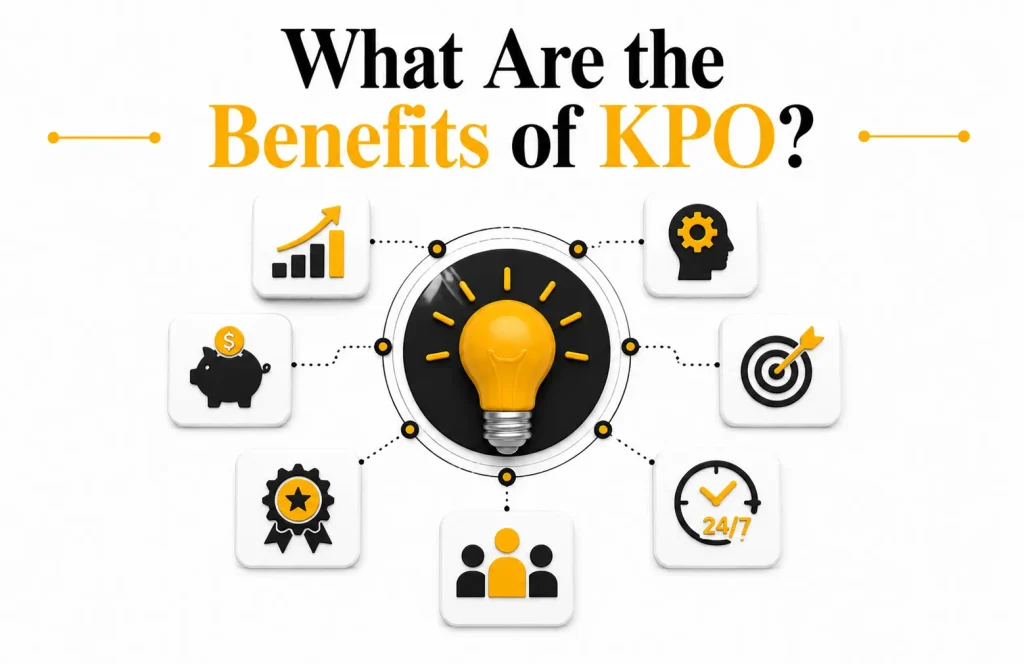
The benefits of KPO include lower operating costs, access to specialist skills, flexible staffing, and freeing up internal teams.
The benefits of KPO are listed below.
- Lower operating costs: A KPO engagement typically costs meaningfully less than an equivalent in-house hire once salary, benefits, and overhead are factored in. This is largely due to labor cost differences between delivery markets and the buyer’s home market, and it’s usually the first benefit that gets a KPO conversation started internally, even though it’s rarely the only reason a business ultimately signs on.
- Access to specialist skills that are hard to hire locally: Niche expertise, such as a specific regulatory specialty, a rare engineering discipline, or a particular research methodology, can be difficult and slow to recruit for locally. An established KPO provider often already has that expertise on staff, since it has built a team around exactly this kind of specialized demand across many clients rather than just one.
- Flexible staffing and faster onboarding: Scaling a KPO engagement up or down is faster than hiring or laying off internal staff, and an established provider can typically start a new engagement in weeks rather than the months a full recruiting cycle takes. That flexibility matters most for businesses with seasonal or project-based demand, where a permanent headcount commitment wouldn’t make sense.
- Internal teams freed for core work: Handing off research-heavy or analytically intensive projects lets an internal team stay focused on the strategic work only they can do, rather than getting pulled into execution. Over time, this can meaningfully change what an internal team’s day-to-day actually looks like, shifting them from doer to reviewer and strategist.
Relative to building an equivalent capability from scratch, a KPO engagement with a reputable, well-vetted provider is generally a low-risk way to test whether a given analytical function is worth building in-house permanently.
What Are the Risks of KPO?
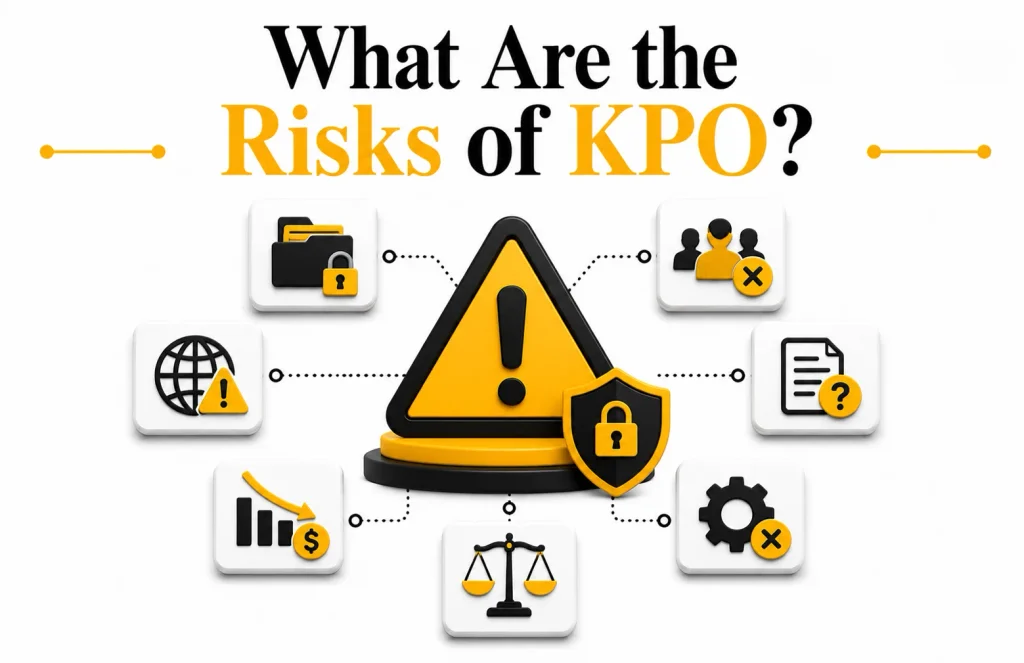
The risks of KPO are listed below.
- Data security and confidentiality exposure: Sharing sensitive business data with an external provider always carries some risk of exposure, whether through a security breach or careless internal handling on the provider’s side. This risk scales with how sensitive the underlying data is, which is why regulated industries need to vet a provider’s security certifications especially closely.
- Intellectual property protection: Without clear contract terms, ownership of research methodologies, models, or other deliverables produced during the engagement can become ambiguous. That ambiguity can create disputes down the line, particularly if the client wants to reuse a model or methodology after the engagement ends and the provider disagrees about who owns it.
- Quality control and output consistency: Deliverable quality can vary between analysts on the provider’s team, and without a structured review process, inconsistent quality can slip through unnoticed. This risk tends to be worse in the early weeks of an engagement, before the provider fully understands the client’s standards and expectations.
- Provider-side talent turnover: If the analyst who understands your account leaves the provider, institutional knowledge about your specific business can leave with them, disrupting continuity mid-engagement. This is a real risk in an industry where analyst turnover is common, and it’s worth asking a provider directly how it handles account transitions when staff leave.
- Legal, cultural, language, and time-zone friction: Differences in legal systems, business norms, and working hours can slow down iterative work and occasionally lead to misunderstandings about scope or expectations. These frictions are usually manageable with clear documentation and defined overlap hours, but they rarely disappear entirely, even in a well-run engagement.
Each of these risks is manageable with the right vetting and contract terms, covered later in this article. They’re also part of why KPO engagements generally come at a higher cost than routine BPO work, since the buyer is paying not just for expertise, but for the provider’s investment in the security, quality control, and retention practices that mitigate these exact risks.
How Much Does KPO Cost?
KPO costs range from under $25 an hour at the low end to $100 to $149 an hour at the high end, with the overall average across the industry landing in the $25 to $49 an hour range, according to a 2026 analysis of 49 KPO firms by SuperbCompanies, 35 of which disclosed pricing. What drives that premium over standard BPO rates isn’t headcount or scale. The same study found that average pricing stays in the same $25 to $49/hr band across every firm-size category, from small boutiques to large providers, and the real driver is the qualifications of the people doing the work.
A KPO analyst with a CFA, a JD, or a relevant advanced degree simply commands a higher rate than a BPO agent trained to follow a script, regardless of which company employs them. This skill‑based pricing model reflects the value of specialized expertise rather than operational volume, making KPO fundamentally different from transaction‑driven outsourcing.Regionally, the same study found KPO firms based in India, Australia, and the UAE cluster in the higher $25 to $49/hr average band, while providers based in the United States and United Kingdom average under $25/hr, a result that likely reflects differences in the mix of firm types sampled as much as raw labor cost, since Western-based “KPO” listings often include smaller boutique operations.
Even at the higher end of KPO pricing, the underlying economics are still a form of labor arbitrage. A client in a high-cost market pays a rate that’s still typically well below what an equivalent senior in-house hire would cost domestically, once salary, benefits, office space, and management overhead are all included. Beyond the headline hourly or monthly rate, buyers should budget for hidden costs that don’t show up on a rate card, including onboarding time, the effort involved in briefing a new provider team thoroughly, and the internal time spent on quality review during the first several deliverables while the relationship is still being calibrated.
What Pricing Models Do KPO Providers Use?
The pricing models KPO providers use are listed below.
- Dedicated full-time equivalent (FTE): FTE pricing is a monthly rate for one or more analysts working exclusively on the client’s account, similar to hiring a dedicated remote employee. It suits ongoing, predictable workloads where the client wants guaranteed capacity rather than paying per deliverable.
- Project or fixed-scope: Project pricing is a flat fee for a defined deliverable with a set scope and timeline, agreed before work begins. It works best when the client can define the scope clearly upfront, since changes mid-project usually require a separate change order.
- Hourly or time-and-materials: Hourly pricing bills the client for actual hours worked, suited to open-ended or unpredictable-scope engagements. It gives both sides flexibility, but it also requires the client to track hours more closely to avoid budget surprises.
- Outcome or retainer-based: Outcome pricing ties payment to a specific result or ongoing availability rather than hours logged, shifting more of the delivery risk onto the provider. It’s becoming more common as AI tools change how long a given deliverable actually takes to produce, covered later in this article.
How Do You Choose a KPO Provider?
To choose a KPO provider, you have to evaluate its domain depth, team qualifications, security posture, and communication model before signing a contract.
To choose a KPO provider, follow the tips listed below.
- Domain depth: Ask for proof of work specifically in your vertical, since a generalist research firm isn’t the same as one with a track record in, say, pharmaceutical regulatory research or structured finance. Case studies and sample deliverables in your specific field tell you far more than a general capabilities pitch does.
- Team qualifications and retention: Ask not just who’s assigned to your account today, but how the provider retains senior talent, since turnover on the provider’s side directly threatens continuity on yours. A provider with a strong retention record is worth paying a premium for over one that constantly rotates junior staff onto client accounts.
- Security posture and certifications: Confirm relevant certifications, such as SOC 2, ISO 27001, HIPAA, or GDPR compliance depending on your industry, rather than taking a general assurance of “enterprise-grade security” at face value. Ask to see the actual certificate or audit report, not just a claim on the provider’s website.
- Communication model and named account ownership: Make sure a specific person, not a rotating pool, owns your account and is accountable for quality and responsiveness. Clarify upfront how often you’ll meet, what channel you’ll use day-to-day, and how escalations are handled if something goes wrong.
- Red flags to watch for: Vague credentials, no named team members, and no sample deliverable are all signs a provider may be overselling its actual capability. If a provider is reluctant to share references from clients in your industry, treat that reluctance itself as a warning sign.
For businesses that don’t want to manage a KPO relationship directly, it’s also worth considering whether to work with a remote staffing partner that sources specialist talent for you. embedding a vetted individual into your team rather than outsourcing an entire function to an external firm. That’s a different model that suits some buyers better than a full KPO engagement.
What Should a KPO Contract Cover?
The clauses that should be in the KPO contract are listed below.
- Confidentiality and data handling: Specifies exactly what data the provider can access, how it must be stored, and what happens to it after the engagement ends.
- IP ownership of deliverables: States clearly that all research, models, and other work product produced during the engagement belong to the client, not the provider.
- SLAs and quality thresholds: Defines measurable standards for turnaround time and deliverable quality, giving both sides an objective basis for evaluating performance.
- Exit and knowledge-transfer terms: Sets out how the relationship can end and what the provider is obligated to hand back, including data, documentation, and institutional context, if it does.
Increasingly, it’s also worth adding a clause covering AI support specifically, including whether the provider uses AI tools as part of delivery, how that affects pricing, and who owns any AI outputs or prompt libraries built using your data, a point covered in more detail next.
How Is AI Changing KPO?
AI is changing KPO by compressing the fastest, most repeatable slices of research and analytical work while growing the market for the judgment-heavy work that sits around that compressed core, and it’s absorbing that work differently than it’s absorbing voice-based BPO. In voice BPO, generative AI mainly automates the interaction itself, since the chatbot or the AI agent replaces the human conversation. In KPO, AI first compresses the mechanical middle of the research process. Literature searches, first-draft summarization, data extraction, and initial contract review can now happen in minutes rather than hours.
A new layer of work is taking shape around validating, contextualizing, and acting on AI‑assisted output, including synthesis across drafts, judgment calls on ambiguous findings, and strategic interpretation for the client. The often-repeated claim that “KPO is AI-resilient” traces back to sources written around 2018, before generative AI existed in its current form, and it shouldn’t be repeated unqualified today, since that framing assumed automation could only handle rules-based BPO work, which is no longer true now that large language models can draft research summaries and flag contract risks directly.
The more accurate 2026 framing is that KPO contains a mix of automation-resilient knowledge work, such as judgment calls, client-specific context, and accountability for a final recommendation, sitting alongside increasingly automatable research mechanics, and the split between the two is what buyers now need to understand before signing a contract. Practically, that means AI is reshaping outsourced work by shifting the buyer’s key question from “how many analyst hours does this cost” to “what does this provider’s AI stack actually do, and what am I still paying human judgment for?” When evaluating a provider, ask specifically what AI tools it uses in delivery, how heavily each deliverable type relies on them, and how that affects both pricing and the location where the remaining human review work happens.
Where Is KPO Work Delivered From?
KPO work is delivered from a handful of established offshore hubs, each with a different specialization.
Regions KPO work is delivered from are listed below.
- India: The largest and most established KPO delivery market, with particular depth in equity research, legal review, and financial analytics. It’s covered in more detail next.
- The Philippines: Historically known for voice BPO, the Philippines has built a growing non-voice KPO sector in finance, accounting, and healthcare analytics. It’s also covered in more detail below.
- Eastern Europe: A strong option for clients needing closer time-zone overlap with Western Europe, particularly for engineering, data science, and technical research work. It tends to command higher rates than India or the Philippines, reflecting the region’s overall cost of living.
- Sri Lanka: A smaller but well-regarded delivery market, especially within financial services research, often used by providers as a satellite location alongside a larger India-based operation. Its talent pool skews toward finance and accounting specifically, rather than the broader mix seen in India.
Choosing an offshore delivery location for a KPO engagement generally comes down to weighing cost against time-zone overlap and the specific domain depth a region has built up, rather than defaulting to whichever market is cheapest.
Why Does India Lead the KPO Market?
India leads the KPO market because of the sheer scale of its STEM graduate pipeline, its status as the sector’s origin point, and the deep concentration of specialized talent it has built up in research-heavy fields. India now produces roughly 2.55 million STEM graduates a year as of 2025 according to the Ministry of Education’s All India Survey on Higher Education (AISHE) framework, second only to China, giving KPO providers a large, continuously replenished pool of candidates for analytically demanding roles.
India was also where the KPO sector itself began, with early firms like Evalueserve establishing the category there in the early 2000s, and that gave Indian providers a multi-decade head start in building institutional expertise and client relationships that newer delivery markets haven’t yet matched. That head start shows up today in concentration.
India’s KPO industry remains especially strong in equity and investment research, legal review, and data analytics, sectors where firms have spent two decades refining delivery processes. That combination of scale and specialization is why India still handles more KPO volume than the Philippines, even as the Philippines’ own non-voice sector has grown substantially, covered next.
What Is the Philippines’ Non-Voice KPO Sector?
The Philippines’ non-voice KPO sector refers to the portion of the country’s outsourcing industry that doesn’t involve phone-based customer interaction, meaning research, analytics, finance and accounting, and other knowledge-driven work delivered through email, documents, and software rather than a call center floor.
Typical non‑voice functions handled from the Philippines include finance and accounting support, healthcare data and claims analytics, and increasingly design and engineering support, jobs that rely on specialized knowledge rather than customer interaction. These sit alongside the software development and IT services work that has grown alongside the country’s traditional voice BPO strength.
What Does KPO Mean as a Job?
As a job, KPO means working in an analytical, research-driven role rather than a transactional, customer-facing, or process-execution one. Day-to-day, a KPO employee is doing research, building models, writing reports, or reviewing complex material, not handling calls or processing routine transactions. That’s a meaningful difference from a BPO agent role, which typically follows a documented script or workflow with measured handling times, since a KPO role instead involves open-ended problem-solving where the “right answer” often requires judgment rather than adherence to a procedure.
Career progression in KPO tends to track more like a professional services career than a call-center career. Junior analysts move toward specialization in a specific domain, then toward managing client relationships or leading research teams, a path that depends heavily on the specific qualification the employee brings into the role.
What Qualifications Do KPO Professionals Need?
Qualifications KPO professionals need are listed below.
- Degree or professional license in the relevant domain: A finance, law, engineering, or life sciences degree, or an equivalent professional license, is typically the baseline requirement, since the work assumes existing domain literacy.
- Sector certifications: Credentials like the CFA in finance, a legal qualification for LPO work, clinical certifications for healthcare KPO, or recognized analytics certifications all signal a level of specialized competence beyond a general degree.
- Analytical tooling skills: Proficiency with the specific software and platforms used in a given field, such as financial modeling tools, statistical software, CAD platforms, or e-discovery systems, is often as important as the underlying domain knowledge.
What Does KPO Mean in Manufacturing?
In manufacturing, KPO means outsourcing engineering and technical analysis work rather than production itself. Engineering design and CAD simulation, R&D and product development support, and supply chain analytics and optimization are the core services that fall under this type of KPO. A manufacturer might, for example, outsource the CAD simulation work for a new product line to a specialized engineering KPO provider rather than expanding its in-house design team for a single project.
This sits alongside the other different types of KPO covered earlier in this article, applied specifically to a manufacturing context, using the same underlying model of expert judgment applied to complex problems, just scoped to engineering and supply chain questions instead of finance or legal research. The benefits of KPO discussed earlier apply directly here too. A manufacturer gets access to specialized engineering expertise it may only need intermittently, without carrying that headcount on payroll year-round.