
An outsourced call center refers to a third-party provider handling a business’s inbound or outbound calls for an agreed rate. The rate depends on two things, including how the agent’s time is billed and where that agent is located. Two anchors are worth holding onto before anything else is shared. Inbound minutes typically run $0.50 to $1.75 per minute, and dedicated agent hours run roughly $6 to $65 per hour, depending on region.
Providers usually bill against one of five structures, including per minute, per hour, per call, per resolution, or a fixed monthly fee, and which one applies changes both the total cost and who carries the risk if volume swings. An important matter is that the quoted rate is not the total cost. Setup, training, QA, and after-hours premiums typically sit on top of the headline number, so the blended rate you actually pay is usually higher than the number in the sales deck, and the only way to compare providers fairly is to work out the total cost of ownership rather than the per-hour or per-minute figure alone.
How Much Does It Cost to Outsource a Call Center?
Outsourcing a call center costs between $6 and $65 per agent per hour, or $1,200 to $4,000 per agent per month, depending mainly on region, whether agents are shared or dedicated, and how complex the work is.
Outsourcing call center cost rates are presented in the table below.
| Region / Anchor | Published Rate | Source |
|---|---|---|
| Offshore (Asia) | $6–$16 per agent hour | Crescendo.ai; JustCall |
| Nearshore (Latin America, Eastern Europe, Caribbean) | $12–$24 per agent hour | PBX.IM; Centris |
| Onshore (US and Canada) | $28–$65 per agent hour | PBX.IM; Crescendo.ai |
| Western Europe and Australia | $33–$55 per agent hour | GigaBPO |
| Dedicated seat retainer | $1,200–$4,000+ per agent per month | PBX.IM; AgentsRepublic |
| Clutch marketplace average | Under $25 per hour | Clutch |
Published onshore ranges genuinely disagree across sources; some put it as low as $22 to $25 per hour, others as high as $65, and averaging them into one number would hide more than it reveals. Three things drive that spread. First, whether the agents are pulled from a shared pool serving several clients or dedicated solely to one account, since dedicated agents cost more per hour but eliminate split attention. Second, whether the work is basic support or technical and regulated work, compliance-heavy or specialized queries command a higher rate than routine calls.
Third, whether QA and technology are already bundled into the quoted rate or billed separately, since a rate that looks low on the surface can hide costs that a more expensive, fully bundled rate already includes. It’s worth understanding the difference between shared versus dedicated agents, specifically before comparing any two quotes, since the agent hour figure alone doesn’t tell you which one you’re being quoted.
What Is Included in an Outsourced Call Center Rate?
The factors that an outsourced call center rate includes are listed below.
- Agent wages and staffing: The base cost of paying and scheduling the people actually handling calls.
- Equipment and workstation: The computer, headset, and desk setup each agent needs to work.
- Day-to-day operations and scheduling: The shift planning and staffing management needed to keep coverage consistent.
- Reporting and call monitoring: Basic dashboards and call logs showing volume, handle time, and outcomes.
- Basic multi-channel support (voice, email, chat): Standard coverage across the most common contact channels, without added specialization.
The factors that an outsourced call center rate often does not include by default are listed below.
- Setup and onboarding: The one-time cost of getting the account and team running before live calls begin.
- Product-specific training beyond the basics: Deeper training tailored to a client’s specific product, beyond general customer service skills.
- Dedicated QA analysts: Staff whose specific job is scoring and auditing calls, rather than QA folded into a supervisor’s broader role.
- After-hours and holiday coverage: Staffing outside standard business hours, which usually carries its own premium.
- CRM licenses and telephony seats: Software and phone-system access, which may be billed separately from the agent rate itself.
Inclusions vary significantly by contract, so this list is best used as what to check for in a quote rather than as a fixed industry standard. Always ask a provider to confirm which pricing model, of the kind covered next, each of these items falls under.
What Are the Outsourced Call Center Pricing Models?
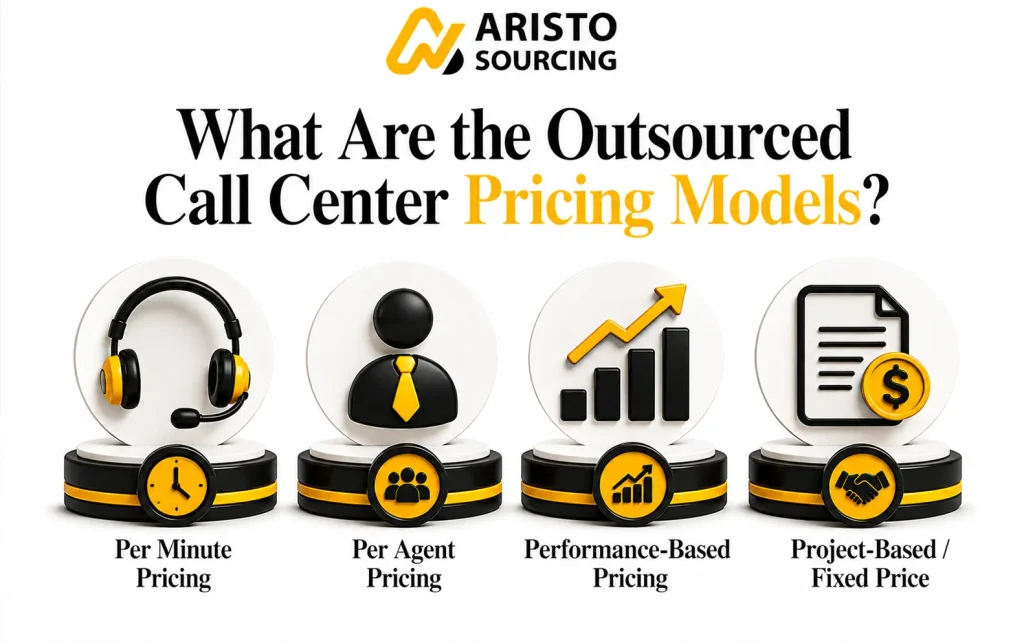
The outsourced call center pricing models include five main structures that determine how a provider bills for agent time or outcomes.
The outsourced call center pricing models are listed below.
- Per-Minute Pricing
- Per-Hour (FTE) Pricing
- Per-Call Pricing
- Per-Resolution Pricing
- Fixed Monthly Pricing
1. Per-Minute Pricing
Per-minute pricing refers to a billing structure where a business is charged according to the minutes defined in the provider’s pricing terms, which may include connected talk time and, depending on the contract, other billable call time. It works by metering the actual minutes an agent spends on the phone with a customer, so idle time between calls generally isn’t billed the way it would be under an hourly model, making it better than hourly for variable or low-volume needs. Rates for inbound work commonly run $0.50 to $1.75 per minute, with US-based agents priced higher, around $1.00 to $1.75 per minute, and offshore agents priced lower, around $0.45 to $0.80 per minute.
Flat packages also exist; a bundle of 1,000 minutes for $1,100 works out to about $1.10 per minute, and the effective unit rate tends to fall as the bundle size grows. This model suits businesses with low or unpredictable inbound volume, or those that need overflow and after-hours coverage without committing to a dedicated headcount. The main drawback is that there’s no dedicated agent building product knowledge over time, so depth of support and brand consistency tend to suffer. Some providers refuse to offer this model at all, calling it the most expensive option per unit of actual work once quality is factored in.
2. Per-Hour (FTE) Pricing
Per-hour, or FTE, pricing refers to a fixed hourly rate charged per dedicated agent, billed regardless of how many calls that agent actually handles in the hour. It works on a simple formula: cost equals the number of agents multiplied by the hourly rate multiplied by hours worked, which makes it straightforward to budget against a known headcount. Rates run $6 to $65 per agent hour depending on region, and a worked example makes the model concrete: five agents at $16 per hour for 40 hours each come to $3,200 for the week.
This model suits steady, predictable volume and work complex enough to require built-up product knowledge, since the agent is dedicated rather than shared, different from pay-per-call, where agents are pooled, and billing is per connected minute. The drawback is that you pay for idle time during quiet shifts regardless of call volume, and running true 24/7 coverage multiplies the number of shifts, and therefore the total hourly cost, well beyond what a single shift’s rate suggests.
3. Per-Call Pricing
Per-call pricing refers to a billing structure where a business is charged per handled interaction, regardless of how long that call actually runs. It works by counting completed calls rather than metering time, which shifts the pricing logic from duration to volume of interactions handled. There’s no reliable published per-call benchmark worth quoting as a spot number. Most figures circulating online are derived from other rates rather than independently measured, so the more useful approach is to calculate it yourself.
Multiply the applicable per-minute rate by the average handle time, then add any per-call connection fee the provider charges on top. This model suits seasonal or campaign-driven volume, where call counts spike and fall predictably around a known event. The drawback is that long or repeated calls erode the economics quickly, since a provider paid per call has less incentive to resolve fully instead of ending the interaction fast. It’s worth understanding how this is different from the per-resolution pricing model before choosing between the two, since one rewards call volume and the other rewards outcomes.
4. Per-Resolution Pricing
Per-resolution pricing refers to a billing structure where a business pays only when an issue is resolved to a standard defined in the SLA, no follow-up is needed, first-contact resolution is achieved, or a positive CSAT score is recorded. Rates commonly run $1 to $7 per resolution, with an industry average of roughly $4, according to Crescendo.ai’s 2026 outsourced call center pricing guide.
AI-led providers price this differently: Crescendo.ai currently advertises resolution-based pricing starting at around $1.25 per resolution for AI-supported service, while its current pricing structure also includes a separate monthly service fee and other plan-specific costs. The packaging typically works through resolution credits purchased upfront against a set period, and whether unused credits expire or roll over is a clause worth checking closely before signing. A worked example: 8,100 to 8,500 tickets a year at $2 each comes to $16,200 to $17,000, plus the monthly platform fee. This model suits complex, multi-step support where the outcome matters more than how fast the call ends. The drawback is that the definition of a “resolution” is negotiable, so the exact SLA wording ends up deciding what you’re actually paying for, a loosely defined resolution favors the provider, and a tightly defined one favors the buyer, and it’s worth understanding how this differs from a flat fixed monthly fee before comparing the two.
5. Fixed Monthly Pricing
Fixed monthly pricing refers to a flat fee charged for a defined scope of work over a month, quarter, or year, regardless of exactly how that volume plays out week to week. It works by locking in a set price upfront for an agreed scope, shifting the volume risk from the client onto the provider for the length of the term.
Published rates for this model should be treated cautiously and rechecked before use: dedicated seat retainers commonly run $1,200 to $4,000 or more per agent per month, while domestic US FTE seats are typically quoted nearer $2,800 to $4,500. Pricing under this model is driven by ticket volume, including expected peaks, support hours required, query complexity, the number of languages covered, and training requirements. It suits businesses with stable, predictable volume that value budget certainty over flexibility. The drawback is that the provider is carrying the volume risk on your behalf, and that risk gets priced into the flat fee as a premium, which is why this tends to be the most expensive model per unit of actual work in most contracts, so it’s worth watching closely for the kind of hidden costs that can widen that gap even further once a contract is signed.
What Are the Hidden Costs of Outsourced Call Center Pricing?
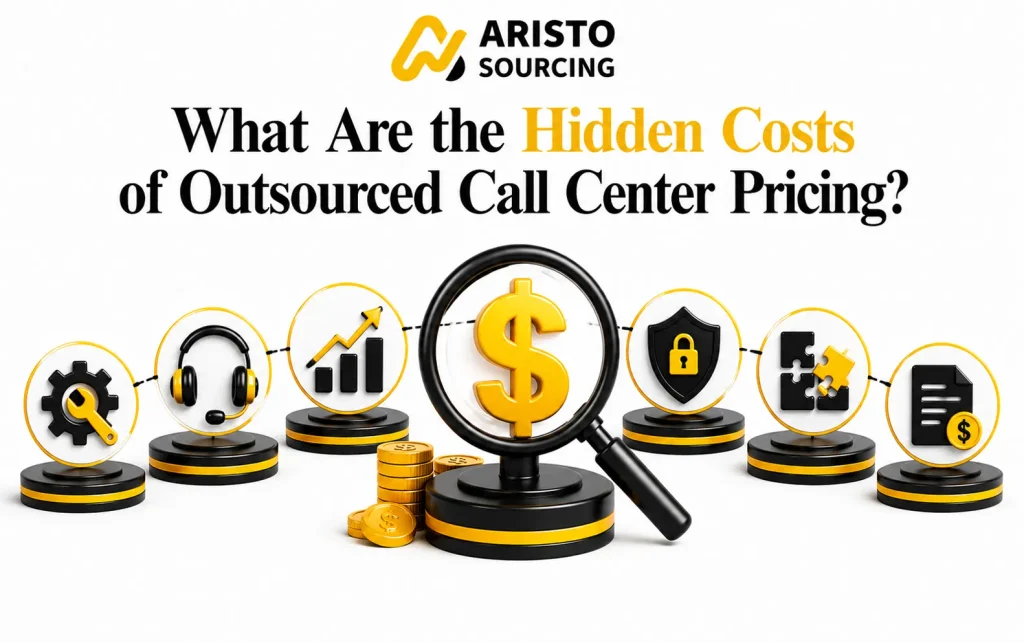
The hidden costs of call center pricing include setup fees, training and attrition costs, QA overhead, technology fees, after-hours premiums, and volume-commitment penalties. Even a well-negotiated headline rate rarely reflects what a business ends up paying month to month; these are the hidden costs buyers miss when outsourcing a call center for the first time. T
The hidden costs of call center pricing are listed below.
- Setup and Onboarding Fees
- Agent Training and Ramp-Up Costs
- Quality Assurance and Supervision Overhead
- Technology and Per-Seat Telecom Fees
- After-Hours, Weekend, and Holiday Premiums
- Minimum Volume and Early Termination Penalties
1. Setup and Onboarding Fees
Setup and onboarding fees refer to the one-time upfront charges a provider bills before an outsourced team goes live. They typically cover software and CRM integration, hardware provisioning, workspace setup, and the initial recruitment needed to staff the account. Published figures vary and are worth rechecking against your specific quote; a commonly cited range runs $2,000 to $20,000 for most mid-market deployments, according to providers like JustCall and PBX.IM, though larger or more complex enterprise rollouts can push well past that, toward $50,000, when heavy CRM integration or custom recruitment is involved. The one lever worth pulling here is asking the provider to amortize this fee across the contract term rather than paying it in full at signing, which smooths the cost and reduces what’s due before an agent even takes a call.
2. Agent Training and Ramp-Up Costs
Agent training and ramp-up costs refer to what it takes to get a new agent from hired to fully productive on a specific account. Published figures put initial product training at roughly $1,000 to $3,000 per agent, with some programs for technical or regulated work quoted as high as $8,000 per agent, figures worth confirming directly with a given provider, since they vary by complexity.
The factor that compounds this cost is attrition. Industry churn is commonly cited at 30 to 45 percent annually, or roughly 6 to 8 percent monthly, which means a business ends up funding training for a meaningful share of its outsourced team more than once a year. Replacing one already-trained agent is estimated at $10,000 to $20,000 once recruitment, retraining, and lost productivity during the ramp-up period are all counted. The clearest way to control this is to ask a provider for their actual monthly attrition rate in writing before signing, a low-attrition provider charging a higher hourly rate is often cheaper over a full year than a low-rate provider that quietly makes you pay for retraining several times over.
3. Quality Assurance and Supervision Overhead
Quality assurance and supervision overhead refers to the cost of monitoring and scoring agent performance beyond the agents’ own wages. Published figures suggest supervisory oversight and QA tracking typically add 10 to 15 percent to the baseline contract value, while dedicated QA analysts, when billed separately, run roughly $500 to $2,000 per month.
The clearest way to control this cost is to confirm upfront whether call scoring, compliance reporting, technology, and team-lead time are already folded into the agent rate or billed as a separate line item. A rate that looks cheaper on paper may simply be pushing this cost into a section of the quote you haven’t read closely yet.
4. Technology and Per-Seat Telecom Fees
Technology and per-seat telecom fees refer to the software and connectivity costs required to actually run each agent’s workstation. They cover software licenses, CRM integrations, call routing, after-hours routing, and telephony access, the systems an agent needs open to take a call at all.
Published figures put this at roughly $50 to $200 per agent per month, and whether it’s bundled into the headline rate or itemized separately varies by provider, so it’s worth asking explicitly rather than assuming. The clearest way to control this cost is to ask whether you can supply your own CRM and telephony seats instead of using the provider’s; doing so typically removes the markup the provider would otherwise add on top of the base license cost.
5. After-Hours, Weekend, and Holiday Premiums
After-hours, weekend, and holiday premiums refer to the extra charges applied when coverage extends beyond a provider’s standard daytime shift. Published figures suggest overnight, weekend, and holiday coverage is commonly quoted at 15 to 50 percent above the standard rate, with some contracts pricing public holidays specifically at 125 to 200 percent of the base rate.
This compounds more than most buyers expect, because true 24/7 coverage requires three shifts plus weekend rotation, so the premium ends up applying to a large share of total contracted hours rather than a small edge case. The clearest way to control this cost is to model your actual contact volume by hour before committing to full 24/7 staffing — overflow-only coverage on a per-minute model is often considerably cheaper than paying a fully staffed night shift for volume that rarely materializes.
6. Minimum Volume and Early Termination Penalties
Minimum volume and early termination penalties refer to contract terms that protect the provider’s own investment in staffing and setting up your account, rather than a published rate you’re being charged. They cover minimum monthly volume commitments, which trigger shortfall charges when your actual usage falls short, and early termination fees, designed to recover the provider’s setup and recruitment costs if you exit the contract early.
These are contract terms rather than published market rates, so there’s no credible public benchmark to cite here. The right move is to ask directly for the exact clause language, the required notice period, and the precise shortfall formula, rather than assuming a standard figure applies across the outsourced call center pricing landscape.
How Does Outsourced Call Center Pricing Compare to the Alternatives?
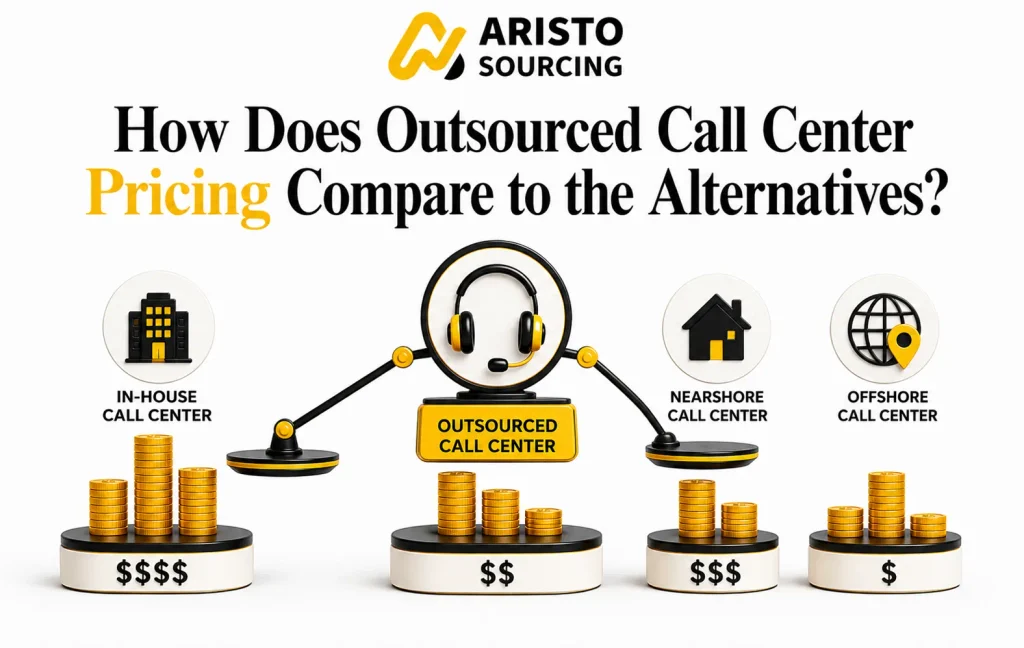
Outsourced call center pricing compared to the alternatives comes down to three separate comparisons, including against building an in-house team, against buying call center software outright, and against deploying AI voice agents. All three should be judged on total cost, not the headline rate each option advertises, since every one of them carries costs that don’t show up in the number a salesperson leads with.
Outsourced Call Center Cost vs In-House Call Center Cost
Outsourced call center cost versus in-house call center cost means comparing the price of buying agent hours from a vendor against the full cost of employing those agents directly. A US in-house support rep’s base wage runs around $18.80 per hour in 2026, according to ZipRecruiter, and that’s before benefits, management, software, or facilities are added.
Benefits and payroll overhead commonly add another 25 to 40 percent on top of that base wage, and recruitment, supervision, floor space, and telephony sit on top again once fully loaded. Volume is what usually decides which option wins. Below roughly 5,000 calls a month, outsourcing is usually the cheaper path, while above roughly 15,000 to 20,000 calls a month, an in-house or partly automated team often comes out ahead. Those specific crossover volumes come from one vendor’s published estimate rather than an independently verified industry standard. So treat them as a useful starting point for your own math rather than a settled fact; they’re a reasonable way to start estimating the cost of hiring and training your own support staff against an outsourced quote, not a substitute for running your own numbers.
Outsourced Service Cost vs Call Center Software Cost
Outsourced call center cost versus call center software cost means comparing labor plus platform against a platform license alone. Contact center software is priced per user, commonly around $1 per active user hour or roughly $150 per named user per month.
Software doesn’t staff, train, schedule, or supervise anyone; it’s purely the technology layer. That means buying call center software you have to pay for on its own still leaves the entire hiring, training, and management burden with you. Which is the cost outsourcing is specifically designed to absorb, a distinction worth keeping in mind before comparing a software quote directly against an outsourcing quote, since they’re not actually pricing the same thing. AI voice agents complicate this comparison further, since some platforms now blur the line between software and staffing.
Human Agent Cost vs AI Voice Agent Cost
Human agent cost versus AI voice agent cost means comparing the per-minute economics of a person on the phone against an AI system handling the same call. AI voice agent platforms advertise rates near $0.07 per minute, a figure Retell AI publishes, significantly reducing costs from $0.50 to $1.75 per minute for human inbound minutes.
It’s worth flagging the source bias here directly. These comparison figures are almost always published by AI vendors themselves, comparing their own pricing against BPO rates, so they’re not a neutral third-party benchmark. In practice, AI absorbs routine, scripted, and lookup-style calls well, but escalations, complaints, and anything requiring real judgment still need a person on the line. Most 2026 deployments reflect that split, a blended setup rather than a full replacement of human agents, which is one of the clearer signs of how AI is changing outsourced customer support in practice rather than in vendor marketing.
How Much Can Outsourcing Actually Cut Your Call Center Costs?
Outsourcing can cut your call center costs between 20% and 50% or 40% and 70%, depending on whether you’re looking at conservative estimates or aggressive vendor marketing, with nearly all figures coming from the outsourcing vendors themselves rather than independent research.
The underlying savings come from real wage differentials between regions and shared overhead across a provider’s client base, not from some efficiency outsourcing has that an in-house team structurally can’t match. That gap narrows once attrition, longer average handle times, and lower first-contact resolution rates common to some outsourced arrangements are factored into the total picture. The only reliable way to evaluate a savings claim is to compare the fully loaded annual cost on both sides, not the hourly rate alone, which is the number most sales conversations lead with because it’s the number that looks most favorable. Getting to a real comparison usually means moving into negotiation with a clearer set of questions in hand.
How Do You Choose and Negotiate an Outsourced Call Center Price?
To choose and negotiate an outsourced call center price, ask the questions listed below.
- Is the rate per shared minute, per dedicated hour, or per resolution?
- What is your monthly agent attrition rate?
- What is included in the rate, and what is billed on top?
- What is the minimum volume commitment, and what is the shortfall formula?
- What is the notice period and the early termination fee?
There are a few red flags that are worth watching for when comparing pricing rates and uncovering call center hidden costs. A single headline rate with no scope definition attached is one of the clearest warning signs, since it usually means the real pricing is hiding in an itemized quote you haven’t seen yet. A provider’s refusal to disclose their attrition rate or QA method is another, since both directly affect the quality and consistency you’ll actually get for that rate. A setup fee demanded in full at signing, rather than spread across the contract, adds unnecessary upfront risk on your side. And a vague or undefined resolution definition on any outcome-based contract is a red flag specifically because it lets the provider decide, after the fact, what actually counts as billable work.
There are also some negotiation levers that are worth trying before accepting a first quote. Committing to longer contract terms or bundling multiple services together commonly moves the price by around 10 to 15 percent. Supplying your own CRM and telephony seats instead of using the provider’s removes the per-seat technology markup entirely. And running a smaller pilot before committing to a full year’s volume lets you validate real performance and true costs against the quoted rates before signing anything larger, which is ultimately the most reliable way to vet and shortlist an outsourcing provider among the many quoting similar-looking rates for very different underlying outsourced call center models.