
The term “AI outsourcing” points in two directions at once: hiring external providers to build or manage AI systems, and AI itself reshaping how traditional outsourcing work gets done. Both meanings matter here.
McKinsey’s November 2025 Global Survey on the State of AI found that 88% of organizations now report regular AI use in at least one business function, based on responses from 1,993 participants across 105 nations. Most of that adoption still hasn’t scaled past the pilot stage, which is exactly why external help has become common. What follows: a clear definition, seven use cases, four engagement models, the benefits and risks, how AI relates to traditional outsourcing, and how to choose a provider.
What Is AI Outsourcing?
AI outsourcing means hiring an external provider to build, manage, or deploy AI systems, like machine learning models, chatbots, or workflow automation, instead of building that capability with an internal team. Providers range from specialized AI development firms and strategy consultancies to staffing agencies placing individual AI talent.
It’s a specific application of the broader IT outsourcing and outsourcing model, scoped to AI-specific work. That definition only covers half the picture, though, since the term itself carries a second, entirely different meaning worth untangling next.
AI Outsourcing vs AI Augmentation vs AI in Outsourcing
The difference between AI outsourcing, AI augmentation, and AI in outsourcing is what’s actually being outsourced or automated, and competitors covering this term rarely untangle the three cleanly.
AI outsourcing means hiring an external provider to build, deploy, or manage AI systems on a company’s behalf, as defined above. AI augmentation describes something different: AI tools boosting the output of existing human workers, whether outsourced or internal, without replacing the role itself. AI in outsourcing points to a third, broader trend entirely: AI reshaping the traditional BPO industry itself, from automated ticket triage to AI-assisted quality scoring across outsourced teams.
These overlap at the edges. An outsourced support agent using an AI tool to draft replies sits in both AI outsourcing and AI augmentation at once. Where they split is scope: AI outsourcing is a specific hiring decision, augmentation is a productivity layer, and AI in outsourcing is an industry-wide shift affecting every provider regardless of what any single client asks for.
What Can You Outsource in AI?
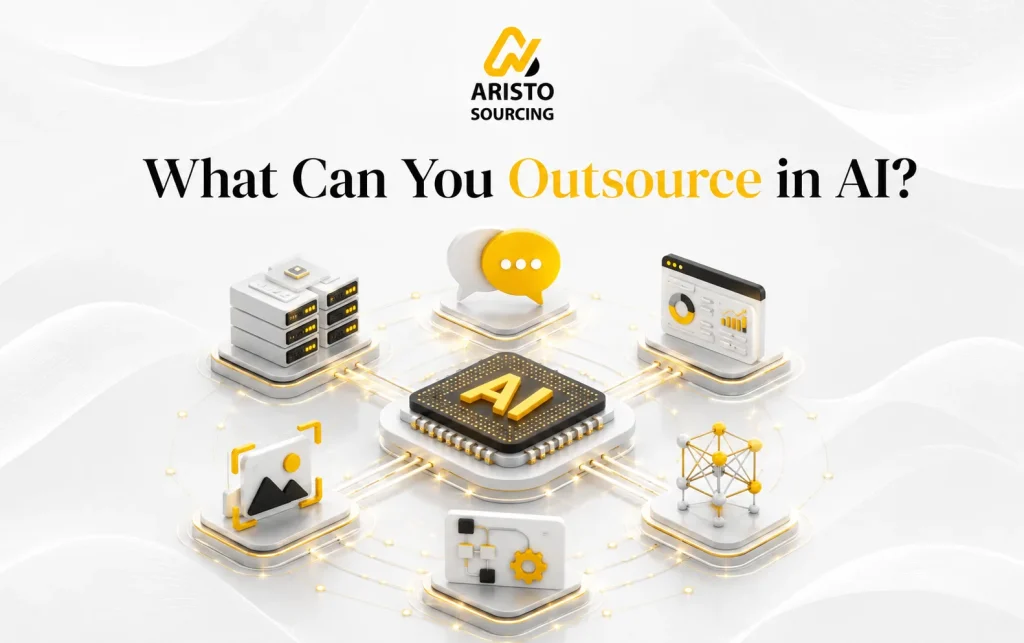
AI work handed off to an external team spans six distinct areas: conversational systems, model development, data preparation, predictive analytics, computer vision, automation, and generative AI. Each solves a different technical problem.
1. Chatbots and Conversational AI
Chatbots and conversational AI encompass the development and training of systems that handle customer conversations, from simple FAQ bots to GenAI-powered assistants that can take action on a customer’s behalf. External teams build these using platforms like Dialogflow or custom large language model integrations, then train and refine them against a business’s actual support history.
A Gartner survey of 3,566 customers, fielded in early 2026, found that customers are now three times more likely to use third-party GenAI tools than a company’s own chatbot for service, a signal of how much trust and design quality matter here. Businesses without in-house AI engineers need this most. Getting the conversation layer right only matters, though, if the model underneath it was built properly in the first place, which brings up machine learning model development.
2. Machine Learning Model Development
Machine learning model development refers to building custom predictive or classification models trained on a company’s own data, rather than relying on off-the-shelf tools. External teams handle this by selecting the right model architecture, training it using frameworks like TensorFlow or PyTorch, and validating performance before deployment.
Businesses without data science talent internally need this most, especially when a problem is too specific for a generic AI product to solve well. A trained model is only as good as what it learned from, though, which is exactly why data labeling and preparation matter just as much as the model itself.
3. Data Labeling and Preparation
Data labeling and preparation covers cleaning, organizing, and tagging raw data so it’s usable for training an AI model in the first place. External teams handle this through manual annotation platforms and quality-control workflows, often at large scale across images, text, or audio.
Companies building custom AI models but lacking the labor to annotate thousands of data points need this most. Clean, well-labeled data is also the foundation for a completely different use case: turning that data into forward-looking predictions through predictive analytics.
4. Predictive Analytics and Data Insights
Predictive analytics and data insights mean building models that forecast future outcomes, like demand, churn, or fraud risk, from historical data patterns. External teams deliver this by combining statistical modeling with business context, translating raw output into dashboards and recommendations a non-technical team can act on.
Retailers, financial services firms, and subscription businesses need this most, since forecasting directly affects revenue decisions. Predicting patterns in numbers is one thing, but recognizing patterns in images requires an entirely different discipline: computer vision.
5. Computer Vision Solutions
Computer vision solutions cover building systems that interpret images or video, from defect detection on a production line to automated product tagging in a catalog. External teams build these using specialized vision models and training pipelines, often combined with the labeled image data covered earlier.
Manufacturing, retail, and logistics companies need this most, wherever visual inspection at scale would otherwise require a large manual team. Vision solves what to look for in an image, but automating what happens next in a business process is a separate use case: process automation.
6. Process Automation (RPA + AI)
Process automation combines robotic process automation with AI to handle repetitive, rules-based tasks, like data entry or invoice processing, while also managing exceptions that pure RPA can’t handle alone. External teams build these using platforms like UiPath or Automation Anywhere, layered with AI models for the judgment calls traditional RPA can’t make.
Grand View Research values the global RPA market at $4.68 billion in 2025, projecting growth to $35.84 billion by 2033. Finance, HR, and operations teams need this most. Automating existing processes is one thing, but generating entirely new content and outputs is where generative AI takes over.
7. Generative AI Solutions
Generative AI solutions cover building custom tools that create content, code, or designs, like product descriptions, marketing copy, or design mockups, rather than just classifying or predicting from existing data. External teams build these by fine-tuning large language or image models on a company’s own brand voice and data.
Marketing, e-commerce, and content-heavy businesses need this most, wherever content volume outpaces what an internal team can produce alone.
What Are the AI Outsourcing Engagement Models?
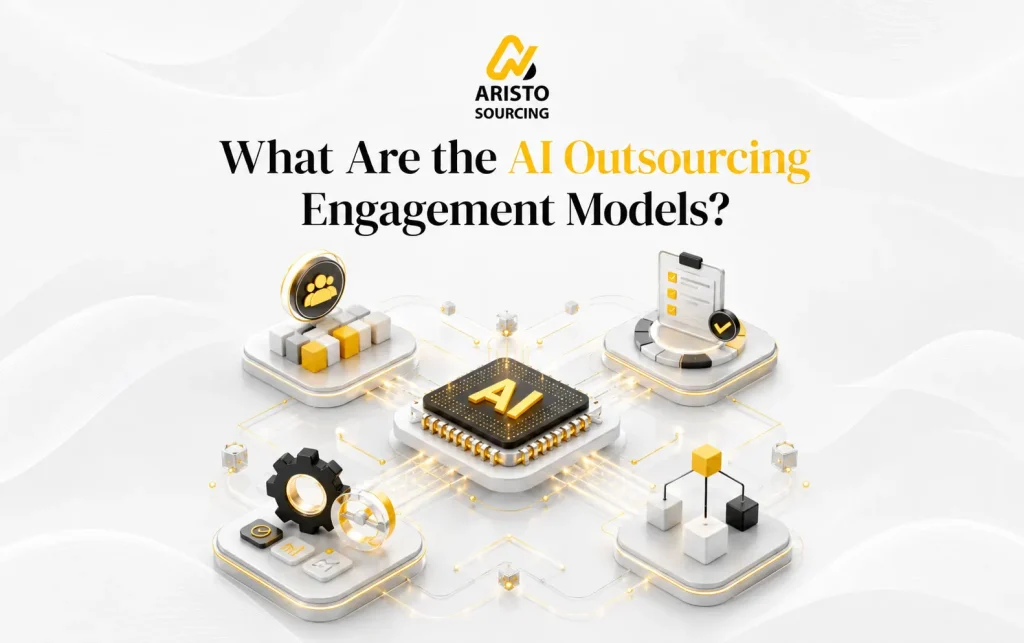
Four distinct models govern how businesses actually engage outside AI help: staff augmentation, dedicated teams, project-based work, and build-operate-transfer. Model choice sets speed, control, and ownership, and most enterprises end up mixing more than one.
1. Staff Augmentation (AI Talent)
Staff augmentation is the talent-placement model, hiring individual AI or ML specialists to work inside a client’s own team rather than delivering a finished product externally. The client directs the specialist’s daily work and priorities, while the staffing provider handles recruitment and placement.
Cost tends to run lower here than the other three models, since there’s no external project management layer built into the price. Businesses with a clear internal roadmap that just need extra hands, not full ownership handed off, are the best fit. Control stays almost entirely with the client, though that also means the client carries the full management load. Aristo Sourcing places AI and ML specialists directly into client teams under exactly this arrangement, for businesses wanting talent rather than a delivered system.
2. Dedicated / Managed AI Teams
A dedicated or managed AI team is staffed and run entirely by the provider, delivering ongoing work as a package rather than individual hires reporting to the client. Day-to-day management, quality control, and often the technical roadmap sit with the provider, within goals agreed upfront.
Expect a higher price than staff augmentation, since management overhead is baked into the arrangement. Companies without the internal capacity to manage AI specialists themselves, or those needing sustained work rather than a single project, tend to reach for this option. What gets traded away is direct daily control, in exchange for one less thing to manage internally.
3. Project-Based Outsourcing
Project-based outsourcing means hiring a provider to deliver one clearly scoped AI project, like a single model or chatbot, rather than an open-ended engagement. The provider manages the full build and hands over a finished deliverable at a fixed or milestone-based price.
Pricing predictability is the standout advantage here, since scope gets locked in before work starts. A clear, well-defined need with no ongoing AI workload beyond that one project points squarely toward this model. Flexibility is what gets sacrificed, since shifting requirements mid-project can strain the fixed scope.
4. Build-Operate-Transfer (BOT)
Build-operate-transfer has a provider build and operate an AI team or system for a set period, then hand full ownership, staff included, over to the client once it’s running smoothly. The initial build and operation phase sits with the provider, followed by a structured transfer of both the system and its people.
Upfront cost runs higher than plain project work, since delivery and knowledge transfer are bundled together. Businesses aiming to eventually own an in-house AI capability, but lacking the maturity to build it from scratch today, are the clearest fit. A longer commitment before ownership fully changes hands is the cost of that eventual independence, along with the added price tag of the transition phase itself.
What Are the Benefits of AI Outsourcing?
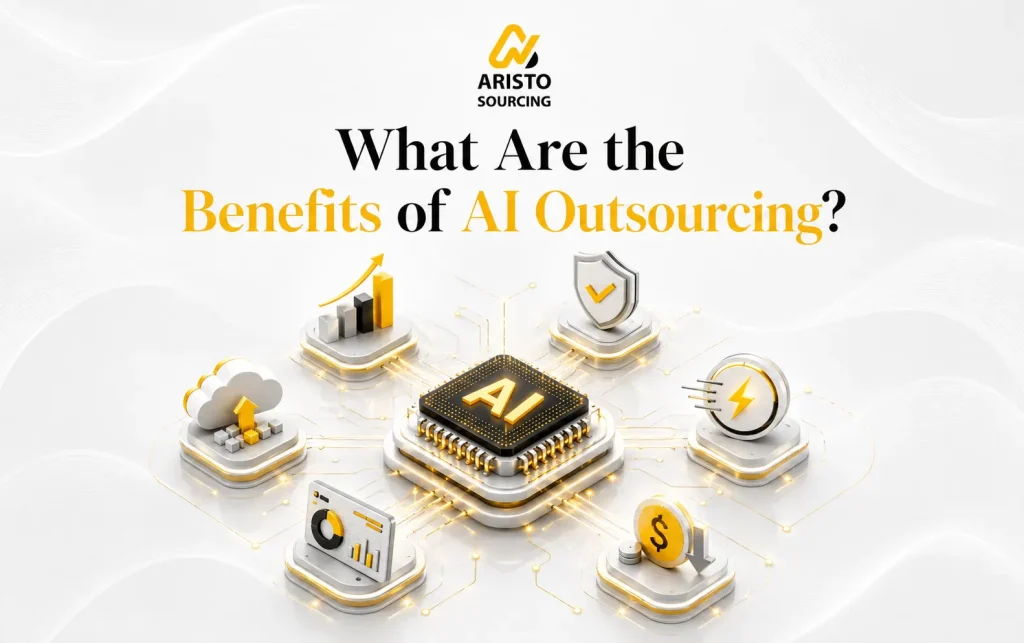
The main benefits of AI outsourcing are cost savings, access to scarce expertise, faster launch times, and scalability without long-term commitment. Outsourcing removes the need to hire full-time AI engineers, buy specialized hardware, or carry that payroll overhead year-round, since the cost is scoped to the project or engagement instead.
Expertise on demand matters just as much, since qualified AI and ML talent remains difficult to hire directly, and providers already have that talent in place rather than requiring a lengthy internal search. Experienced teams working from pre-trained models and existing frameworks also launch projects faster than an internal team starting from zero. Engagements can scale up or down without the long-term commitment a full-time hire requires, and starting with a proof-of-concept first reduces the risk of a large investment before value is proven.
What Are the Risks of AI Outsourcing?
The main risks of AI outsourcing are data privacy exposure, IP ownership disputes, vendor lock-in, and a high project failure rate rooted mostly in data and integration problems rather than the technology itself. Sharing sensitive business or customer data with an external provider raises real compliance exposure, and unclear contracts can leave ownership of the resulting model or code ambiguous.
On failure rates, the commonly cited “92%” figure circulating online is outdated. The current, verified figure comes from MIT NANDA’s July 2025 report, “The GenAI Divide: State of AI in Business 2025,” based on interviews with business leaders, employee surveys, and analysis of 300 public AI deployments: 95% of enterprise generative AI pilots fail to deliver measurable profit-and-loss impact, with the report attributing most failures to integration and workflow gaps rather than model quality itself.
Mitigating these risks comes down to a handful of concrete steps: requiring ISO 27001 or SOC 2 certification from any provider, signing a GDPR-compliant data processing agreement where relevant, securing clear IP assignment in the contract upfront, and starting with a proof-of-concept before committing to a full build.
Which Industries Benefit Most from AI Outsourcing?
The industries that benefit most from AI outsourcing are healthcare, finance, e-commerce, marketing, and customer support, each applying AI to a distinct operational bottleneck.
- Healthcare – Uses AI for medical coding automation, claims processing, and patient intake support.
- Finance – Uses AI for fraud detection, risk modeling, and automated reporting.
- E-commerce – Uses AI for product recommendation engines, demand forecasting, and catalog automation.
- Marketing – Uses AI for content generation, ad targeting, and campaign performance analysis.
- Customer support – Uses AI for chatbots, ticket triage, and automated first-response drafting.
Each of these industries shares a common trait: high transaction volume paired with repetitive, data-heavy decisions, exactly the conditions where an external AI provider delivers value faster than building the capability internally from scratch.
How Is AI Changing Outsourcing Itself?
AI is changing outsourcing by automating the routine, rules-based work that made offshore labor arbitrage profitable in the first place, a shift Harvard Business Review’s June 2026 piece “AI Is Rewriting the Economics of Outsourcing” argues directly. Practitioners are actively debating the resulting cost math, whether an AI-per-task rate now beats an offshore hourly rate, though that comparison remains a live forum and industry discussion rather than a settled statistic. What’s emerging instead is the AI-augmented outsourced team, where human agents and AI tools work side by side rather than one replacing the other. The broader trend lives on our IT and BPO trends pages.
Will AI Replace Outsourced Teams?
AI will not fully replace outsourced teams because it absorbs routine, rules-based work far better than it handles judgment, empathy, and exception cases, the parts of outsourced work that still need a human. Harvard Business Review’s own analysis of the shift frames it as a repricing of outsourcing, not its disappearance, with routine tasks automating while oversight and nuanced decisions stay human.
The fear behind this question is real and worth addressing directly rather than dismissing. The emerging model isn’t replacement; it’s augmentation: human teams working alongside AI tools that handle volume, while people handle the judgment calls AI still can’t reliably make.
In-House vs Outsourced AI: Which Should You Choose?
The choice between in-house and outsourced AI depends mainly on data sensitivity, internal maturity, and speed requirements. In-house AI gives full control over data and IP and builds deep contextual knowledge over time, but it’s slow and expensive to staff, especially given how scarce qualified AI talent remains. Outsourced AI trades some of that control for speed, ready-made expertise, and flexible scaling without a long hiring cycle.
Most enterprises now run a hybrid model, building core, differentiating AI capability in-house while outsourcing specialized or one-off work externally. Early-stage companies typically lean outsourced first, then bring capability in-house as AI becomes core to the business.
How Do You Choose an AI Outsourcing Partner?
Choosing a partner starts with confirming proven expertise in your specific need; GenAI, NLP, or traditional ML are different disciplines, not interchangeable skill sets. Check domain experience and real case studies relevant to your industry next.
Security posture matters just as much: confirm ISO 27001 or SOC 2 certification, GDPR compliance where relevant, and a written no-training agreement ensuring your data isn’t used to train the provider’s other clients’ models. Finally, weigh engagement-model fit, pricing transparency, and scalability against your own roadmap. The next step is a scoped consultation rather than a full commitment, so both sides can confirm fit before signing anything larger.