
Customer service outsourcing is the practice of hiring a third-party provider to manage customer inquiries across channels such as phone, email, live chat, and social media on a company’s behalf. Businesses use this model to extend support hours, handle volume spikes, and access trained agents without building an internal team from scratch.
Grand View Research values the global call and contact center outsourcing market at $97.31 billion in 2024, projecting growth to $163.86 billion by 2030 at a 9.8% CAGR. This article covers what customer service outsourcing involves, the main delivery types, its benefits, the trade-offs to weigh, how the process works in practice, and how to decide if it fits your business.
What Is Customer Service Outsourcing?
Customer service outsourcing is the practice of contracting a third-party provider to manage customer inquiries, technical support, order processing, and returns on a company’s behalf. It sits within front-office business process outsourcing, the BPO category focused on direct customer-facing work rather than back-office functions like payroll or data entry.
Companies adopt this model to cut labor costs, scale support during demand spikes, and maintain 24/7 omnichannel coverage across phone, email, and chat. Providers deliver this through a few distinct types, each suited to different business needs.
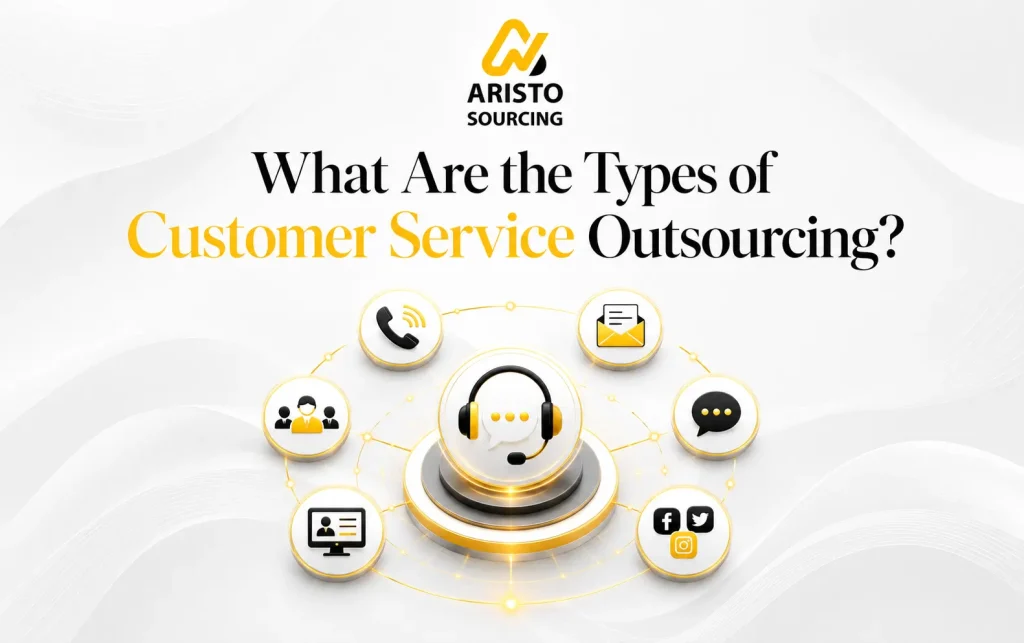
What Are the Types of Customer Service Outsourcing?
Customer service outsourcing splits along three independent axes: location, channel, and agent model. Businesses classify their outsourcing decision by where the provider operates, which channels the team covers, and whether agents work exclusively for one client or share time across several.
By Location: Onshore, Nearshore, Offshore
Customer service outsourcing is grouped by location into onshore, nearshore, and offshore delivery. Onshore providers operate within the client’s own country, offering cultural alignment and zero time-zone gap, though at the highest hourly rate. Nearshore providers sit in neighboring regions, such as US companies partnering with teams in Mexico or Colombia, trading some savings for overlapping business hours.
According to industry benchmarks, offshore providers, particularly in the Philippines and India, can help businesses reduce labor costs by an estimated 50% to 70%, although doing so often requires managing time-zone differences. A fintech handling compliance-sensitive queries may choose an onshore provider for closer oversight, while a retailer scaling seasonal chat volume may prefer an offshore team for greater cost efficiency. Channel coverage shapes the next layer of this decision.
By Channel: Phone, Live Chat, Email, Social
Customer service outsourcing divides by channel into phone, live chat, email, and social media support. Phone support suits urgent or complex issues where tone and real-time resolution matter most. Live chat and email handle higher ticket volume at lower cost per interaction, while social support manages public-facing brand reputation on platforms like Instagram and X.
An airline typically outsources phone support for disruptions but keeps email and chat for routine bookings. Coverage choice often depends on ticket urgency and volume, not budget alone. Once channels are set, the agent staffing model determines day-to-day control.
By Agent Model: Shared, Dedicated
Customer service outsourcing is further split by agent model into shared and dedicated teams. Shared agents split their time across multiple client accounts, lowering cost but limiting brand-specific training depth. Dedicated agents work exclusively for one client, delivering deeper product knowledge and tighter quality control at a higher monthly rate.
Startups testing outsourced support often start shared, then move to dedicated once volume justifies a full-time team. The right fit depends less on company size than on how specialized the support interaction needs to be.
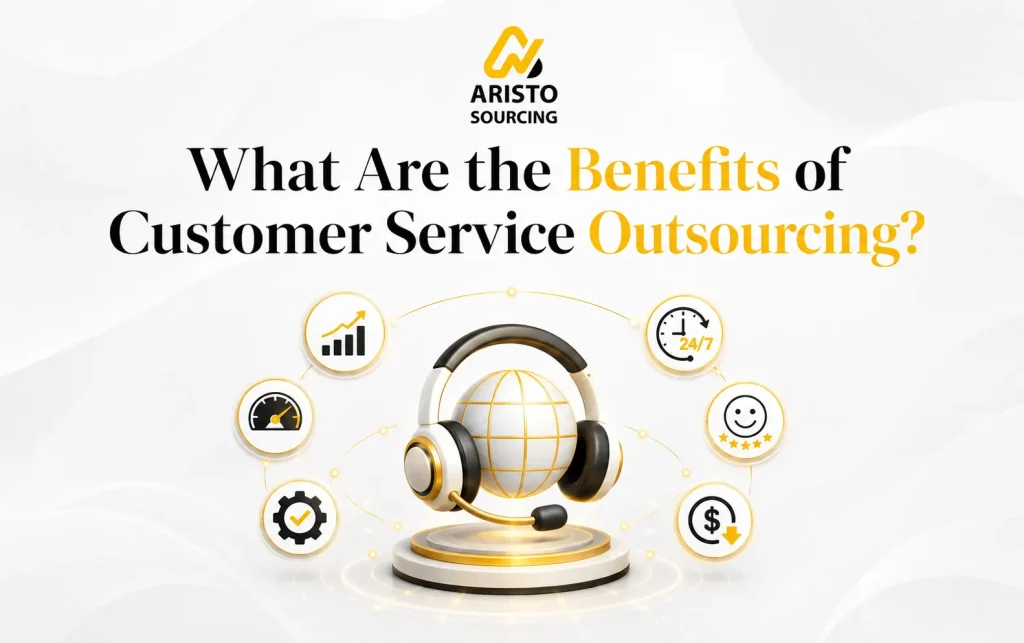
What Are the Benefits of Customer Service Outsourcing?
Customer service outsourcing delivers five measurable advantages: lower operating costs, round-the-clock coverage, elastic scalability, access to specialized and multilingual talent, and freed internal capacity for core business priorities.
1. Cost Savings
Cost savings are the reduction in support delivery expenses compared to running an equivalent team in-house. Customer service outsourcing achieves this by replacing salaries, benefits, office space, and training budgets with a single vendor contract. Deloitte’s Global Business Services Survey found that 55% of organizations with a dedicated global business services leader achieved savings exceeding 20% annually, a gap that widens further for offshore delivery models.
Savings compound over time rather than showing up as a one-off discount. As contracts mature and onboarding costs get absorbed, the ratio of cost to service quality tends to improve year over year. A distributed workforce built to keep costs down is also what makes 24/7 coverage possible in the first place.
2. 24/7 Coverage
24/7 coverage refers to support availability outside standard business hours, including nights, weekends, and holidays. Providers deliver this by staffing distributed teams across time zones instead of paying overtime to a single domestic team. Salesforce research found that 77% of customers expect to interact with someone immediately when they contact a company, a bar that in-house teams working single shifts rarely clear.
Global customer bases feel this gap most acutely, since a missed overnight query in one region often means a lost sale or a frustrated buyer by morning. Round-the-clock staffing at that scale is also what gives providers room to flex headcount on demand.
3. Scalability
Scalability describes the ability to adjust support capacity up or down without a hiring or layoff cycle. Providers deliver this by reallocating shared agent pools during demand spikes, such as holiday sales or product launches. Grand View Research projects the global call and contact center outsourcing market to grow from $97.31 billion in 2024 to $163.86 billion by 2030, growth driven largely by companies needing flexible capacity rather than fixed headcount.
Flexibility like this removes the financial risk of overstaffing during slow periods and understaffing during peak demand, a balance most in-house teams struggle to strike. Scalable agent pools increasingly run on specialized and multilingual expertise rather than generalist staffing alone.
4. Specialized and Multilingual Expertise
Specialized and multilingual expertise gives businesses access to trained agents covering technical products or multiple languages without building that capability internally. Providers build this through concentrated hiring in established talent hubs. The Philippines’ IT-BPM sector alone employed 1.82 million workers in 2024, generating $38 billion in revenue, according to IBPAP.
Depth of talent at that scale lets businesses serve international markets and technical product lines without years of internal hiring and training. Handling that expertise externally frees internal teams to focus sharply on the core business instead.
5. Focus on Core Business
Focus on core business is the redirection of internal time toward product, sales, or strategy instead of support operations. Outsourcing creates this by shifting day-to-day ticket handling entirely to the vendor. Deloitte’s 2024 Global Outsourcing Survey found that 50% of executives now use outsourced services for front-office functions, up from a back-office-only norm a decade earlier.
Growth-stage companies gain the most here, since founders and product teams stop absorbing support workload directly and redirect that energy toward what actually grows the business.
Cons of Outsourcing Customer Service
Cons of outsourcing customer service are the operational risks businesses take on when a third party manages customer interactions instead of an internal team. These risks center on reduced oversight, data exposure, and inconsistent brand representation, though most can be managed with the right contract structure and tools.
- Loss of direct control – Day-to-day quality depends on the vendor’s management, not yours, which can slow how quickly issues get corrected.
- Security and privacy concerns – Sharing customer data with an external provider raises compliance risk, particularly under regulations like GDPR and HIPAA.
- Brand voice and learning curve – New agents need time to absorb tone, product knowledge, and edge cases, creating a gap before service feels native to the brand.
- Mitigation – QA monitoring software, enforceable SLAs, and structured onboarding and training close most of these gaps within the first few months.
Customer Service Outsourcing
How Do You Outsource Customer Service?
Outsourcing customer service comes down to two decisions: recognizing when your business actually needs it, then selecting a partner capable of delivering it well. Getting the timing right shapes how much value the partnership delivers from day one.
When Should You Outsource Customer Service?
You should outsource customer service when internal support is straining under conditions it wasn’t built to handle. High agent turnover and lengthening wait times are the clearest signal, since replacing and training in-house staff faster than they leave becomes a losing cycle. Seasonal spikes are another trigger, particularly for retail and e-commerce businesses where support volume can double or triple within weeks and permanent hires make no financial sense. A third sign is a team spread too thin across departments, where the same employees juggling sales, operations, and support can no longer keep pace with rising customer demand. Once these pressures are clear, the next step is choosing a customer service outsourcing company suited to your specific volume and industry.
How to Choose a Customer Service Outsourcing Company
You choose a customer service outsourcing company by defining your goals first, then evaluating vendors against them rather than against price alone. Start by clarifying what you need: channel coverage, industry experience, and expected ticket volume. From there, weigh team location and cost against overall value, not just the hourly rate, and check for cultural and communication fit, since tone mismatches undermine even a technically capable team. Finally, confirm the provider offers clear SLAs and a documented QA process before signing, since these two elements determine whether service quality holds steady once the contract is live.
Is Customer Service Outsourcing Right for Your Business?
Whether customer service outsourcing fits your business depends on three factors: your required level of control, your budget constraints, and your current support volume. These three decision points, examined together, usually point to a clear answer.
In-House vs Outsourced Customer Service
The difference between in-house and outsourced customer service is the trade-off between control and cost. In-house teams give full oversight of hiring, training, and daily quality, but carry the higher expense of salaries, benefits, and office infrastructure. Outsourced teams trade some of that direct control for scale, established expertise, and lower overhead, since the provider absorbs recruiting and management costs. Neither model is inherently better; the right choice depends on how much oversight your business needs against how much budget flexibility it has, a trade-off examined further in in-house recruitment vs outsourcing.
Is It Cheaper to Outsource Customer Service?
Outsourcing customer service is usually cheaper because it removes the hiring, training, and equipment overhead that an in-house team requires. Providers in offshore markets like the Philippines and India also offer labor arbitrage, where equivalent talent costs a fraction of onshore salaries.
It may not be cheaper, however, for highly specialized or low-volume support needs, where vendor minimums and management overhead can outweigh the savings. The fuller cost-benefit picture, beyond price alone, is covered in Why Choose Outsourcing Customer Service.
How Much Does Customer Service Outsourcing Cost?
Customer service outsourcing costs depend on the pricing model, the delivery location, and the complexity of the support required. Providers typically bill per ticket, per hour, or through a dedicated team retainer, with per-ticket suiting low-volume needs and dedicated teams suiting sustained, high-volume support. Location drives the largest swing in price.
The U.S. Bureau of Labor Statistics puts the median hourly wage for a domestic customer service representative at $20.59, while offshore and nearshore providers routinely charge a fraction of that fully loaded rate, since wages, benefits, and overhead are all lower in those markets.
What ultimately sets the price within any model is ticket complexity, required language coverage, and whether the engagement uses shared or dedicated agents, with specialized technical support commanding higher rates than routine inquiry handling.
What Are the Best Customer Service Outsourcing Companies?
The best customer service outsourcing companies are those with proven SLA performance, low agent churn, and true omnichannel delivery across phone, chat, email, and social. Top providers separate themselves through documented uptime and resolution guarantees, stable staffing that keeps institutional knowledge intact, and the infrastructure to handle every support channel from one unified system rather than bolting channels together after the fact. Shortlisting a provider comes down to checking these three areas directly: request their churn rate, ask for referenceable SLA data, and confirm their channel coverage matches what your business actually needs. A full comparison of leading providers is covered in Customer Service Outsourcing Companies.
How Is Customer Service Outsourcing Used in Ecommerce and Retail?
In ecommerce and retail, customer service outsourcing is used for order tracking, returns processing, peak-season scaling, and omnichannel coverage across chat, email, and social. Retailers lean on outsourcing because demand is rarely flat. Holiday sales, flash promotions, and returns windows create volume spikes that a fixed in-house team cannot absorb without either overstaffing in the off-season or falling behind during peak periods. Outsourced teams flex up for these windows, then scale back down once volume normalizes, which keeps support costs aligned with actual demand rather than a static headcount. If you’re weighing this for your own store, our ecommerce customer support services page breaks down how the model works for retail specifically.
What Does Customer Service Outsourcing Handle?
Customer service outsourcing handles the full range of routine and technical customer interactions a business would otherwise manage internally. This includes general inquiries, technical troubleshooting, order processing, and returns or refund requests. Providers manage these tasks across whichever channels a business operates, including phone, live chat, email, and social media.
Coverage typically spans the entire customer journey rather than a single touchpoint, so the same provider handling a pre-purchase question can also manage a post-purchase return. This end-to-end scope is what lets businesses outsource a full support function instead of piecing together separate vendors per channel.
Same flag as before: the two linked URLs are placeholders built from the anchor text, not confirmed live pages on your site. Send me the real slugs, and I’ll drop them in.