

Leaders split into two camps when they hear the word outsourced because they optimize for different variables. One side prioritizes risk and worries about quality drift, brand damage, and security exposure. The other side prioritizes leverage and cares about speed, overhead reduction, and a calmer operating rhythm for the core team. That tension does not come from ideology, it comes from lived outcomes. Once you name the variables, you can design an outsourced model that captures leverage without inviting avoidable risk.
Modern virtual assistants also do not operate in a purely manual world. A strong VA can run repeatable workflows across your tools, keep process documentation current, and manage AI assisted tasks with human review checkpoints. In practice, the VA often becomes the operator of your automation triggers, exception queues, and reporting routines. That structure helps you scale output without scaling chaos. If you want growth without bloated payroll, you need operational design that protects quality while your workload expands.

Why outsourced triggers fear and why experience fuels that fear
Skeptics do not fear remote talent as a concept, they fear losing control of outcomes. They picture inconsistent execution, unclear handoffs, and rework that boomerangs back to leadership. They also worry about customer trust because a single weak interaction can undo weeks of marketing effort. Those concerns deserve respect because they map to real failure modes. Before you debate cost, ask a more useful question, how will you keep brand standards stable when execution moves outside the core team.
Many negative outsourcing stories share the same pattern. Leaders hire fast, delegate vaguely, and expect the person to infer standards that never existed on paper. They also confuse outsourced with gig marketplace freelancing, and that confusion distorts the debate. Freelancers often thrive on one time projects, but daily operations demand continuity, context, and consistent availability. When you outsource without a system, you do not buy leverage, you buy variability.
The leverage argument and why cognitive load erodes profit
The leverage camp starts with a constraint most teams ignore. Executive attention sits at the top of the value chain, yet leaders spend it on coordination, cleanup, and routine follow ups. Constant interruption increases cognitive load, and cognitive load reduces decision quality. When leaders live in reactive mode, strategy becomes something they do “later.” That pattern does not just slow growth, it quietly compresses margins because mistakes and delays pile up.
Research on multitasking explains why this happens. The American Psychological Association cites researcher David Meyer, who found that even brief mental blocks from shifting between tasks can cost as much as 40 percent of someone’s productive time. That number sounds dramatic until you watch an executive day split between email, Slack, meetings, customer issues, and last minute requests. A dedicated virtual assistant can protect focus by owning defined lanes like inbox triage, scheduling, reporting, CRM hygiene, and follow ups. You do not outsource judgment, you outsource fragmentation.

In-house hiring can protect quality and still slow growth
The pro in house argument often wins on culture and clarity. A local full time employee can absorb context faster through informal conversations and shared environment. That advantage matters for roles that require high trust, high judgment, or constant collaboration. The problem appears when a company needs capacity now but cannot justify internal headcount. Hiring moves slowly, and the business pays while it waits.
Cost per hire also pushes hiring into the future. SHRM released 2025 benchmarking figures that list a nonexecutive average cost per hire of $5,475 and an executive average of $35,879. These costs stack on top of compensation, benefits, equipment, and ramp time. Even if you can afford the money, you still pay with delay during the recruiting cycle. A team can protect quality and still lose momentum when it cannot add capacity at the speed of demand.
The real debate is not geography versus quality
Teams often argue offshore versus onshore as if location determines outcomes. Systems actually determine outcomes, and systems travel well. In-house teams can still deliver inconsistent work when nobody defines the output, documents the workflow, or audits results. Remote teams can deliver excellent work when leaders build clarity and enforce standards through review loops. The difference comes from operational efficiency, not office proximity.
Use a simple test to cut through opinion. Can someone follow documented steps and produce the same result you expect. If you cannot answer yes, you do not have an outsourcing problem yet. You have a process problem that will hurt you in house too. Once you document the work, you control the standard and you reduce the role of guesswork.
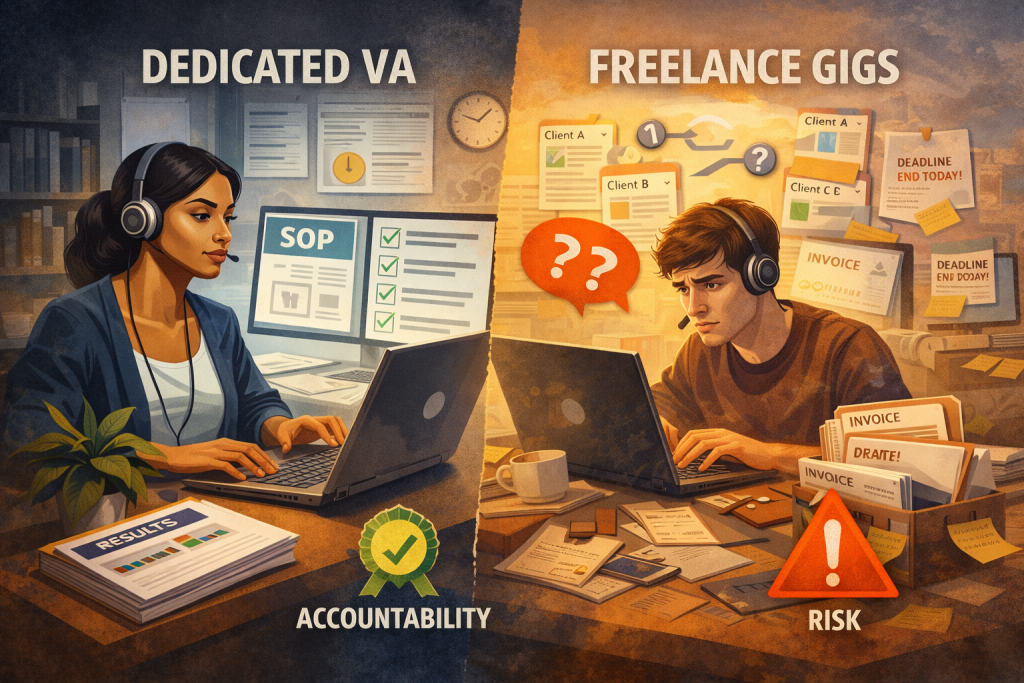
Dedicated VA versus freelance gigs and why many teams blame the wrong model
A freelance marketplace can produce great project results. The model often struggles with daily operational needs because freelancers juggle multiple clients and shifting timelines. That dynamic increases context loss, and context loss increases errors. Leaders then spend time re explaining, re checking, and re doing. At that point the cost shows up in management overhead, not in invoices.
A dedicated virtual assistant changes the relationship and the learning curve. The VA builds institutional knowledge, learns your preferences, and improves through repetition. Continuity reduces the context switching burden on leadership because the VA remembers how you run work. That structure looks more like remote staffing than freelance contracting. If your past outsourcing experience involved rotating contractors, treat that outcome as a verdict on the model, not a verdict on remote talent.
Unit economics and why quality protection drives profitability
Cost conversations often fixate on hourly rate, and that framing misses the bigger economic engine. Remote operations can reduce overhead and convert fixed costs into flexible capacity. That flexibility can improve unit economics because you align staffing to demand instead of paying for idle time. It also protects cash flow, which gives you runway to test marketing channels and improve onboarding. Leaders who chase “cheap labor” usually ignore the real prize, which involves operating leverage.
Retention makes the case even stronger. Harvard Business Review notes that acquiring a new customer can cost anywhere from five to 25 times more than retaining an existing one. Quality shows up in response speed, consistency, and follow through, not in where a person sits. A virtual assistant who closes loops faster and keeps promises intact can protect repeat revenue. If you want a grounded debate question, ask whether your model increases consistency for customers or increases variability.
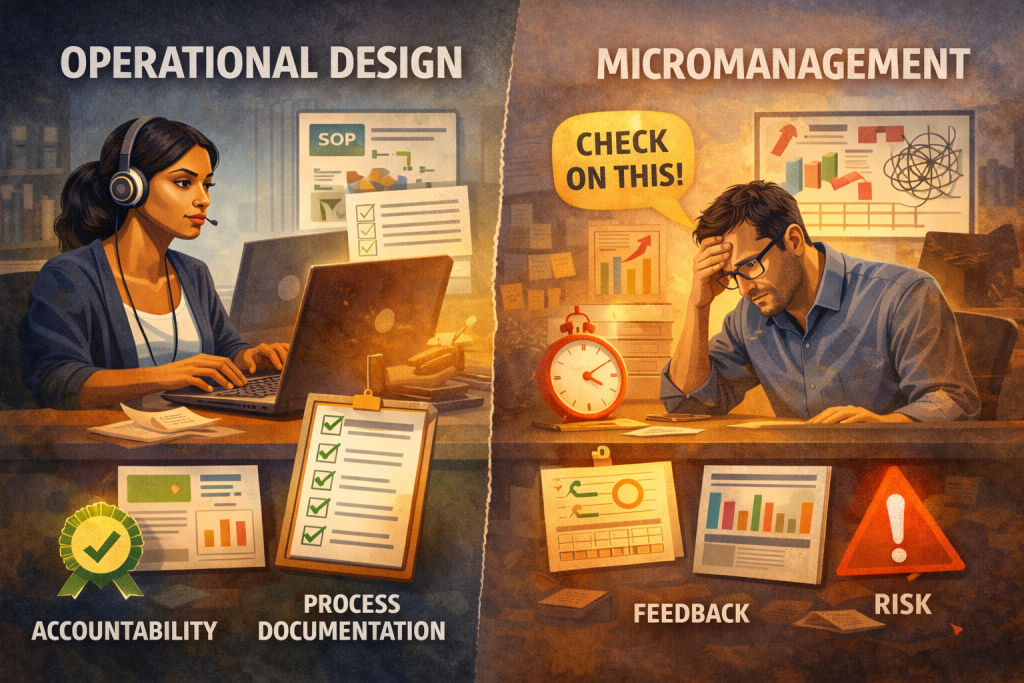
The operational design that protects quality without micromanagement
Quality does not require proximity. Quality requires definition, documentation, and review. Start with role clarity, because ambiguity creates most errors. Define outputs in measurable language such as inbox triage completed by a set time, follow ups sent within a set window, CRM updated daily, and weekly reporting delivered on schedule. That approach gives you a standard you can inspect.
Then build process documentation that people actually use. Keep SOPs short, add checklists, and include examples of correct and incorrect outputs. Use templates and screenshots so the VA can self check before delivery. Finally, run a weekly feedback loop that includes audits and coaching. You create quality when you review work consistently and improve the system instead of blaming the person.
AI and automation and how a VA can run hybrid workflows
Modern VA roles often involve supervising automation, not just doing manual admin. A VA can manage workflow automation, monitor triggers, and handle exceptions that automation cannot resolve cleanly. This human in the loop approach matches how high performing organizations scale automation. McKinsey notes that successful organizations adopt human in the loop solutions to scale automation programs.
In practice, the VA can run structured prompt workflows, maintain a knowledge base, and update SOPs based on real exceptions. The VA can draft first pass customer responses, summarize tickets, and route edge cases to the right owner. Automation moves fast, but humans keep judgment and brand tone aligned. When you combine a dedicated VA with automation checkpoints, you increase speed without eroding standards.
Mitigating security risk requires least privilege access
Mitigating security risk requires a Least Privilege Access model. Proximity does not equal security, and office walls do not prevent credential misuse. Use role based permissions, separate accounts, and 2FA for every critical platform. Add a password manager, disable shared logins, and use audit logs where tools support them. These controls reduce risk because they limit blast radius and make behavior visible.
Security intersects with brand safety in customer facing work. Create a response library, a style guide, and escalation rules that define what the VA can handle alone. Require written summaries for sensitive cases so leadership can review patterns and tighten policy. Treat access design as part of operational excellence rather than a checkbox. Ask one question that matters, could one credential expose sensitive data, and did you design permissions to prevent that outcome.
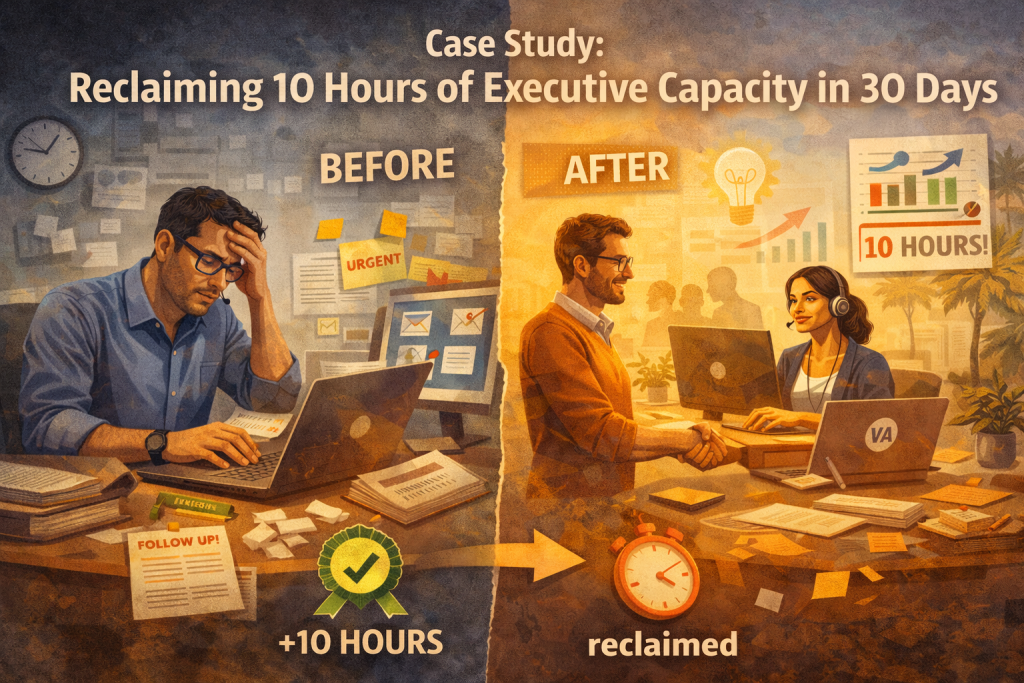
Case study reclaiming 10 hours of executive capacity in 30 days
Consider a service business where one leader carries sales, delivery, and client communication. The in house camp argues for direct hiring because client work demands tight accountability. The leverage camp argues for a dedicated VA because the business needs capacity now and cannot wait through a hiring cycle. The team assigns the VA four lanes, inbox triage, calendar scheduling, proposal formatting, and CRM hygiene. Leadership reviews a daily summary and keeps decision points inside the core team.
This structure creates measurable capacity within weeks. Two hours a day of reclaimed time equals ten hours a week, and those hours can move into sales enablement, retention calls, and process improvement. The VA improves performance because the lane stays stable and feedback stays consistent. This model protects quality because leadership audits outcomes weekly and updates SOPs when standards evolve. If you want a practical question here, ask how many deals you lost last quarter because nobody followed up on time.
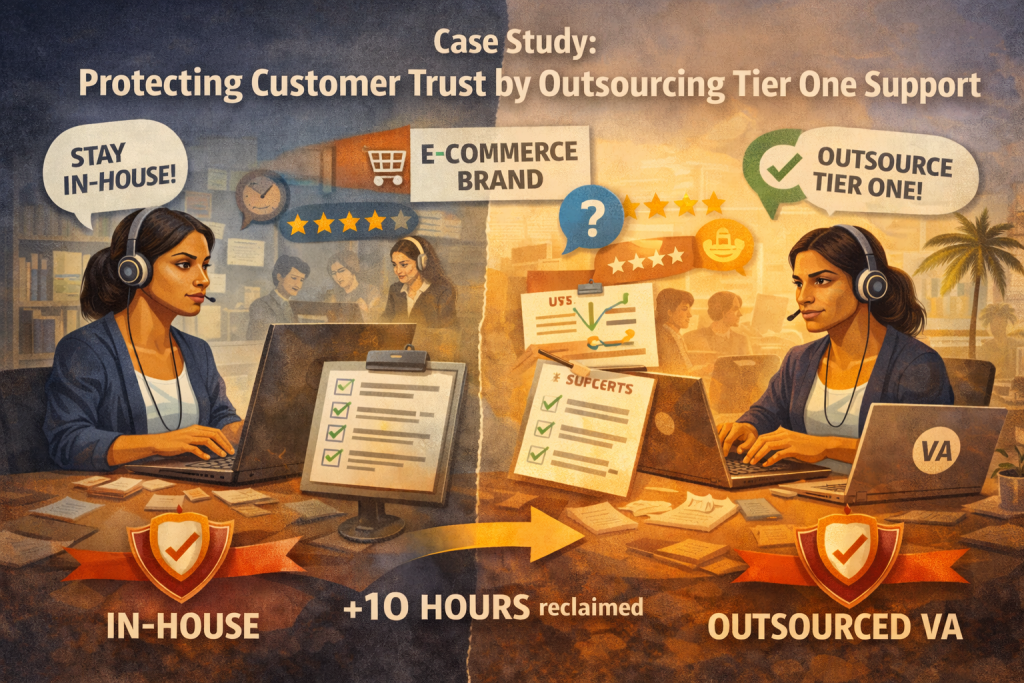
Case study protecting customer trust by outsourcing tier one support
Now consider an ecommerce brand where customer support influences repeat purchases. Skeptics argue that support must stay internal because tone and trust matter. Supporters argue that tier one support can run through scripts, tagged workflows, and escalation rules that protect brand voice. The brand hires a dedicated VA for first responses, order tracking, refund policy explanations, and ticket tagging. The internal team keeps escalations and public review responses.
This model protects quality because it standardizes predictable work. The VA uses a response library, follows escalation rules, and logs recurring issues so the team can fix root causes. Leadership audits a sample of conversations each week and updates scripts as policies change. Speed improves, and consistency improves at the same time. Ask a hard question, do you want your founder writing routine replies or improving the systems that reduce tickets in the first place.
Conclusion a decision framework that ends the debate
Outsourced with virtual assistant to scale without losing quality works when you treat it as operational design, not staffing optimism. The risk first camp protects the business when it demands quality control, security controls, and documented workflows. The leverage first camp protects the business when it fights for focus, speed, and overhead reduction that improves unit economics. Both camps lose when delegation stays vague and feedback stays inconsistent. Both camps win when leaders define outputs, document processes, and audit results weekly.
Use one final test to decide what to outsource first. If you can describe the work as a repeatable workflow with a definition of done, you can delegate it to a dedicated VA and protect quality through audits and feedback loops. If you cannot describe it yet, build the SOP and add basic automation triggers, then delegate the lane. This approach scales execution while keeping judgment and brand standards anchored in the core team.
How to manage time zone differences with an outsourced virtual assistant?
Time zone differences are managed by using partial overlap and asynchronous tools. Time zone management uses a 2–4 hour overlap for live syncs plus asynchronous tools like Loom for walkthroughs and Slack for updates. This model turns the time gap into an advantage by letting your VA complete “overnight” tasks so your inbox and task list are ready when your workday begins.
What is the difference between a virtual assistant (VA) and an online business manager (OBM)?
The difference is role scope and responsibility. A VA executes tasks using established SOPs, maintaining throughput and delivering work. An OBM manages operations, builds systems, and oversees project health, focusing on strategy and team coordination. Businesses commonly start with a VA to reclaim time and add an OBM when operational complexity demands dedicated management.
How to handle international payments and tax compliance for remote VAs?
International payments and tax compliance are handled through global payroll and compliance platforms. Use Employer of Record (EOR) services and tools like Deel, Rippling, or Wise to manage local labor law requirements, tax withholdings, currency conversion, and contracts. These platforms ensure compliance without the traditional administrative burden.
Is it possible to outsource roles that require high‑level brand voice and creativity?
Yes. Outsourcing high‑level brand voice and creative roles works with a detailed Style Guide and logic decision tree. Brand voice outsourcing uses a repository of brand language rules, sample content, and “never‑use” phrases so a VA can write first drafts or engage on social media while preserving brand alignment.
How to know when to move from a VA to a full‑time in‑house hire?
The move happens when role complexity and collaboration demand increase. Transition triggers include high‑touch collaboration (e.g., 6+ hours of daily team meetings) or critical intellectual property work that requires constant availability. A VA‑first approach lets the business define role requirements before incurring full‑time hire costs.
