

You can invest in “SEO” for months and still watch growth stall because you hired the wrong role first. One hire fixes what happens on your site, and the other hire earns credibility signals from other sites. When you sequence those roles correctly, you turn SEO from a string of tasks into a compounding system.
Most teams skip the diagnostic because they want a quick answer. You will get a better answer when you identify your bottleneck first. Ask yourself this: does Google struggle to crawl and understand your pages, or does Google understand you and still trust competitors more?
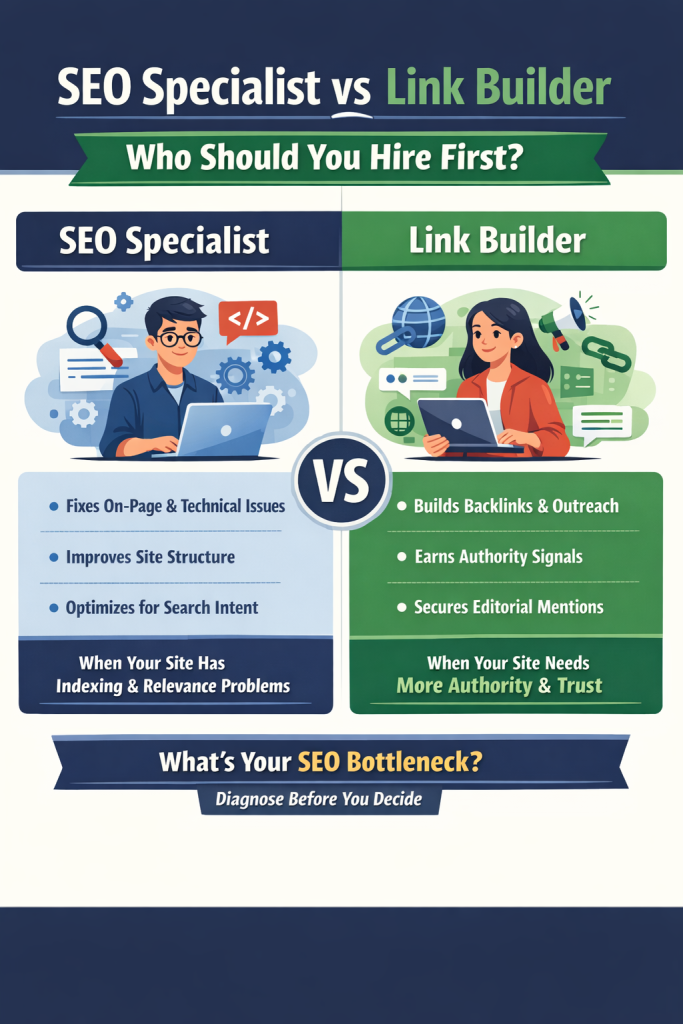
The decision rule that saves budget
Hire an SEO Specialist first when your foundation breaks. Hire a link builder first when your foundation holds and authority limits you. That rule works because Google needs two things to rank you: it needs to understand your relevance, and it needs to trust your credibility.
If your pages do not index reliably, link outreach cannot rescue you. If your site matches intent and you hover on the edge of page one, authority often blocks the final jump. When authority blocks you, you should hire a link builder.
Run this one-afternoon diagnostic before you decide
Start in Google Search Console and filter for non-branded queries. Look at query expansion, not just total clicks, because branded growth often hides weak SEO growth. Then check your position distribution: do you live in positions 6 to 15 for valuable queries, or do you barely appear at all?
Next, map search intent to pages. When multiple URLs target the same intent, you trigger ranking swaps, split signals, and create confusion for both users and crawlers. When one strong URL targets one clear intent and you still cannot outrank established sites, you likely face an authority gap.
Finally, ask a question most people avoid. If you doubled your backlinks tomorrow, would the page convert, or would it frustrate users because the offer, content, and UX do not answer the query? That answer tells you whether you should fix the site first or build authority first.
Comparison table for quick clarity
| Feature | SEO Specialist | Link Builder |
|---|---|---|
| Primary focus | On-page SEO, technical SEO, site structure | Off-page SEO, authority, digital PR |
| Main goal | Improve crawlability, intent match, structural relevance | Increase trust, credibility, editorial references |
| Typical outputs | Technical fixes, content alignment, internal authority flow | Placements, mentions, contextual links, link monitoring |
| Best first hire when | Indexing feels unstable or rankings swing | You sit on page 2 or low page 1 despite strong pages |
| Core metrics | Index stability, page group visibility, intent coverage | Placement quality, topical fit, link persistence |
What an SEO Specialist changes that links cannot
An SEO Specialist improves the parts of SEO you control completely. They fix crawl waste (Google spending time on useless pages) and canonical conflicts (Google not knowing which URL counts as the “real” one). They also align titles, headings, and content to the search intent so the right page answers the right query.
They also design your information architecture. They decide which pages deserve prominence, how your site hierarchy should flow, and how internal authority distribution should push value into the pages that monetize. If your structure leaks relevance, even great links will spread across the wrong URLs and dilute impact.
Example: why “SEO first” often wins
Imagine a service business with strong testimonials and good case studies, but it publishes city pages that reuse the same template with minor edits. Those pages cannibalize each other, and Google swaps rankings between them week to week. The blog posts also sit three clicks deep, so neither users nor crawlers discover them easily.
In that situation, a link builder can earn placements, but the site will struggle to translate authority into stable leads. An SEO Specialist can consolidate overlapping pages, tighten intent targeting, and rebuild the site hierarchy so relevance flows to the most important URLs. After that, outreach starts compounding instead of scattering.
What a Link Builder changes that on-page work cannot
A Link Builder earns third-party validation. They secure editorial mentions, citations, and contextual links that place your brand inside the web’s reference graph. Those references matter most when competitors publish similar content and compete on credibility.
Backlinko’s large-scale analysis reports that the #1 result averages about 3.8 times more backlinks than results in positions #2 to #10. You should not treat that stat as “build links at any cost,” but you should treat it as evidence that off-page authority still correlates strongly with top rankings. When competitors accumulate more editorial references, they often win even with comparable pages.
Example: why “Link Builder first” sometimes wins
Picture a SaaS company that nails intent. It publishes strong comparison pages, builds fast templates, and routes users from educational content into product pages with clean site structure. Search Console shows impressions for high-intent non-branded queries, but the site sits in positions 7 to 12 month after month.
That pattern usually signals that Google understands relevance but hesitates to grant top placement. Competitors often hold stronger authority through years of citations and mentions. A link builder can close that gap by earning contextual placements that persist.
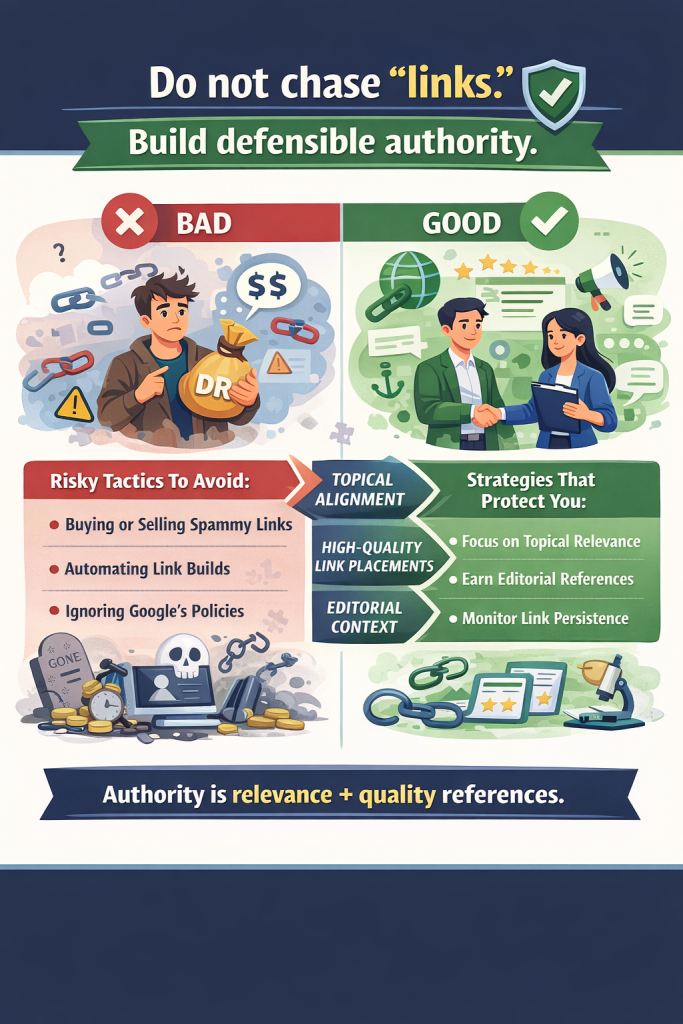
Do not chase “links.” Build defensible authority.
A link builder should protect your domain as much as they grow it. Google’s spam policies explicitly call out link spam, including buying or selling links for ranking purposes and using automated programs to create links. When someone sells you a “guaranteed DR link package,” they usually sell you risk and volatility.
Ask a practical question: do you want growth you can defend, or do you want growth that disappears after a policy update? Google also enforces policies around reputation abuse and other spam patterns, so you should treat compliance as a performance lever, not a legal footnote. A good Link Builder focuses on topical fit, editorial context, natural anchors, and steady pacing.
How you should think about authority
Authority does not mean “more backlinks.” Authority means other relevant sources reference your site in ways that make sense to real readers. That is why editorial context matters, and that is why topical alignment beats raw metrics.
Ahrefs has also argued that links matter less than they used to overall, but links still matter, especially in competitive spaces where multiple pages look equally relevant. That nuance helps you hire properly. If you lack relevance, fix the site. If you already have relevance, build authority.
Performance and accountability (what to measure and what to ask)
Most businesses lose money because they measure the wrong thing. They accept “tasks completed” instead of “visibility gained,” and they accept “links built” instead of “authority strengthened.” You can fix that with a short accountability model for each role.
For an SEO Specialist, ask them to show how they track index stability, page group visibility, and intent coverage over time. Ask how they prevent cannibalization, and ask how they design internal authority flow so commercial pages benefit from informational content. When they answer, they should name specific Search Console checks and explain why they matter.
For a link Bbuilder, ask them how they qualify opportunities beyond DR or DA. Ask how they manage anchor text risk, how they pace acquisition, and how they verify placement context and attributes. Then ask the question most teams forget: “How do you monitor link persistence and handle link decay?”
Link monitoring matters more than people admit
Many teams treat link building as a one-time transaction. Links disappear, pages redirect, and sites change attributes, so that mindset leaks value. You should treat link building like asset management, not like shopping.
Ahrefs reports that at least 66.5% of links to sampled sites over the last nine years became dead. That stat makes a strong point: if you do not monitor links, you will lose a large portion of what you earn over time. A Link Builder who tracks persistence and runs reclamation protects the compounding effect.
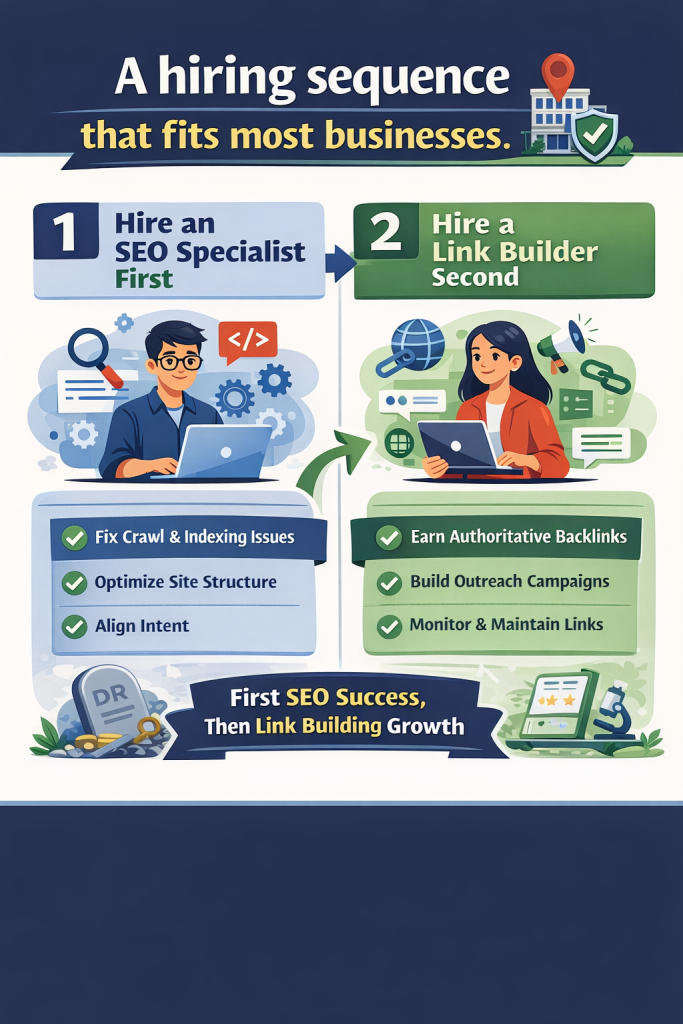
A hiring sequence that fits most businesses
Most businesses win with a staged approach. First, hire an SEO Specialist to clean the foundation, align intent, and build a clear site hierarchy that routes relevance into your money pages. Second, hire a link builder to earn external validation that helps those pages compete against stronger brands.
Budget constraints sometimes force a single hire. Use your diagnostic to pick the bottleneck, not your intuition. If Search Console shows indexing instability and weak intent mapping, hire the SEO Specialist first. If Search Console shows strong impressions and stable relevance but weak positions, hire the link builder first.
The bottom line
- Hire an SEO specialist first when Google struggles to crawl, index, or interpret your site, or when your structure leaks relevance.
- Hire a link builder first when your pages match intent and competitors beat you on authority and editorial references.
- When authority blocks you, hire a link builder and treat outreach like asset management with monitoring and reclamation.
