

At $5 per hour, a virtual assistant for dentist roles looks like a shortcut to lean operations. But dental billing does not reward low prices. It rewards precision, compliance, and consistency. In high-stakes Dental Revenue Cycle Management (RCM), a low price often creates a hidden Supervision Tax. You are not just buying labor. You are assuming risk. Your revenue, compliance, and patient trust sit on the line.

The Real Problem: Operational Drag
Dental practices do not fail because of poor dentistry. They stall because of operational drag.
Insurance verification piles up. Claims sit unsubmitted. Recall lists grow longer. Front-desk staff juggle five roles at once.
According to the American Dental Association, administrative inefficiency ranks among the top causes of delayed reimbursement. The Medical Group Management Association reports denial rates in healthcare often range between 5% and 10%. Even a small denial rate disrupts cash flow.
This is not a staffing issue. It is a systems issue.
A structured virtual assistant for dentist operations solves the system problem first.
From “Assistant” to Remote Revenue Engine
Most dentists think of a VA as a helper. That mindset limits growth.
A modern practice needs defined remote roles:
- Virtual Insurance Coordinator
- Remote Patient Care Coordinator
- Dental RCM Specialist
- Recall and Reactivation Manager
These are not gig roles. These are structured functions inside your practice engine.
When a trained remote professional manages insurance verification, CDT coding checks, and claim submission inside your cloud-based PMS, your in-office team gains focus. Clinical staff serve patients. Remote staff manage structured workflows.
IBM states, “Organizations that redesign work around specialization increase productivity and reduce error rates.” Dental practices follow the same rule.
The Supervision Cost: The Math Behind “Low-Cost”
Cheap support feels efficient. Until you calculate it.
If your assistant completes a one-hour insurance verification task incorrectly and you spend 30 minutes correcting it, the math changes fast. If your production value equals $400 per hour, that correction costs $200 in opportunity.
The task no longer costs $5. It costs $205.
Stanford research on remote work performance shows that productivity rises when structure and accountability exist. It drops when supervision replaces systems.
Low-cost hiring often creates what consultants call “Management Debt.” You spend evenings fixing errors instead of leading growth.
High-ROI staffing removes that debt.
Dental RCM: Where Growth Actually Happens
Dental Revenue Cycle Management drives cash flow. It includes:
- Insurance verification
- Current Dental Terminology (CDT) code accuracy
- Claim submission
- Accounts receivable follow-up
- Coordination of benefits
A virtual assistant for dentist RCM tasks protects this chain.
For example, a Remote Insurance Coordinator verifies benefits 48 hours before treatment. They review annual maximums, waiting periods, and exclusions. They confirm coverage inside Dentrix, Open Dental, or Eaglesoft.
If they detect a non-covered procedure, they flag it early. Your front desk collects payment upfront. You avoid surprise bills. Patients trust your transparency.
The U.S. Department of Health and Human Services reports that billing inaccuracies remain a primary cause of reimbursement delay. Precision in RCM is not optional. It is strategic.
Compliance Is a Growth Strategy
Dentists handle Protected Health Information under HIPAA. Data security is not a side concern. It is central to trust.
Low-cost freelancers often work from unsecured networks. They use personal laptops. They lack encrypted systems.
A professional virtual assistant for dentist operations must operate under:
- Encrypted communication tools
- Secure password vault systems
- Business Associate Agreements
- Cloud-based PMS with controlled permissions
- EHR (Electronic Health Record) compliance standards
Patients expect privacy. A single breach damages reputation faster than any marketing campaign can repair.
Security is not overhead. It is brand protection.
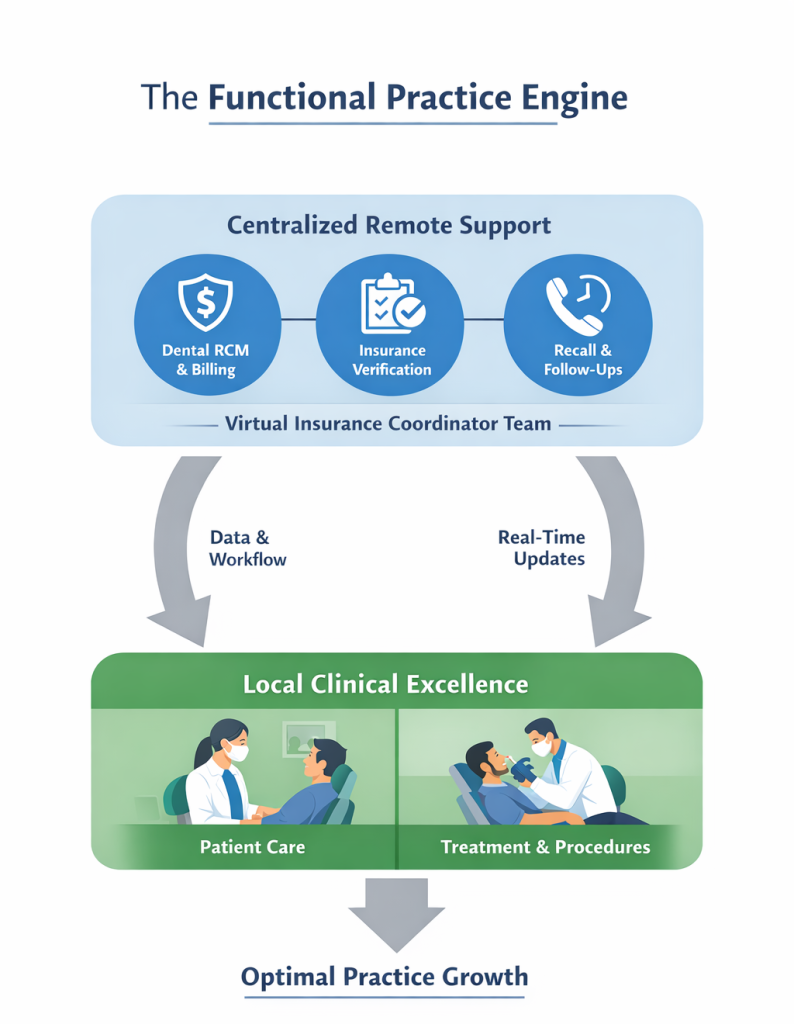
The Functional Practice Engine
Scaling requires structure.
Below is a simplified view of the “Functional Practice Engine.”
Centralized Remote Support
- Insurance Verification
- Dental RCM
- Recall and Reactivation
- Claims & AR
Local Clinical Excellence
- Patient Care
- Treatment Planning
- Case Acceptance
- Chairside Service
Remote systems feed clinical excellence. Clinical excellence generates revenue. Structured admin protects it.
This model allows a practice to increase patient volume without expanding physical space.
Why Aristo Sourcing Aligns with High-Performance Dentistry
Not all remote staffing models work. Process alone does not solve turnover.
Aristo Sourcing applies a management-first philosophy. The company vets candidates using structured assessments, including Big Five personality profiling, to match detail-oriented professionals with billing-heavy roles.
Dental billing requires conscientiousness, consistency, and focus. Personality alignment matters.
Aristo maintains a 93% retention rate. This stability eliminates the “Hire–Train–Quit” cycle that drains practice energy.
You do not just receive a worker. You gain a supported professional embedded in a managed system.
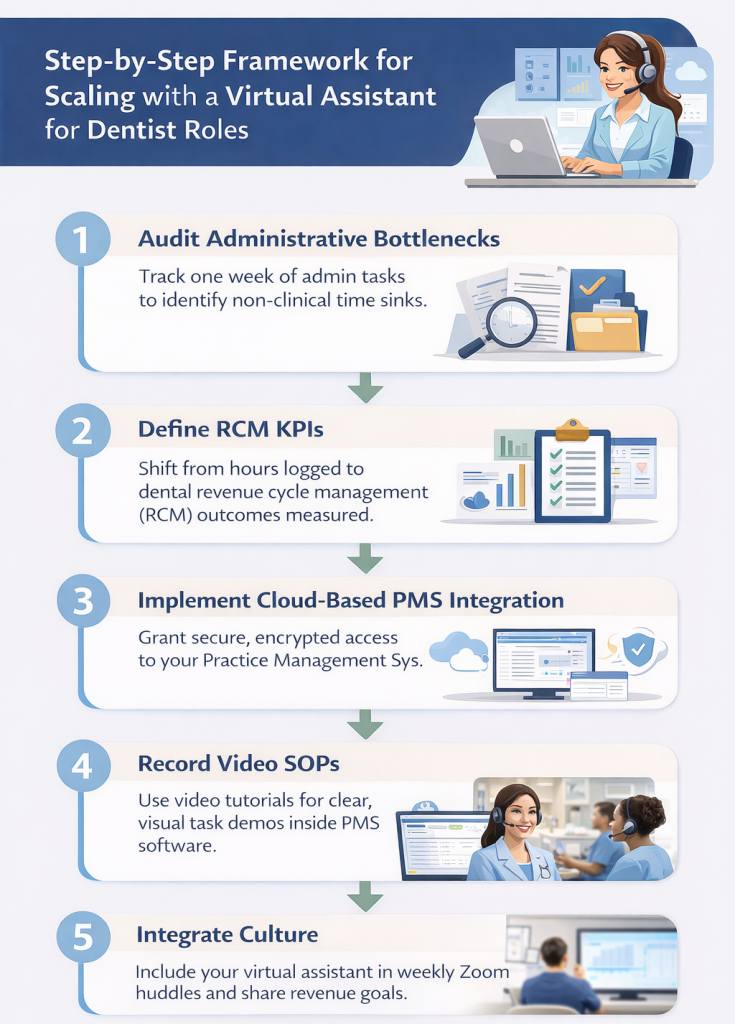
Step-by-Step Framework for Scaling with a Virtual Assistant for Dentist Roles
1. Audit Administrative Bottlenecks
Track one week of non-clinical tasks. Measure time spent on verification, claims, recall calls, and AR follow-ups.
Clarity drives delegation.
2. Define RCM KPIs
Shift from hours logged to outcomes measured:
- 100% insurance verification 48 hours prior
- Claims submitted within 24 hours
- AR over 60 days reduced monthly
- Reactivation calls completed weekly
Measurement creates accountability.
3. Implement Cloud-Based PMS Integration
Grant access through controlled, encrypted remote desktop systems. Use password vault software. Never share credentials through chat.
Structure protects compliance.
4. Record Video SOPs
Use Loom to document workflows. Keep videos concise. Show real examples inside your PMS.
Video reduces training friction.
5. Integrate Culture
Include remote coordinators in weekly Zoom huddles. Share revenue targets. Celebrate wins.
Gallup research shows engaged teams outperform disengaged teams by over 20% in productivity.
Engagement increases retention. Retention increases stability.
Real Practice Case Studies
Multi-Location Consistency
A three-location practice struggled with inconsistent RCM. Each office verified insurance differently. Denial rates varied. Cash flow fluctuated.
They hired a Virtual Insurance Coordinator through Aristo Sourcing. The coordinator centralized Dental RCM inside a shared cloud-based PMS.
Denied claims dropped by 22% within 90 days. The group added a fourth location without increasing in-house admin payroll.
Systems scaled. Overhead did not.
Reactivating Dormant Treatment
A solo practice had $400,000 in unscheduled treatment plans. The in-office team lacked time to follow up.
A Remote Patient Care Coordinator called patients systematically. They used structured scripts. They documented outcomes.
Within one month, the practice scheduled $15,000 in previously dormant treatment. The remote support cost remained a fraction of the recovered revenue.
Focus generates growth.
Common Strategic Mistakes
Hiring for price instead of performance.
Low cost does not equal low risk.
Ignoring Dental RCM metrics.
Without KPIs, you pay for activity, not output.
Failing to secure compliance.
A single HIPAA issue can erase years of goodwill.
Treating remote staff as temporary.
Turnover kills momentum.
High-performance dentistry requires high-performance support.
Can a Virtual Assistant Work in Your PMS?
Yes.
Experienced remote dental professionals operate inside:
- Dentrix
- Open Dental
- Eaglesoft
- Other cloud-based PMS systems
They connect via secure remote protocols. Patients hear them through VoIP systems like RingCentral or Weave. The experience feels seamless.
The workflow remains secure.
The Strategic Shift
Peter Drucker said, “Efficiency is doing things right. Effectiveness is doing the right things.”
Dentists should focus on diagnosis, treatment planning, and patient care. Remote RCM specialists should focus on claims, verification, and AR follow-up.
This division of labor increases productivity. It reduces burnout. It improves cash flow.
Scaling a practice does not require more chairs. It requires better systems.
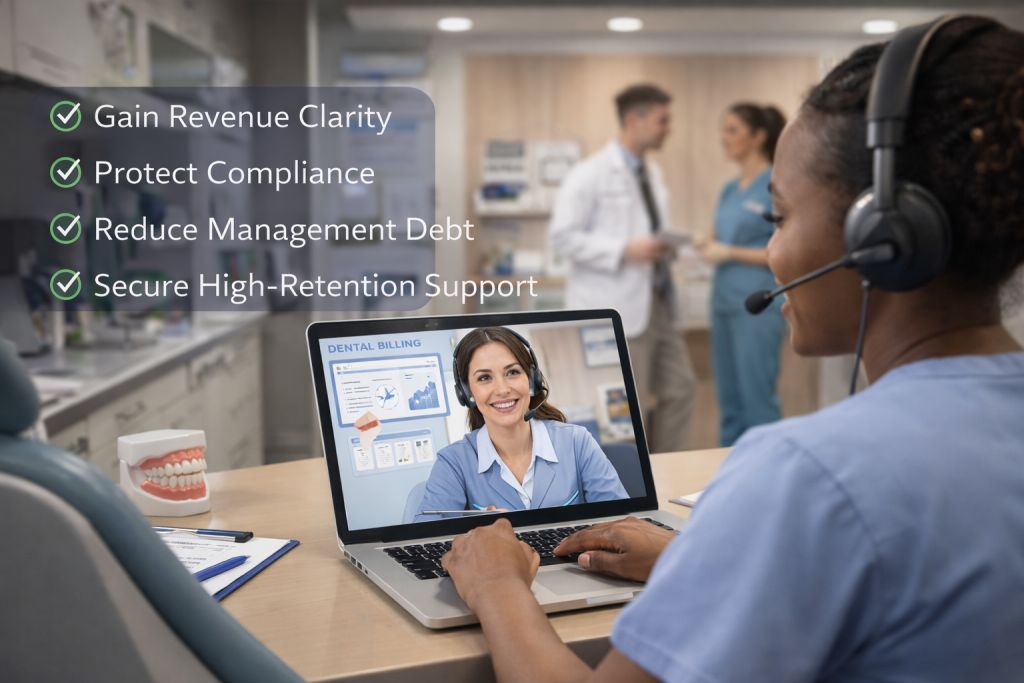
Final Step: Build a High-ROI Support Structure
A virtual assistant for dentist operations should increase revenue clarity. They should protect compliance. They should reduce management debt.
Move beyond price-point thinking. Focus on performance and retention.
If you want to scale without expanding overhead, build a structured remote support system. Visit Aristo Sourcing to book a free consultation and discover how vetted, high-retention professionals can strengthen your Dental RCM and accelerate your growth.
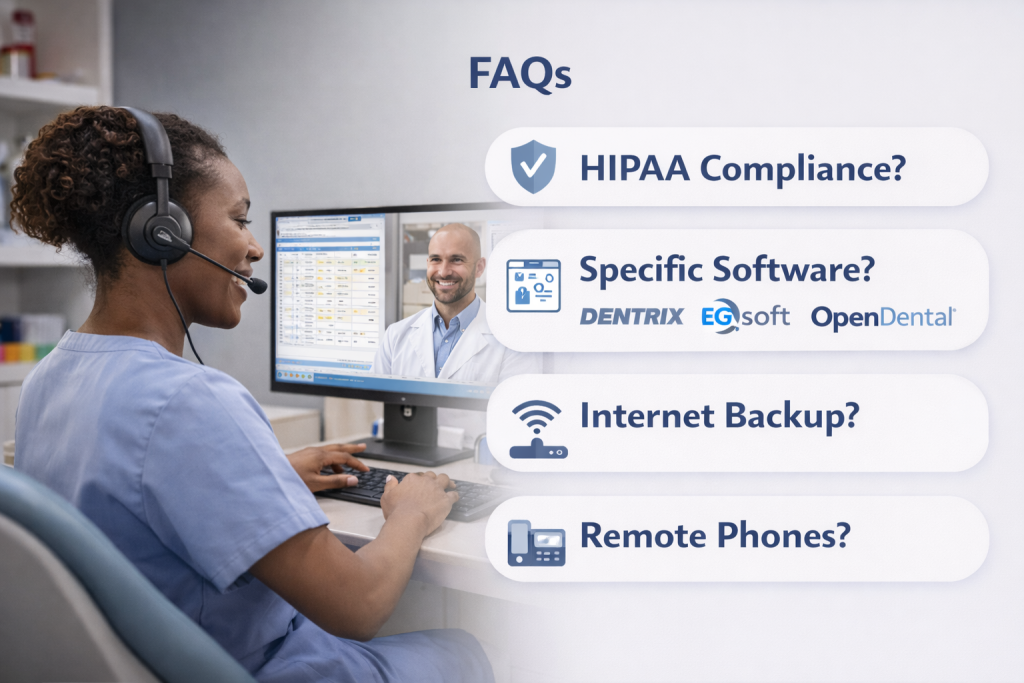
FAQs
How does a virtual assistant for dentist roles handle HIPAA-compliant file sharing?
Professional remote staff use end-to-end encrypted platforms and Business Associate Agreements (BAA). They avoid public email for Protected Health Information (PHI). Instead, they operate within your secure Cloud-based PMS or use encrypted portals like ShareFile or specialized dental communication apps to ensure every data transfer meets current HIPAA Security Rulestandards.
What is the difference between a general VA and a Dental RCM Specialist?
A general VA handles administrative tasks like email. A Dental RCM Specialist understands the lifecycle of a claim. They know the difference between a Prophylaxis (D1110) and Periodontal Maintenance (D4910). They monitor your First-Pass Resolution Rate (FPRR)and understand how to navigate Electronic Remittance Advice (ERA) to ensure payments post accurately to patient ledgers.
Can a remote assistant manage my dental supply procurement?
Yes. A trained virtual assistant for dentist operations can track inventory levels reported by the in-office team. They manage relationships with vendors (like Patterson or Henry Schein), compare “Price-per-Unit” across secondary suppliers, and ensure orders arrive “Just-in-Time” to minimize overhead and prevent “Stock-out” delays in the operatory.
How do virtual assistants integrate with VOIP systems like Weave or RingCentral?
Remote staff connect to your office’s VOIP (Voice over IP) system via a softphone application. This allows them to make and receive calls using your local office number. To the patient, the experience is seamless. The assistant can also manage two-way SMS for appointment reminders and “Quick-Fill” list texting directly through the software interface.
What is the “Management Debt” associated with hiring a solo freelancer?
Management Debt occurs when a business owner saves money on a low hourly rate but pays for it in “Cognitive Load.” If you have to recruit, vet, train, and provide IT support for a solo freelancer, you are acting as their manager, HR director, and Tech Support. Aristo Sourcing removes this debt by providing Managed Support, where the agency handles the operational overhead, leaving you to lead the clinical team.
How does a virtual assistant help with “credentialing” and “PPO fee schedule” updates?
Credentialing is a massive administrative burden. A specialized virtual assistant for dentist offices tracks expiration dates for licenses and insurance. They also manage the submission of updated fee schedules to PPO providers, ensuring the practice is always billing at the highest allowable contracted rate rather than outdated figures that leak revenue.
Can a virtual assistant help reduce “Insurance Aging” over 90 days?
Absolutely. While the in-office team focuses on the patients in the chair, the remote assistant systematically “works the aging report.” They call insurance adjusters to investigate “pended” claims, submit missing Supporting Documentation (like X-rays or narratives), and ensure that no claim falls past the Timely Filing Limit.
