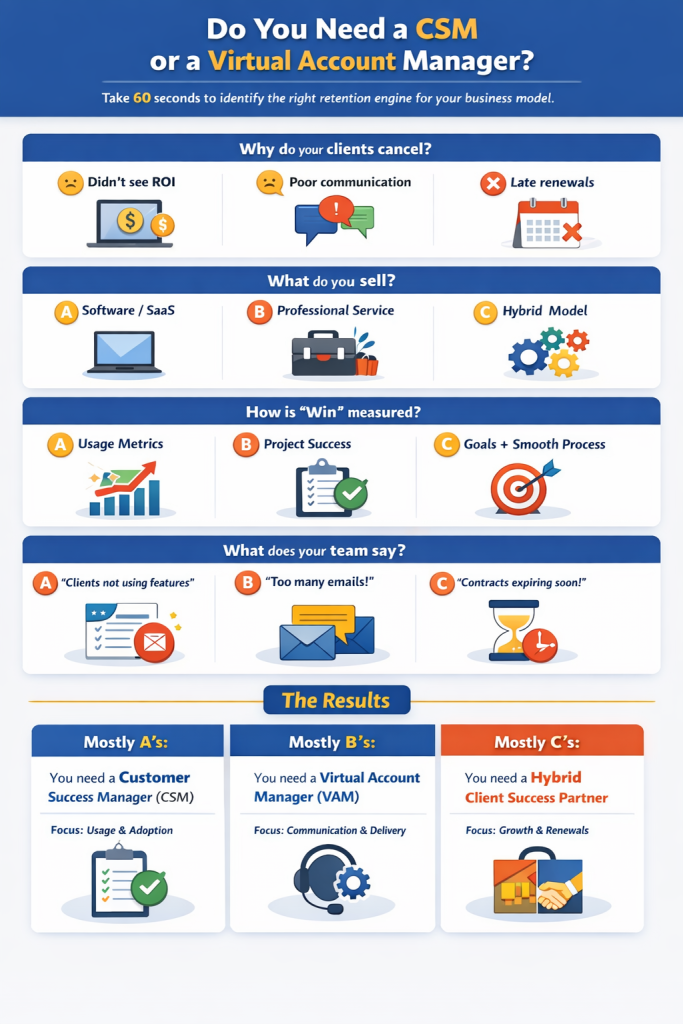
If you are comparing a Virtual Account Manager and a Customer Success Manager (CSM), you are usually trying to stop one expensive leak: churn. Harvard Business Review points out that acquiring a new customer can be five to 25 times more expensive than retaining one. That cost rarely shows up as one dramatic event, it shows up as revenue volatility, forecasting misses, and a sales team that has to “replace” lost customers before it can grow. The practical question is not “Which title is better?” but “Which role fixes the reason customers leave in my business?”
Retention is also measurable in ways executives care about. Bain’s research links a 5% increase in retention with profit improvements of 25% to 95%, depending on the business. Even if your company does not land at the top end of that range, the direction is consistent: retention compounds profit because service costs drop, trust increases, and expansions become easier. That is why role clarity between account management and customer success is an operating decision, not an HR debate.
Definitions (one clear distinction, no buzzwords)
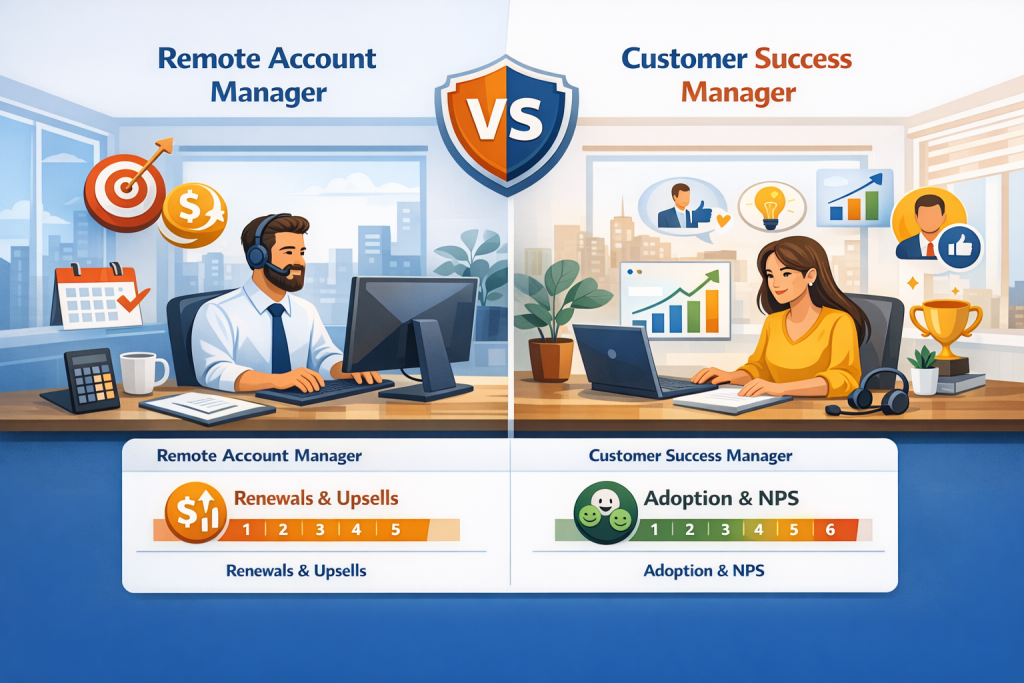
A Customer Success Manager (CSM) owns value realization. They help customers achieve outcomes through onboarding success, adoption milestones, enablement, and measurable progress tied to the customer’s goals. They are most effective when product usage and time-to-value predict renewals, which is why the role is so common in SaaS. When the customer stalls, the CSM’s job is to remove friction, prove value, and keep momentum.
A Virtual Account Manager is an account manager working remotely, often as a dedicated resource who owns the relationship rhythm and commercial continuity. They keep stakeholders aligned, protect expectations, coordinate escalations, and make sure the renewal timeline is not an afterthought. In agencies and professional services, they often control scope and change requests to protect margins while keeping clients confident.
Remote Account Manager vs Customer Success Manager: the ownership test that ends confusion
Stop debating titles and run this test instead. Ask, “Who owns revenue continuity, and who owns outcomes?” In many SaaS models, the CSM owns outcomes and strongly influences renewals by proving value and driving adoption. In many services and agency models, a remote account manager owns revenue continuity by managing expectations, scope, stakeholder alignment, and renewal execution.
This is not semantics, it is accountability. Customers do not experience your org chart, they experience your handoffs and your follow-through. When nobody owns the renewal timeline, renewals become a last-minute scramble and customers feel uncertainty. When nobody owns adoption and outcomes, customers pay but never get the “win” they expected, so churn becomes inevitable.
Account management is tied to RevOps, whether you admit it or not
Account management has become inseparable from Revenue Operations (RevOps) in modern go-to-market teams. RevOps is commonly defined as the function that aligns revenue-related activities across marketing, sales, customer success, and finance, using consistent processes and technology.
A strong virtual account manager supports RevOps alignment by keeping CRM fields accurate, enforcing lifecycle stages, and ensuring renewal forecasting reflects what is happening in real customer conversations. When the CRM is clean, leadership gets better forecasting, and customers get smoother handoffs because internal teams operate from the same reality.
This matters because retention is not only a relationship problem, it is also a data problem. If your pipeline and renewal dates are wrong, your team will communicate too late, resource too late, and negotiate under pressure. A remote account manager is often the person who prevents that slow-motion failure. The CSM can contribute, but the operating system is usually owned on the account side.
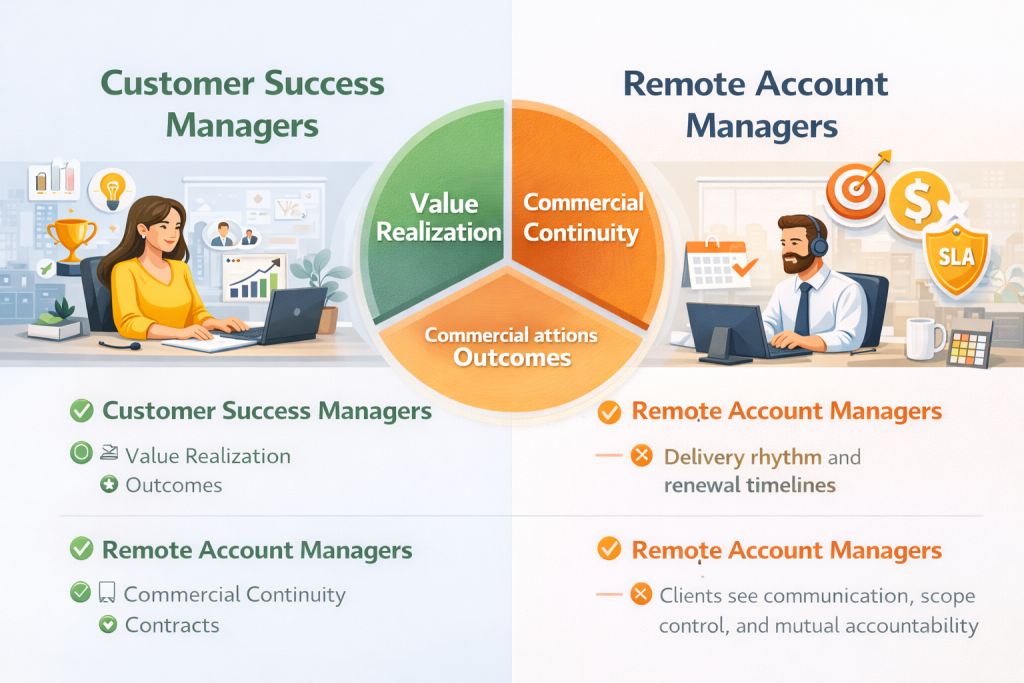
Comparison table: what each role optimizes (and what gets worse without it)
| Lens | Remote Account Manager / Outsourced Account Manager | Customer Success Manager (CSM) |
|---|---|---|
| Primary KPI | Gross retention, renewal execution, expansion readiness | Adoption, time-to-value, NPS/CSAT trends |
| Ownership | Stakeholder alignment, cadence, commercial continuity, contract timeline | Value realization, enablement, success plan, adoption milestones |
| Core output | Fewer surprises, clearer decisions, stable communication rhythm | Faster wins, measurable outcomes, deeper product usage |
| SLA management | Owns client SLAs, response-time expectations, escalation triggers | Supports SLAs by removing blockers and reducing recurring issues |
| RevOps connection | Improves CRM hygiene, renewal forecasting, lifecycle stages | Feeds usage signals, risk flags, and outcomes into the CRM |
| Human skills that matter | EQ, conflict resolution, expectation setting, de-escalation | Coaching, change management, stakeholder enablement |
The human skill line is not “nice to have.” Many renewals are won or lost in tense moments, like missed deadlines, scope disputes, or internal sponsor changes. A remote account manager often protects the relationship by handling conflict early and calmly. A CSM often protects the relationship by reducing frustration through faster value and better enablement.
Where the Remote Account Manager creates outsized value
A remote account manager creates the most value when your churn drivers are operational. Agencies and services businesses rarely lose clients because the team “did not care,” they lose clients because communication breaks, scope creeps, and delivery feels unpredictable. A strong outsourced account manager prevents silent churn by maintaining a consistent cadence, documenting decisions, and running escalation workflows before a problem becomes a crisis. This is the work that keeps clients calm even when projects are complex.
SLAs are one of the most underrated levers here. Customers feel safe when expectations are explicit, even if something goes wrong. A remote account manager manages SLAs like a system: response times, escalation paths, ownership, and reporting frequency are clearly defined and consistently delivered. This is also where professional services teams build reputation, because reliability is often more valuable than charm.
Here is a simple example. A marketing agency with 30 retainers can deliver strong work and still churn clients if updates arrive late, priorities change without explanation, or stakeholders feel ignored. A remote account manager fixes that by standardizing weekly updates, creating a decision log, and forcing clarity on deliverables and timelines. That structure looks “high-end” to clients because it reduces uncertainty, and uncertainty is what drives client anxiety.
Where the Customer Success Manager creates outsized value
A CSM creates the most value when adoption predicts retention. If customers churn because they never implemented properly, never trained their team, or never reached the first meaningful outcome, customer success is the lever. The CSM makes value visible by building success plans, tracking milestones, and enabling stakeholders so the customer actually changes behavior. That work is especially important in SaaS, where usage depth and time-to-value often correlate with renewal likelihood.
This is also where the economics get blunt. Many SaaS operators use a simple benchmark: an LTV to CAC ratio around 3.0x is often treated as healthy, while ratios below 1.0x can signal a business that struggles to monetize new customers efficiently. In practical terms, if it costs $10,000 to acquire a customer and lifetime value is only $10,000, your growth engine is fragile because you are buying revenue at break-even. A CSM improves LTV by increasing retention duration, improving expansion likelihood, and reducing churn drivers tied to poor onboarding and weak adoption.
A concrete example makes this obvious. If your average customer pays $1,000 per month and churns after six months, LTV is roughly $6,000 before gross margin adjustments. If a CSM program moves the average lifespan to 12 months, LTV doubles to $12,000, and your CAC efficiency improves without spending another cent on ads or outbound. That is not motivational language, it is basic unit economics, and it explains why SaaS teams treat customer success as a growth function.
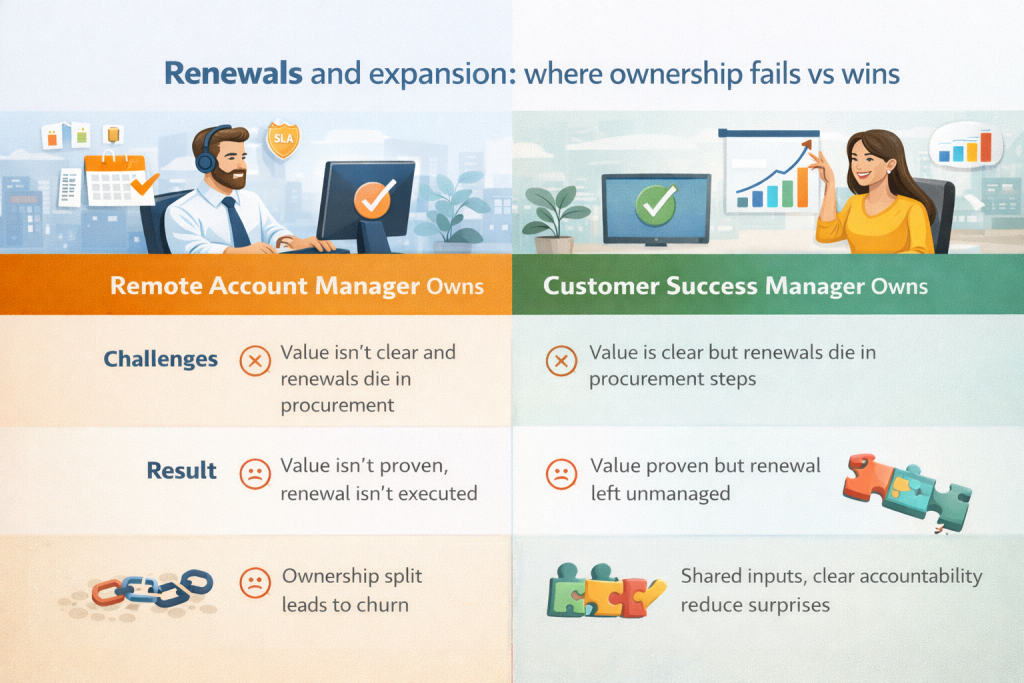
Renewals and expansion: where role design wins or loses money
Most churn does not happen because your team forgot to “care.” It happens because value is unclear, the renewal timeline starts too late, or procurement steps are unmanaged. Renewals sit at the intersection of outcomes and commercial execution, so splitting responsibilities without coordination is expensive. If customer success proves value but nobody runs the renewal clock, you still lose deals in procurement. If account management runs the renewal clock but value is not proven, you still lose to “we did not use it enough.”
A balanced model is not complicated, but it must be explicit. Let the CSM own adoption milestones, risk signals, and renewal readiness evidence. Let the remote account manager own stakeholder mapping, commercial terms, procurement steps, and the operational work that closes the renewal. Customers experience one coordinated story: “Here is what we achieved, here is what we will do next, and here is the renewal timeline.”
Outsourcing without chaos: strategy and tactics in one integrated model
Outsourcing succeeds for one strategic reason: it turns retention work into an operating system instead of a personality-dependent function. When retention depends on tribal knowledge, scaling is fragile because execution quality changes with each hire. When retention is run through playbooks and templates, quality becomes repeatable and measurable. That shift is what creates leverage, not the cost savings alone.
The tactical side is where most teams stumble, so treat it like implementation. Build a documented cadence (weekly update template, monthly scorecard, QBR agenda). Define ownership rules (who answers what, how escalations work, when leadership gets pulled in). Standardize the tech stack workflow (CRM fields required, renewal date hygiene, meeting notes location, customer health indicators). If you do those three things, outsourcing becomes less risky because the role executes a system, not guesswork.
A decision framework you can use in 10 minutes
Start with a direct diagnostic: Why do customers leave today? If they leave because outcomes are unclear, onboarding stalls, and adoption is shallow, prioritize customer success. If they leave because communication breaks, scope creeps, stakeholders feel unmanaged, and delivery feels chaotic, prioritize a remote account manager. If both are true, segment your accounts and tier the motion so you do not build one blended role that fails at both.
Next, ask a question that reveals reality: What do customers complain about most often? “We did not get value” points to success planning and enablement. “We did not know what was going on” points to cadence, stakeholder management, SLAs, and execution rhythm. The role that directly addresses the complaint is the role that will show ROI fastest.
Finally, check your operational readiness. Do you have playbooks, templates, and clear KPIs? If yes, outsourcing becomes safer and faster because you can train for execution. If no, fix the system first, because hiring cannot compensate for missing process.
Bottom line: you are choosing a retention mechanism, not a title
A Customer Success Manager improves retention by making value measurable through adoption, enablement, and outcome tracking. A Remote Account Manager improves retention by making the relationship stable through cadence, SLAs, stakeholder management, and renewal execution. Both can impact NRR, but they do it through different mechanisms, and confusing them creates hidden churn. If you match the role to your churn mechanics and reinforce it with RevOps alignment, you stop guessing and start building a predictable retention engine.