

For years, affiliate SEO was framed like a writing challenge: publish, rank, repeat. Then portfolio reality arrives quietly, because it shows up as a slow drip of small failures: a product that changed, a link that breaks, a comparison that’s no longer true.
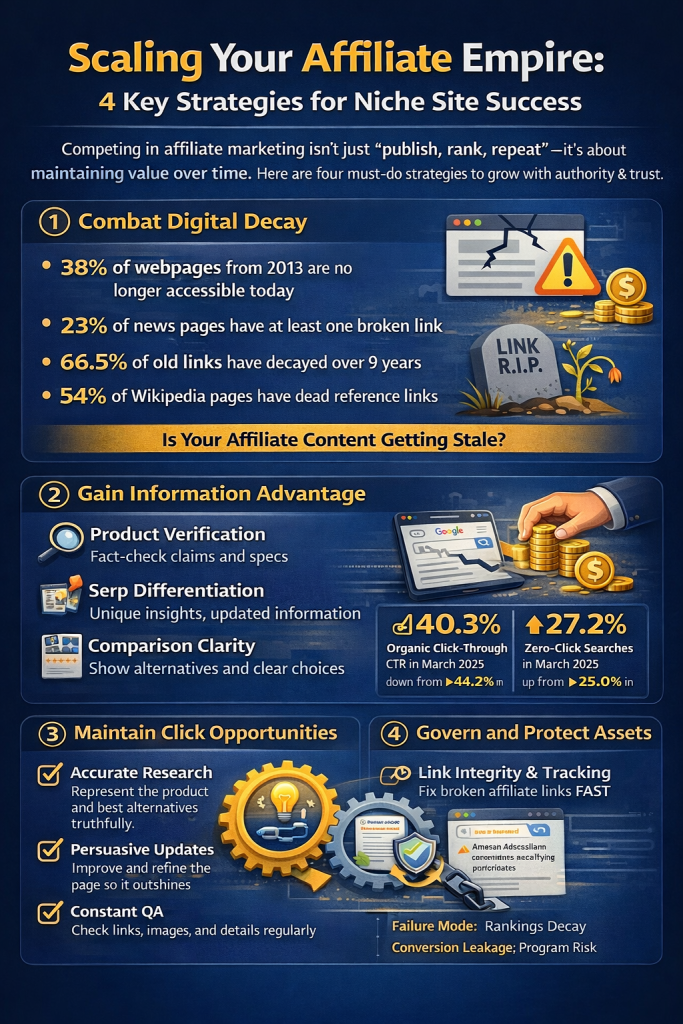
Pew Research put numbers to that “digital decay,” finding 38% of webpages that existed in 2013 were no longer accessible a decade later, and 23% of news webpages contained at least one broken link. If the open web degrades at that rate, your affiliate library is either actively maintained or it’s silently becoming less trustworthy. The sharper question is the one most site owners avoid: how many of your top pages are still ranking while quietly misleading the reader?

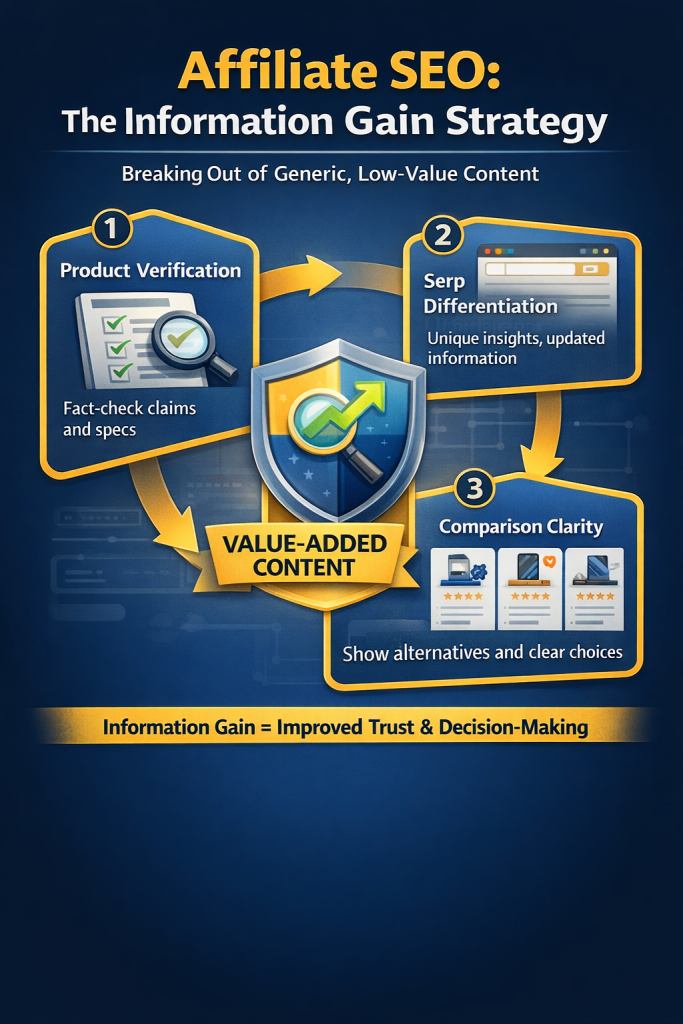
The “Information Gain” moat
Affiliate marketing is too big to tolerate generic publishing for long. EMARKETER reports that US affiliate marketing spending will exceed $12B in 2025, and it also says affiliate marketing will drive more than $210B in US ecommerce sales that year. When a channel moves that much commerce, competition hardens, and platforms get stricter, because low-quality content becomes an ecosystem tax.
Google’s March 2024 changes made that direction explicit, and Google later updated the outcome: you should see “45% less low-quality, unoriginal content” in search results after rollout. In this landscape, “more posts” isn’t a strategy; it’s a bet that your backlog won’t rot faster than you can publish.
Why position #1 is a revenue event
A ranking move is not a dashboard vanity metric in affiliate marketing; it’s a P&L line item. Backlinko’s CTR research reports the #1 organic result averages a 27.6% CTR, and the #1 result is 10x more likely to receive a click than the #10 result. That matters more now because the click itself is becoming scarcer.
Search Engine Land reported that only 40.3% of U.S. Google searches resulted in an organic click in March 2025, down from 44.2% the prior year, while zero-click searches rose to 27.2% in the U.S. If fewer searches produce a visit, your top pages must be maintained like your best salespeople: always accurate, always persuasive, never broken.
The SEO VA as an Entity Operator
In a scaled affiliate business, an SEO virtual assistant is not “a writer who can upload content.” They’re an Entity Operator: someone who manages relationships between content clusters, internal links, money pages, affiliate links, and disclosures, then proves the work with logs and measurable outputs. Their day lives inside a practical technical stack: Google Search Console (GSC) for query drift and decay, GA4 for engagement and conversion proxies, Screaming Frog for crawl-based QA, and Ahrefs/Semrush for competitive gap and link monitoring. The point is not to “sound technical,” it’s to remove uncertainty during volatility, because volatility always asks the same question: what changed, when did it change, and what did it affect? When your VA can answer that with a change log, scaling stops feeling like chaos.
The three engines of a scalable affiliate portfolio
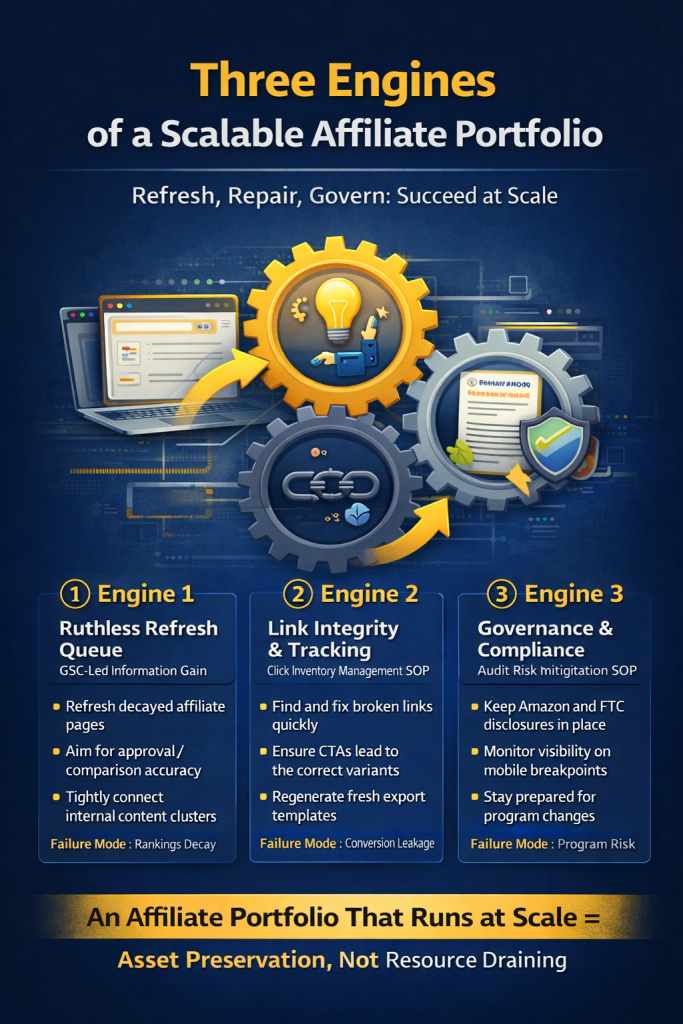
A niche site empire is not a pile of articles. It’s a repeatable operating model that preserves winners while creating new ones, with workflows that run weekly whether you feel motivated or not. In practice, that operating model has three engines: a ruthless refresh queue, link integrity and tracking, and governance for Amazon Associates and FTC disclosure requirements. Each engine targets a different failure mode: rankings decay, conversion leakage, and program risk. If any engine is missing, growth becomes fragile, because the web decays and the SERP is engineered to keep the user from clicking.

Engine 1: the ruthless refresh queue (GSC-led information gain)
Most affiliate sites don’t need 50 new posts first; they need their existing money pages to stop bleeding relevance. Ahrefs documented a republishing case where updating and republishing older content delivered a 302% traffic uplift, essentially tripling traffic after a structured refresh. That is the logic behind the refresh queue: you target URLs that already have demand, then add information gain that improves trust and decision-making.
The VA pulls GSC pages with declining clicks, rising impressions with falling CTR, or shifting queries, and then maps each page to the current intent behind those queries. A refresh is not “change the date,” it’s verification and upgrade: product specs, alternatives, comparison criteria, clearer “best for” logic, and tighter internal linking that makes the cluster feel complete.
Engine 1 SOP: how high-volume updates become routine
SOPs are the difference between one-off improvements and scalable operations. A strong GSC Refresh SOP starts with a weekly export of candidates, then a simple prioritization score that combines commercial value (is it a money page?), position range (pages sitting in striking distance), and decay signals (click drop, CTR collapse, query drift).
The VA then uses a consistent update checklist: validate product availability, confirm key claims, add missing comparisons, expand FAQs to match real questions, and improve scannability with tables or decision summaries that don’t waste words. After publishing, they log the changes, annotate the URL, and track outcomes over a defined window so performance is attributed to actions rather than vibes. This is how a portfolio scales without becoming a mess: repeatable inputs, repeatable process, repeatable reporting.
Engine 2: link integrity and link tracking (click inventory management)
In affiliate SEO, the click is your inventory, and broken pathways destroy inventory at the point of purchase intent. Ahrefs’ link rot research found at least 66.5% of links to sampled websites rotted over a nine-year period, and it also noted additional links showing temporary errors. Pew’s research adds another signal of how widespread this is, reporting that 54% of Wikipedia pages had at least one dead reference link, which shows decay happens even in heavily maintained environments. That means your affiliate site will experience link decay whether you notice it or not. The VA’s job is to notice it first, fix it fast, and prevent it from recurring with patterns and templates.
Engine 2 SOP: the crawl, fix, verify loop
A proper Link Inventory SOP is not a random broken-link plugin running in the background. It’s a weekly crawl (often via Screaming Frog) focused on money-page templates, outbound affiliate links, and internal linking depth, with explicit checks for 4xx errors, redirect chains, and wrong destinations that “work” but don’t convert.
The VA then verifies that top CTA buttons land on the correct product variant and that the page path makes sense for the user who is ready to buy, not just for a crawler. Fixes are applied in batches, and the VA re-crawls the affected sections to confirm the error count actually dropped. The deliverable is a short report: issues found, issues resolved, remaining risk, and which templates are responsible for most failures.
Engine 3: governance and multi-platform risk mitigation
Affiliate empires don’t only die from ranking loss. They also die from program violations and disclosure failures that get ignored until the day an account is restricted. Amazon Associates is unusually explicit, stating the Operating Agreement requires that the following statement “clearly and conspicuously” appear on your site: “As an Amazon Associate I earn from qualifying purchases.” Amazon also requires a pricing disclaimer when you show price or availability information, including: “Product prices and availability are accurate as of the date/time indicated and are subject to change.” The FTC frames disclosure around a simple truth-in-advertising principle and says, “That common-sense premise is at the heart” of its Endorsement Guides. When you scale, these aren’t legal footnotes; they’re operational requirements that must remain correct after every theme update, plugin change, or template tweak.
Governance SOP: keeping disclosures live under constant change
A strong Compliance Audit SOP is scheduled, logged, and template-based. The VA checks that Amazon’s Associate statement is present where required, that pricing disclaimers are used when pricing is displayed, and that disclosures are visible on mobile, where most affiliate consumption happens. FTC staff guidance on online disclosures emphasizes that necessary disclosures must be “clear and conspicuous” regardless of device, and it even notes that if a disclosure is too small to read on mobile, it’s not adequate. The VA should test disclosure placement on real breakpoints, not just desktop previews, because layout changes can “technically” keep a disclosure while functionally hiding it. Governance is what keeps revenue durable: your portfolio grows, but your risk doesn’t.
The KPI layer: how you know the empire is compounding
If you can’t measure the work, you can’t scale the work. A best-in-class SEO VA dashboard focuses on leading indicators: refresh velocity (pages updated per week), recovery rate (how many refreshed URLs regain clicks/CTR), link integrity (broken link rate and redirect-chain count), and governance coverage (disclosure correctness across templates). It also includes change logs that tie outcomes to actions, which is how you avoid superstition when rankings move. Google’s own guidance says its systems prioritize content “created to benefit people,” which is exactly what high-frequency refresh and verification work supports. This is what “maintaining an empire” looks like in practice: fewer surprises, faster fixes, and compounding improvement on your best assets.
The hiring filter: hire an operator, not a task-taker
Don’t hire an SEO VA because they say they can “do SEO.” Hire them because they can run SOPs, produce artifacts, and protect revenue pathways without constant supervision. Ask operational questions that expose systems thinking: “How do you pick the first 10 pages to refresh using GSC data?” and “What’s your weekly process for detecting monetization leakage from broken paths before revenue reports show it?” Then ask a governance question framed as risk mitigation, not as a repeat of “Amazon compliance”: “What’s your template-level audit process after a theme update to ensure disclosures remain clear on mobile?” If they can’t describe tools, cadence, outputs, and logging, they’re not an operator, and a portfolio needs operators.
Conclusion: The empire is maintained, not created
Scaling a niche site empire is the practice of reducing entropy. The web decays, clicks get rationed, and platforms reward information gain while punishing generic content. The sites that survive treat content like an asset portfolio: audited, refreshed, link-verified, and governed with SOPs. If you stopped publishing today, would your site still improve over the next 60 days because your refresh queue, link inventory, and governance audits are running weekly? With an SEO VA operating these three engines, the answer becomes yes, by design, not yes by hope.
