

When companies begin exploring global outsourcing, two countries consistently appear on the shortlist: South Africa and the Philippines.
Both have built strong reputations for delivering skilled remote professionals at a significantly lower cost than hiring locally in North America or Europe. For many businesses, outsourcing to either destination can reduce staffing costs by 50–70% while maintaining high professional standards.
Yet the two outsourcing ecosystems developed in very different ways.
The Philippines has become one of the largest outsourcing industries in the world, with millions of professionals working in call centers, back-office operations, and administrative services.
South Africa has emerged more recently as a high-skill outsourcing hub, attracting companies that prioritize strong communication, Western business alignment, and professionals capable of handling complex operational roles.
Choosing between the two is rarely about which country is “better.”
The real question is which environment best supports how your business operates.
Understanding the differences between these two talent markets can help companies build remote teams that deliver long-term value rather than short-term savings.
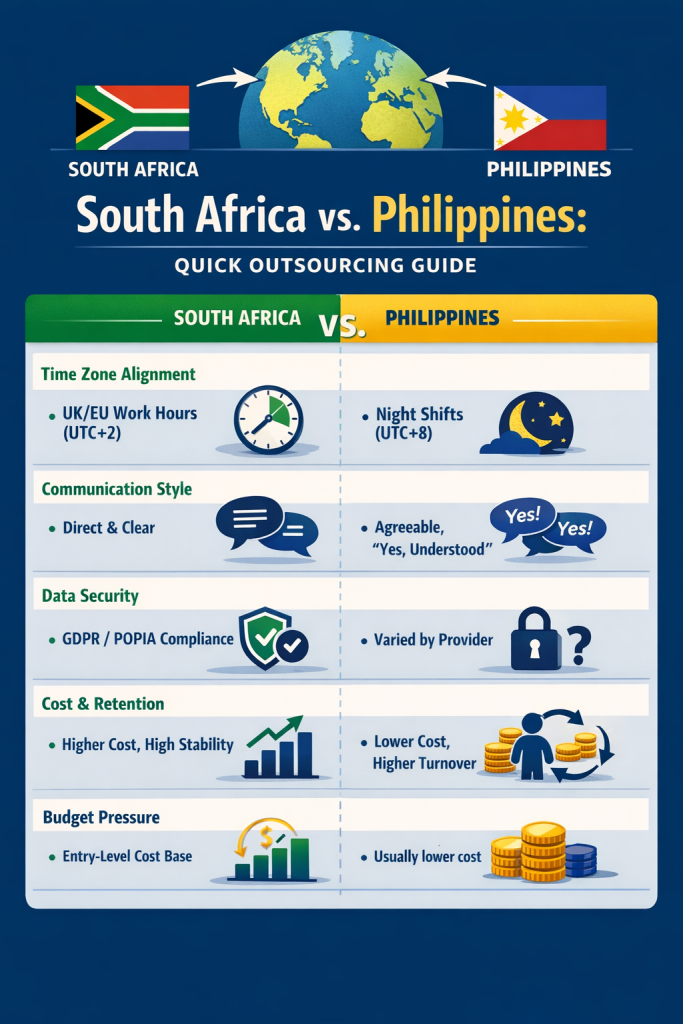
South Africa vs Philippines: Quick Comparison
| Factor | South Africa | Philippines |
|---|---|---|
| English proficiency | Native-level English widely used in business | Very strong English proficiency |
| Accent neutrality | Often closer to UK/European accents | Mild regional accent |
| Time zone alignment | Overlaps with UK and Europe | Optimized for US overnight operations |
| Cost savings | Typically 50–70% vs local hiring | Typically 50–70% vs local hiring |
| Talent strengths | Marketing, finance, operations, customer success | Customer service, admin, back-office |
| Industry maturity | Rapidly expanding outsourcing sector | One of the largest BPO industries globally |
These structural differences become clearer when examining cost structures, talent development, and operational alignment.
Cost Comparison: Looking Beyond Salary
Most outsourcing conversations start with salary comparisons. However, experienced companies evaluate outsourcing through a broader lens: total operational efficiency.
While salaries in both South Africa and the Philippines remain significantly lower than Western markets, the real financial impact often comes from productivity, management overhead, and retention.
As Harvard Business Review notes:
“The true cost of hiring is not salary alone, but the systems required to support productivity and retention.”
For example, many companies find that strong communication and autonomy reduce the number of hours managers spend supervising remote teams.
Typical salary ranges for 2026 include:
| Role | South Africa | Philippines |
|---|---|---|
| Virtual Assistant | $900 – $1,500 | $600 – $1,200 |
| Customer Support | $1,000 – $1,800 | $800 – $1,400 |
| Marketing Specialist | $1,800 – $3,000 | $1,200 – $2,200 |
| Finance / Bookkeeping | $1,500 – $2,800 | $1,000 – $2,000 |
However, companies should also evaluate Total Cost of Ownership (TCO), which includes:
• Employer-of-Record (EOR) service fees
• Equipment and software licensing
• Training and onboarding time
• Management oversight
• Employee retention and replacement costs
A remote professional who requires less supervision and stays with a company longer often generates greater long-term value than a lower-salary alternative with higher turnover.

Talent Pool and Education
Another key difference lies in the educational structure of the workforce.
South Africa produces a large number of university graduates across disciplines such as business administration, finance, marketing, and information technology. Many professionals enter the workforce with formal training aligned with international business environments.
This educational pipeline has helped South Africa build a growing reputation for roles requiring analytical thinking, project coordination, and client interaction.
A report from BPESA (Business Process Enabling South Africa) highlights this advantage:
“South Africa’s BPO workforce combines strong communication skills with professional training, making it well suited for knowledge-based services.”
The Philippines also has an impressive talent pool, particularly in service-oriented sectors. Decades of investment in the outsourcing industry have created a workforce experienced in customer support, administrative operations, and large-scale service delivery.
Where the two markets diverge is in the types of roles each country tends to specialize in.lains why these hidden costs show up differently in each country.
Communication and Cultural Compatibility
Communication quality often determines whether remote teams succeed or struggle.
South Africa has earned global recognition for its English proficiency and clear communication style. Many professionals speak English as a first language, and accents often align closely with UK and European speech patterns.
This clarity can make a measurable difference in customer-facing roles.
For example, international call center studies frequently show higher customer satisfaction when agents speak with accents that customers easily understand.
Filipino professionals are also highly regarded for their English skills and exceptional service mindset. The country has built a global reputation for hospitality, patience, and strong interpersonal communication.
Where differences sometimes appear is in business communication culture.
South African professionals often operate within frameworks similar to Western corporate environments. They tend to participate actively in meetings, challenge ideas constructively, and collaborate across departments.
Filipino professionals often come from workplace cultures that emphasize hierarchy and structured management.
Neither approach is inherently better. However, companies that rely on high-touch collaboration may find South African professionals easier to embed directly within existing teams.
Time Zone Alignment
Time zones can dramatically influence how remote teams collaborate.
South Africa operates in a time zone that aligns naturally with the United Kingdom and most of Europe. Companies in these regions can work with South African professionals during standard office hours without requiring late-night meetings.
Businesses in the United States also maintain several hours of overlap each day.
The Philippines, on the other hand, built its outsourcing industry around servicing North American markets.
Many Filipino outsourcing teams operate overnight shifts specifically designed to align with US business hours.
This structure makes the Philippines particularly effective for:
• 24-hour customer service
• technical support operations
• overnight administrative processing
For European businesses, however, South Africa often offers a smoother collaboration schedule.
Regulatory Environment and Data Protection
Data protection regulations have become an increasingly important factor when selecting outsourcing destinations.
South Africa operates under the Protection of Personal Information Act (POPIA), which aligns closely with the principles of the European Union’s GDPR framework.
For UK and EU companies handling sensitive customer data, this alignment simplifies compliance requirements.
Many European businesses view this regulatory compatibility as a significant advantage.
The Philippines also maintains data privacy regulations through the Data Privacy Act of 2012, but regulatory alignment with European frameworks can sometimes require additional compliance layers.
For companies operating in regulated sectors such as finance, healthcare, or legal services, these regulatory differences can influence outsourcing decisions.
Infrastructure and Industry Maturity
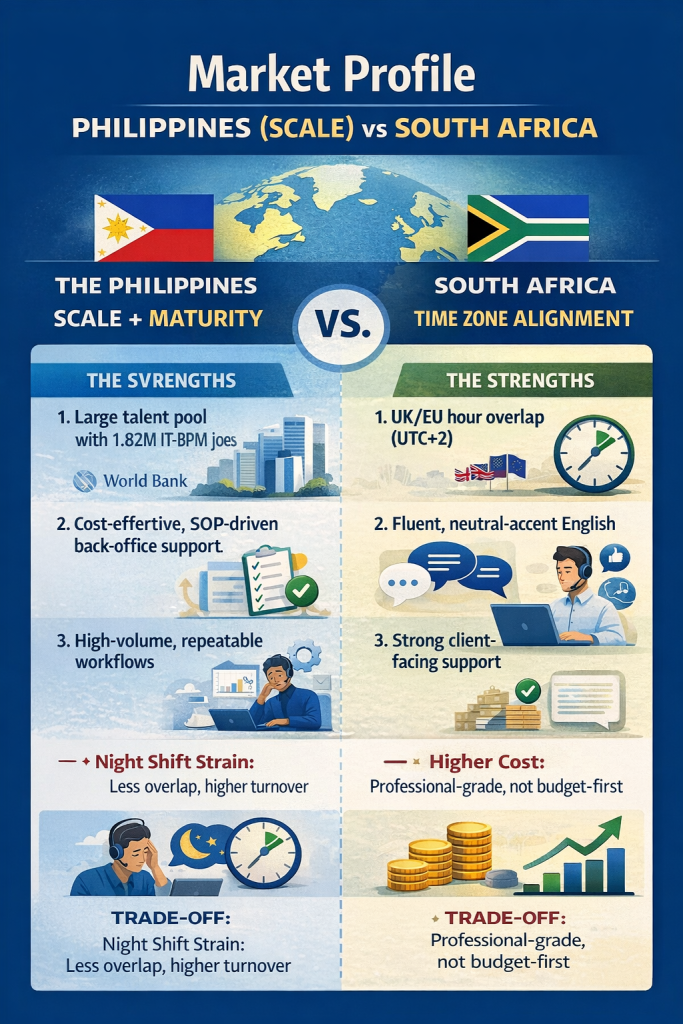
The Philippines remains one of the largest outsourcing markets in the world.
The industry employs over 1.5 million professionals and generates billions of dollars in annual revenue. Major multinational corporations operate large service centers throughout the country.
This scale provides advantages in recruitment pipelines, training infrastructure, and operational stability.
South Africa’s outsourcing industry is smaller but expanding rapidly.
Government initiatives, improved telecommunications infrastructure, and increased global demand have accelerated growth in the country’s Business Process Outsourcing sector.
Industry analysts frequently describe South Africa as a “high-quality challenger market” in global outsourcing.
While the Philippines dominates in size, South Africa has gained recognition for delivering high-quality customer experience and knowledge-based services.
When South Africa Is the Better Choice
South Africa often becomes the preferred outsourcing destination when companies need professionals who function as seamless extensions of internal teams.
Organizations frequently hire South African talent for roles that require strategic thinking, client interaction, or cross-department coordination.
Examples include:
• Digital marketing and campaign management
• Executive assistant roles supporting leadership teams
• Financial administration and bookkeeping
• Customer success management
• Sales support and lead generation
In these environments, professionals do more than complete tasks.
They contribute ideas, participate in planning, and help move projects forward.
This type of embedded collaboration can be especially valuable for startups, SaaS companies, and growing service businesses.
When the Philippines Is the Better Choice
The Philippines remains one of the most efficient outsourcing destinations for companies that need large operational teams.
The country’s mature outsourcing infrastructure supports organizations that require scale and operational consistency.
Common use cases include:
• Large customer support teams
• Administrative virtual assistants
• data entry and processing roles
• technical support centers
• round-the-clock service operations
Companies that prioritize cost efficiency and operational scale often find the Philippine outsourcing ecosystem highly effective.
Strategic Verdict
Both South Africa and the Philippines offer compelling outsourcing opportunities.
The Philippines continues to lead the world in large-scale outsourcing operations thanks to its deep infrastructure and massive workforce.
South Africa, however, has rapidly gained recognition as a destination for businesses seeking skilled professionals capable of working within Western business environments.
As one global outsourcing consultant summarized:
“The Philippines wins on scale. South Africa wins on communication and professional collaboration.”
For many companies, the decision ultimately depends on the nature of the roles being outsourced.
Organizations focused primarily on operational efficiency and large service teams may lean toward the Philippines.
Companies seeking professionals who can collaborate closely with leadership, manage complex workflows, and contribute strategically often find South Africa to be the stronger fit.
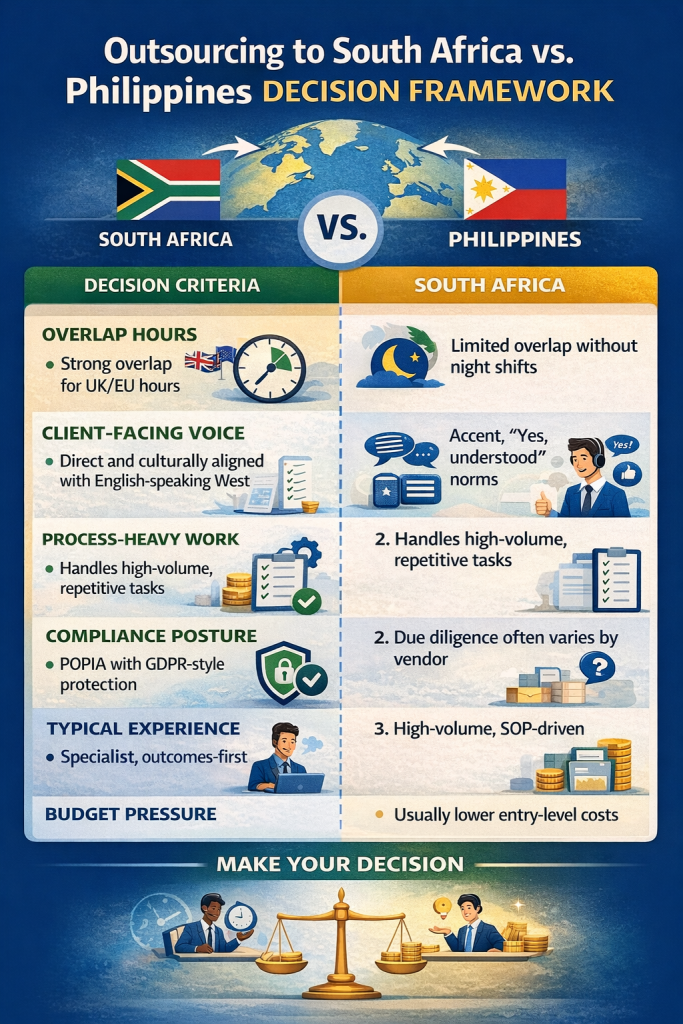
Outsourcing to South Africa vs Philippines Decision Framework
Quick comparison table
| Decision Criteria | Why it matters | South Africa | Philippines |
|---|---|---|---|
| Overlap hours | Faster decisions, fewer handoffs | Strong for UK/EU | Often off-hours |
| Client-facing voice | Brand protection and trust | Strong | Strong (accent varies) |
| Process-heavy work | Cost-efficient throughput | Capable | Excellent |
| Communication defaults | Fewer silent errors | More direct | Often harmony-first |
| Compliance posture | Auditability and trust | POPIA with GDPR-aligned concepts | Varies by vendor |
| Typical experience | Day-to-day feel | Specialist, outcomes-driven | High-volume, SOP-driven |
| Budget pressure | Entry-level cost base | Usually higher | Usually lower |
Decision Framework: Seven Questions Before You Choose
1. Overlap Requirement
If your UK or EU business needs same-day execution, you need a destination that works your hours. South Africa wins for most UK and EU teams. Philippines wins for US overnight coverage and pure async workflows.
2. Role Type: Front Office vs Back Office
- Front office — client communication, scheduling, sales support, onboarding. Choose the market where cultural alignment and time overlap are strongest.
- Back office — data entry, tagging, document cleanup, research. Choose where process scale and price efficiency win.
3. Error Tolerance
If one wrong email damages a client relationship, pay for the market that structurally reduces misfires. If mistakes only slow internal work, optimise for cost.
4. Manager Maturity
Teams in both markets succeed when managers write clean briefs, approve fast, track decisions in one system, and give feedback without ambiguity. The country you choose does not fix a management problem.
5. Compliance Exposure
If you handle personal data, credentials, payment data, or regulated workflows, you need a defensible controls stack before you hire anyone, regardless of geography.
6. Retention Sensitivity
If you want an assistant who grows with your business over years, avoid structural churn drivers — especially long-term night shifts. Design for tenure, not coverage.
7. Scaling Plan
If you are building specialist pods support, ops, finance, admin you need a team architecture, not a single hire. Design the structure before you post the role.
Industry Vertical Fit: Which Sector Benefits from Which Market
This is the question most outsourcing guides skip. The answer matters more than most buyers expect.
| Industry | Recommended Market | Primary Reason |
| E-commerce | Philippines | High-volume SOP-driven tasks; strong catalogue management and customer support infrastructure |
| Real estate | Philippines | Transaction coordination, CRM management, and listing support at scale |
| Healthcare administration | Philippines | SOP adherence, appointment scheduling, and patient data management workflows |
| SaaS and tech startups | Philippines | CRM upkeep, data enrichment, and back-office processing at speed |
| Fintech | South Africa | Compliance-sensitive call handling, nuanced escalation, and regulated-industry communication |
| Telecommunications | South Africa | Complex query resolution, Tier 2 technical support, and escalation management |
| Travel and hospitality | South Africa | Real-time booking, itinerary changes, and emotionally sensitive customer interactions |
| Professional services | South Africa | Executive support, client onboarding, and relationship-sensitive account coordination |
| Hybrid operations (any sector) | Both | Process volume to Philippines; client-facing and judgment-heavy work to South Africa |
Scenarios — Which Business Chooses Which Destination
Scenario 1: UK agency with high client communication load
The agency needs same-day client replies, calendar management, and deliverable coordination across multiple accounts. The team is entirely UK-based.
South Africa fits better. It removes the overlap gap entirely, reduces back-and-forth latency, and places client-facing communication inside a cultural and temporal context that matches the agency’s clients.
Role to hire: Executive assistant or account coordinator based in South Africa on a UK-hours schedule.
Scenario 2: US ecommerce brand with heavy ticket volume
The brand needs round-the-clock ticket handling, order status updates, returns workflows, and product catalogue management across thousands of SKUs.
Philippines fits well for the operational volume. With careful shift design, strong SOPs, and a QA cadence, the Philippines delivers the throughput and cost efficiency this model requires.
Role to hire: Customer support VA and catalogue/data VA based in the Philippines. Separate roles — do not combine.
Scenario 3: Scaling services firm with compliance exposure
The firm handles client documents, credentials, and sensitive financial information. It supports clients in the UK, EU, and the US simultaneously.
Hybrid model works best. South Africa for client-facing, compliance-sensitive, and real-time coordination roles. Philippines for process-heavy tasks with tight SOPs and internal workflow management.
Controls to implement before hiring in either market: role-based access, audit trails, vendor NDA, documented incident response process.
Scenario 4: Fintech Platform Managing Regulatory Escalations
The platform handles complex compliance queries, account verification escalations, and regulated-product support calls. Errors carry regulatory consequence.
South Africa fits this profile specifically. The combination of communication precision, contextual interpretation under ambiguity (McKinsey), and strong first-contact resolution rates on advanced tiers (BPeSA) makes it the lower-risk environment for this type of work.
Role to hire: Tier 2 support specialist or compliance support VA based in South Africa with documented escalation SOPs.
Building a Successful Remote Team
Regardless of location, outsourcing success depends less on geography and more on how companies structure and manage remote teams.
Businesses that treat offshore professionals as long-term contributors rather than temporary support staff tend to see stronger results.
When remote professionals receive clear expectations, proper onboarding, and consistent communication, they often become some of the most productive members of a company’s workforce.
Many modern organizations now build entire operational functions around distributed teams.
Aristo Sourcing helps businesses connect with experienced professionals in South Africa across marketing, operations, finance, and executive support roles.
For companies exploring outsourcing for the first time or considering expanding existing remote teams the right hiring strategy can turn global talent into a long-term competitive advantage.
Which country offers better English for virtual assistants?
Both markets produce excellent English speakers. South Africa frequently offers a neutral-accent advantage for voice roles — Everest Group highlights this specifically. The Philippines offers strong empathetic intonation and service-oriented communication suited to high-volume support environments.
Do I need to hire night-shift staff in the Philippines for UK clients?
Most UK teams will struggle with full UTC+8 overlap. Night shifts can solve coverage but structurally raise stress and retention risk in judgment-heavy roles. Design your workflow to minimise the night-shift dependency.
Why do some outsourced teams say “yes” but deliver the wrong thing?
Communication norms drive this. High-context cultures rely on implied meaning and harmony; disagreement can feel socially costly. Reduce errors by explicitly rewarding clarification and documenting decisions in writing.
Can South Africa handle high-volume support like the Philippines?
Yes. The Philippines dominates on scale and operational maturity for Tier 1 volume, but South Africa can run high-volume operations with strong SOPs and QA. The choice depends on whether your volume requires process throughput (Philippines advantage) or complex interaction handling (South Africa advantage).
Does POPIA make South Africa “GDPR compliant” automatically?
No. POPIA and GDPR share many conceptual foundations, but operational compliance still requires: access management, audit trails, vendor data processing agreements, and documented incident response. Do not conflate legal alignment with operational compliance.
Which destination fits sales support and appointment setting best?
South Africa fits UK, EU, and US East schedules more cleanly because UTC+2 overlaps without requiring night shifts. For sales roles requiring real-time conversation and decision-making, schedule alignment is a performance variable, not just a preference.
How do I estimate the real cost difference between the two markets?
Compare total outcome cost, not salary alone. Include: management time spent, correction cycles per month, turnover rate and retraining cost, tooling overhead, and compliance risk. Statista data shows a 20–35% salary differential in favour of the Philippines, but that gap narrows significantly when total outcome cost is calculated.
What roles should I never outsource without a tight process?
Any role touching money, credentials, regulated data, or direct client trust. Build SOPs, role-based access, and audit trails before you hire. The process comes before the person.
What does a good onboarding process look like for either country?
A written SOP for every task. A daily handoff format. Loom walkthroughs for judgment-heavy tasks. A shared task management system. Weekly QA reviews. A culture norm that rewards clarification over assumption.
When does the hybrid model beat a single-country team?
Hybrid wins when you run both client-facing and high-volume process work, or when you need resilience across multiple markets. It lets you buy overlap quality where it matters and cost efficiency where it counts. The functional arbitrage principle, matching talent ecosystems to operational needs, is the framework that makes this work.
What industries are best suited to each market?
E-commerce, real estate, healthcare administration, and SaaS operations typically suit the Philippines due to structured, SOP-driven workflows. Fintech, telecommunications, travel, and professional services frequently benefit from South Africa’s communication precision, escalation capability, and European time-zone alignment.
Your Next Step
Ready to build the right team for your business? Aristo Sourcing offers free consultations to help you select the right country for each function using a capability-first, role-matched approach. Book a free consultation.
