
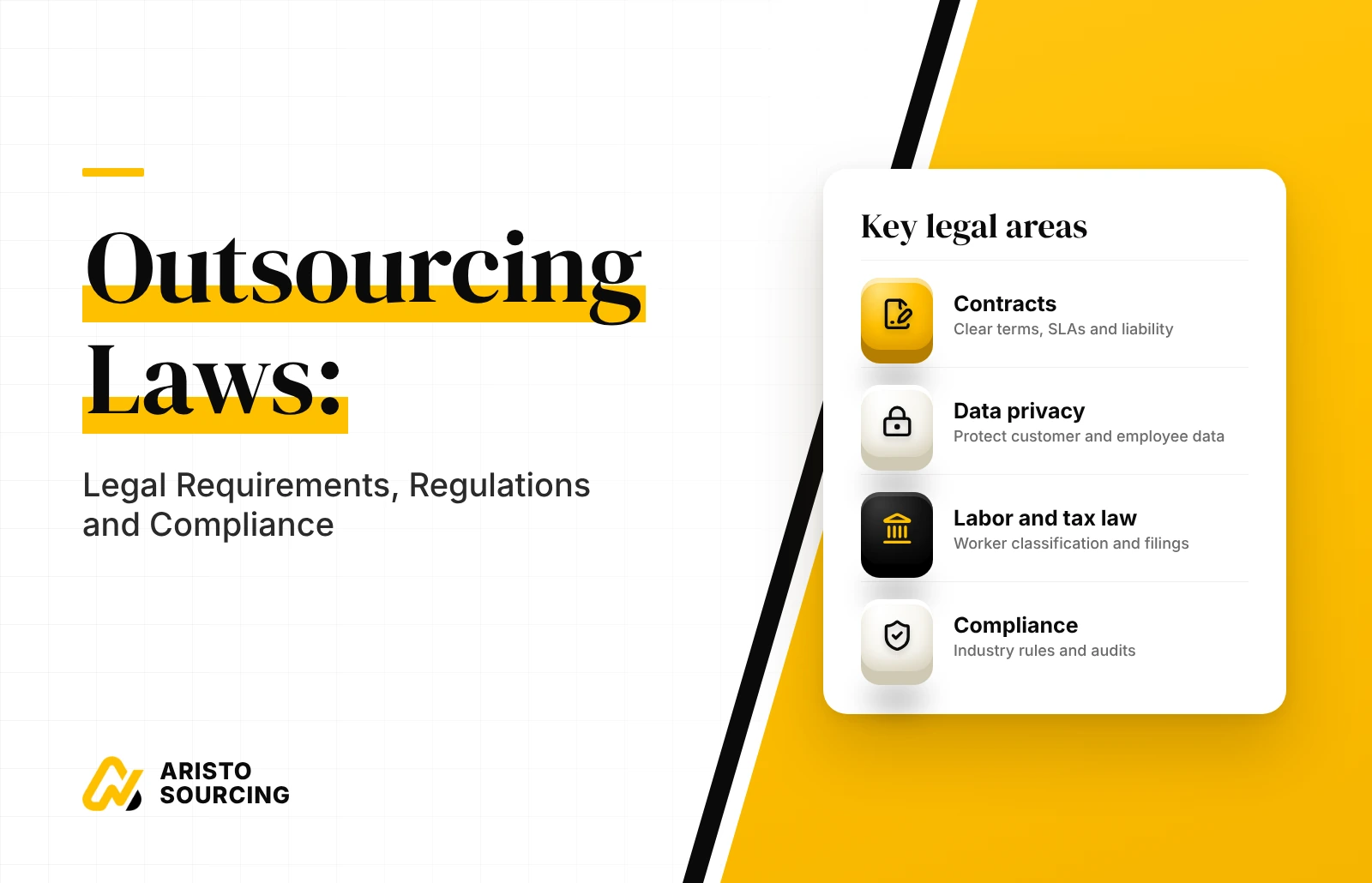
Outsourcing laws basically refer to the legal rules that govern how a business assigns work to an outside provider. Outsourcing is generally legal in the United States, but every arrangement must comply with the contract, labor, data privacy, and industry laws that apply to the work. The main areas these laws cover are the legal requirements for outsourcing, the federal and state regulations behind those requirements, and the compliance practices that keep each arrangement defensible.
Understanding the requirements and regulations protects a business from legal and financial risk, including regulatory fines, lawsuits, and costly contract disputes. Working with an experienced outsourcing partner also helps a business stay compliant, because the provider already maintains the contracts, security controls, and employment structure that the law expects.
What Are Outsourcing Laws?
Outsourcing laws are the combined legal rules, regulations, and contract principles that govern how a business transfers work, data, and responsibilities to an external service provider. No single law governs every outsourcing arrangement; instead, the rules that apply depend on the type of work, the location of the provider, and the kind of data the provider handles.
The major areas of law that apply are contract law, employment law, data privacy, intellectual property, and tax law. Contract law sets the terms of the relationship, and employment law determines who employs and protects the workers. Data privacy law controls how personal information is handled, intellectual property law decides who owns the work product, and tax law sets the reporting and withholding duties for domestic and foreign providers. Multiple legal requirements often apply to the same outsourcing relationship at once, so compliance means meeting every applicable rule rather than just one.
Is Outsourcing Legal?
Yes, outsourcing is legal, but each arrangement must follow the labor law, privacy rules, and contract requirements that apply to the work. Outsourcing creates legal problems when a business misclassifies workers, shares personal data without proper safeguards, skips required layoff notices, or sends regulated work to an unqualified provider. U.S. outsourcing laws are not found in one statute, so legal compliance requirements depend on the country, state, industry, and type of work involved. No federal law bans outsourcing jobs overseas, but offshore outsourcing still has to meet export control, cross-border data transfer, and government contract restrictions.
What Are the Legal Requirements for Outsourcing?
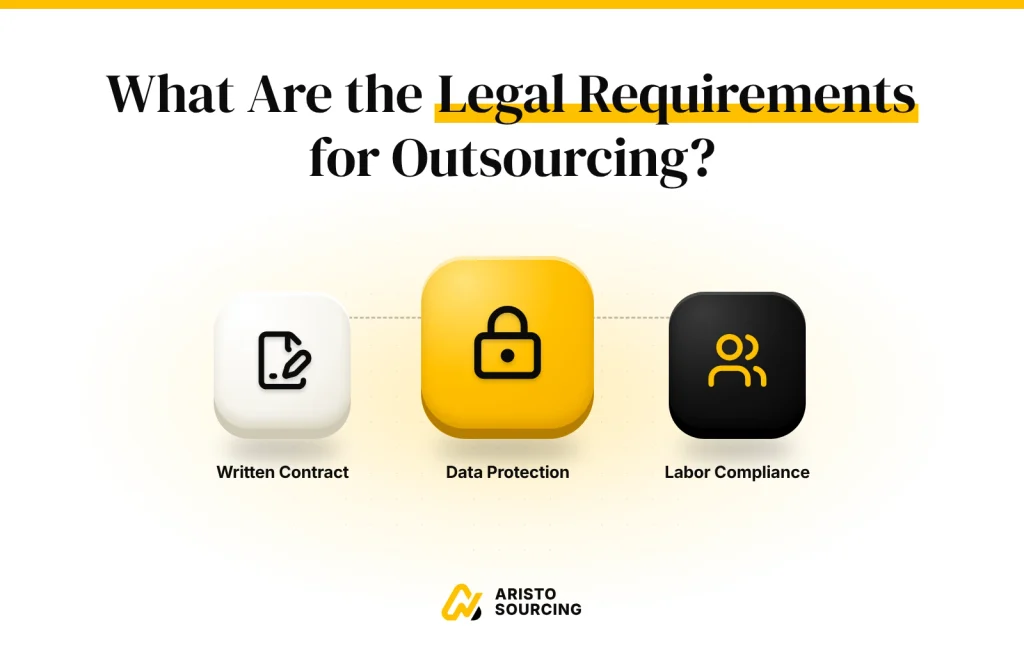
The legal requirements for outsourcing include written contracts and agreements, labor and employment rules, data privacy and security duties, intellectual property protections, and licensing or industry rules.
The 5 main legal requirements for outsourcing are listed below.
- Outsourcing Contracts and Agreements
- Labor and Employment Requirements
- Data Privacy and Security Requirements
- Intellectual Property Requirements
- Licensing and Industry Requirements
1. Outsourcing Contracts and Agreements
Outsourcing contracts and agreements are the legally binding documents that define the scope, obligations, and risk allocation between a business and its outsourcing provider. The common documents in an outsourcing contract package are the master services agreement (MSA), the statement of work (SOW), the non-disclosure agreement (NDA), and the data processing agreement (DPA).
U.S. contract law is mostly state law, so every outsourcing contract should name the governing law and the jurisdiction where disputes will be heard. The contract should also set the dispute resolution method, and offshore deals often choose international arbitration because arbitral awards are easier to enforce across borders than court judgments.
2. Labor and Employment Requirements
Labor and employment requirements are the labor law and employment law rules that determine how outsourced workers are classified, supervised, paid, and protected. The Fair Labor Standards Act (FLSA) uses an “economic reality” test to separate employees from independent contractors, and while the Department of Labor (DOL) proposed rescinding its 2024 contractor rule in February 2026, stricter state tests, such as California’s ABC test, keep worker misclassification a serious risk.
A client that directs outsourced staff day-to-day risks becoming a joint employer, and an outsourcing decision that triggers a mass layoff requires 60 days’ notice under the federal WARN Act, plus any notice that state “mini-WARN” laws require. Offshore workers fall under the labor laws of their own country, which is why the provider’s role as employer of record matters.
3. Data Privacy and Security Requirements
Data privacy and security requirements are the data protection and data security rules that control how an outsourcing provider accesses, stores, uses, and transfers personal information on a client’s behalf. The United States has no single federal privacy law, so data privacy obligations come from sector laws, such as HIPAA for health information and the Gramm-Leach-Bliley Act (GLBA) for financial data, plus more than 20 state comprehensive privacy laws.
The GDPR applies when an outsourcing provider processes EU personal data, which requires a written data processing agreement (DPA) under Article 28 and a valid transfer mechanism, such as Standard Contractual Clauses (SCCs), when the data moves outside the EU. Baseline security duties include access controls, encryption, client audit rights, and breach notification, and every U.S. state has its own breach notification law.
4. Intellectual Property Requirements
Intellectual property requirements are the contract terms and legal rules that decide who owns, uses, and protects the intellectual property (IP) created or shared during an outsourcing engagement. Under U.S. copyright law, work created by an independent contractor is usually not “work made for hire” by default, so the outsourcing contract needs an explicit IP assignment clause that transfers ownership to the client. The contract should also cover licensing of any pre-existing (background) IP the provider brings and protect trade secrets through confidentiality obligations that survive termination. IP law is national, so these clauses must be enforceable in the provider’s country, and the contract should define who owns AI-generated output because purely AI-generated material may not qualify for copyright protection.
5. Licensing and Industry Requirements
Licensing and industry requirements are the licensing requirements and industry regulations that apply when businesses in regulated industries outsource functions to a third party.
Regulated businesses stay accountable for the functions they outsource, so regulators treat a vendor’s compliance failure as the business’s own failure. Offshore work also triggers export controls and sanctions rules, such as the Export Administration Regulations (EAR), the International Traffic in Arms Regulations (ITAR), and Office of Foreign Assets Control (OFAC) sanctions, which can restrict sharing controlled data or technology with foreign staff.
What Are the U.S. State-Specific Regulations on Outsourcing?
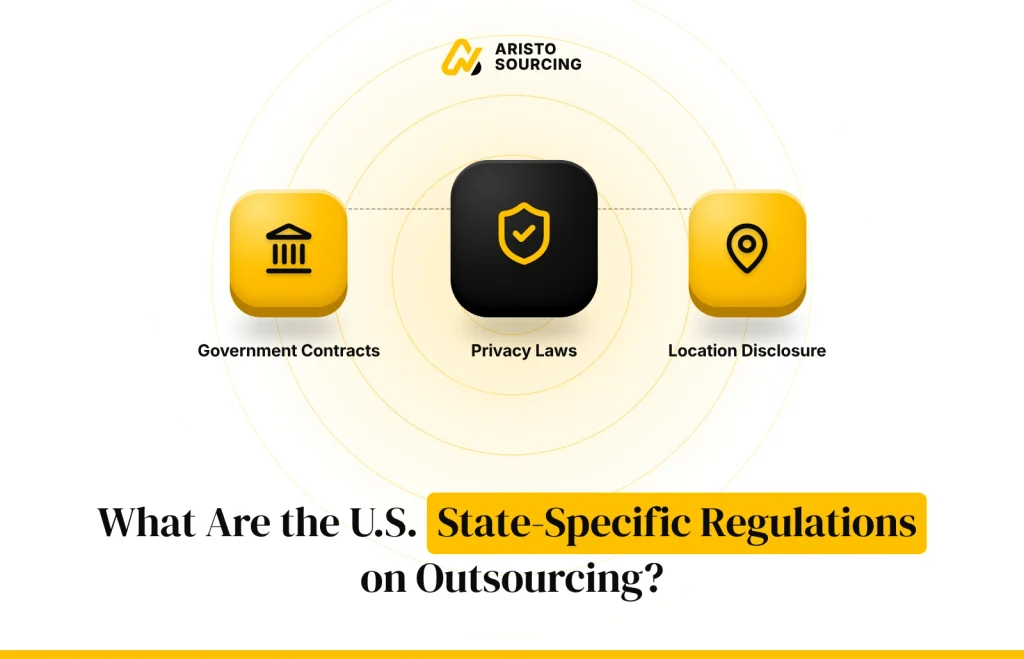
The U.S. state-specific regulations on outsourcing include state privacy and data security laws, such as the CCPA and the New York SHIELD Act, and state employment laws, such as Arizona’s civil rights and worker verification statutes.
4 key U.S. state-specific regulations on outsourcing are listed below.
1. California Consumer Privacy Act (CCPA): The California Consumer Privacy Act (CCPA) is a state privacy law that gives California residents rights to know, delete, correct, and opt out of the sale of their personal data. The CCPA requires businesses to honor these rights and to bind every service provider or contractor that receives California residents’ personal information to a written contract that limits how the data is used, retained, and shared. An outsourcing vendor that handles California residents’ data must follow those contract limits and help the client respond to consumer requests.
2. Arizona Civil Rights Act (ACRA): The Arizona Civil Rights Act (ACRA) is an Arizona law that prohibits employment discrimination based on race, color, religion, sex, age, national origin, disability, or genetic testing results. The ACRA covers employers with 15 or more employees, or one or more employees for sexual harassment claims, and it also applies to employment agencies that refer workers to Arizona businesses. ACRA protections apply to employees rather than true independent contractors, so worker misclassification or a joint employment relationship can extend a client’s discrimination liability to outsourced or contracted workers in Arizona.
3. Legal Arizona Workers Act (LAWA): The Legal Arizona Workers Act (LAWA) is a 2007 Arizona law that prohibits employers from knowingly or intentionally employing unauthorized workers and requires E-Verify checks for new hires. Every Arizona employer must verify the employment eligibility of each employee hired after December 31, 2007, through the federal E-Verify system. The law also reaches contract, subcontract, and independent contractor arrangements, so an Arizona business cannot knowingly use an outsourcing provider or subcontractor that employs unauthorized workers, and violations can lead to the suspension or revocation of business licenses.
4. New York SHIELD Act: The New York SHIELD Act is a 2019 data security law that requires any business holding New York residents’ private information to safeguard that data and report breaches. The SHIELD Act requires reasonable administrative, technical, and physical safeguards, including selecting service providers capable of maintaining appropriate safeguards and requiring those safeguards by contract. Since a December 2024 amendment, a vendor that maintains New York residents’ data must notify the data owner of a breach within 30 days of discovery, which makes vendor security a legal matter for the client, not just an IT concern.
What Other Crucial U.S. Outsourcing Legal Matters Should You Note?
Beyond the laws covered above, a few other legal matters are worth noting for U.S. outsourcing: industry-specific rules, contractual indemnification, and evolving state privacy legislation. Industry-specific rules, such as FINRA supervision rules for broker-dealers and state insurance data security laws, add outsourcing requirements that general business laws do not cover.
Indemnification clauses decide which party pays when a vendor’s error leads to fines, lawsuits, or legal battles, so they deserve the same review as pricing terms. State privacy legislation keeps changing, with Alabama, Louisiana, Oklahoma, and Vermont each enacting a comprehensive privacy law in 2026, so regulatory compliance needs regular review rather than a one-time check.
How Do Legal Battles Over Outsourcing Arise?
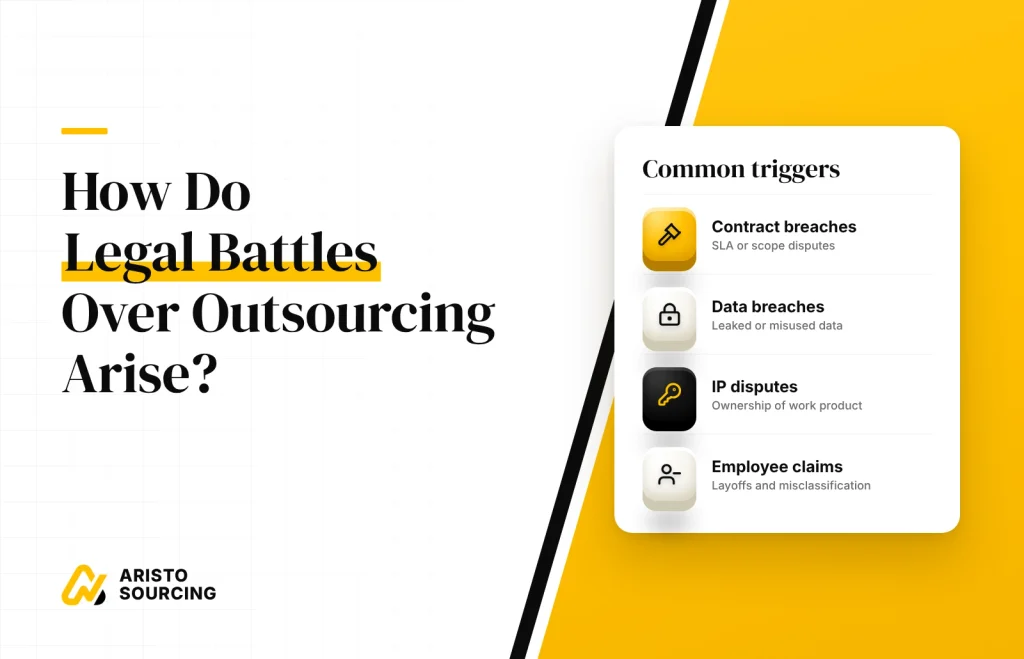
Legal battles over outsourcing commonly arise from breach of contract, data breaches, worker misclassification, and intellectual property disagreements between a business, its provider, and the workers involved. Breach of contract claims usually follow missed service levels, unclear scope, or disputed invoices, and they turn on how precisely the outsourcing contract defines each party’s obligations.
Data breaches create legal liability toward regulators and affected individuals, and they often lead to disputes between the client and the provider over who caused the incident and who pays for it. Worker misclassification claims arise when outsourced workers argue that the client, not the provider, controls their work and therefore owes them wages, overtime, or benefits. Intellectual property disagreements typically involve ownership of code, content, or designs that the contract never assigned in writing. These disputes show why a well-structured outsourcing contract is the primary tool for legal compliance, because it settles ownership, responsibility, and remedies before a conflict starts.
What Should the Outsourcing Contracts and Service Level Agreements Include?
An outsourcing agreement should establish the services, responsibilities, performance standards, payment terms, liability, and termination rights that govern the relationship. The services section defines the exact scope of work, deliverables, and exclusions, so both parties know what falls inside the outsourcing contract and what requires a change order. The responsibilities section assigns duties to each party, including who provides systems access, who supervises daily work, and who handles regulatory compliance tasks.
Performance standards set measurable targets, such as turnaround times or accuracy rates, while payment terms define rates, invoicing schedules, and late fees. Liability clauses cap damages, assign indemnification duties, and specify insurance coverage, which determines who absorbs the cost of a data breach or a missed deadline. Termination clauses define notice periods, termination for cause or for convenience, and exit steps, such as data return, data deletion, and access revocation. A Service Level Agreement (SLA) translates performance standards into specific, measurable metrics with remedies, such as service credits, when the provider misses a target. The SLA gives both parties an objective measure of performance and serves as the baseline for every compliance checklist review.
What Should an Outsourcing Compliance Checklist Include?
An outsourcing compliance checklist should include vendor due diligence, reviewing the contract and SLA, addressing employment, privacy, cybersecurity, and IP requirements, and establishing monitoring and termination procedures.
The core items an outsourcing compliance checklist should include are listed below.
- Vendor due diligence: Verify the provider’s legal registration, security audit reports, financial stability, insurance, and client references before signing the outsourcing contract.
- Reviewing the contract and SLA: Confirm that the outsourcing contract and SLA define scope, metrics, liability caps, audit rights, governing law, and dispute resolution.
- Addressing employment requirements: Confirm worker classification, the employer of record, and the provider’s compliance with local labor laws for every outsourced role.
- Addressing privacy requirements: Sign a DPA wherever personal data is involved, and map every applicable data protection law, such as HIPAA, GDPR, or state privacy laws.
- Addressing cybersecurity requirements: Require access controls, multi-factor authentication, encryption, and a written breach notification timeline from the provider.
- Addressing IP requirements: Include an IP assignment clause, licenses for any background IP, and confidentiality terms that protect trade secrets.
- Establishing monitoring and termination procedures: Schedule regular audits and performance reviews, and document an exit plan for data return, data deletion, and access revocation.
Treating the checklist as an ongoing risk management process keeps privacy and IP protections current and helps the business avoid penalties as laws change.
What Are the Penalties of Outsourcing Noncompliance?
Penalties for outsourcing noncompliance depend on the specific law and jurisdiction, and they range from regulatory fines to lawsuits and contract damages. Fines can be severe; GDPR fines, for example, reach up to €20 million or 4% of a company’s worldwide annual turnover, whichever is higher. Regulatory enforcement can also include investigations, consent orders, and mandatory corrective action plans from agencies such as the Federal Trade Commission (FTC), the Department of Health and Human Services (HHS), or state attorneys general.
Lawsuits from customers, employees, or business partners add legal liability, and contractual liability under indemnification clauses shifts those costs between the client and the provider. A data breach can trigger notification costs, regulatory investigations, and class actions, while employment violations such as worker misclassification can lead to back wages plus an equal amount in liquidated damages under the FLSA. Working with a compliant, experienced outsourcing provider reduces exposure to these risks, because the provider already maintains the contracts, controls, and documentation that regulators expect.
How to Choose a Legally Compliant Outsourcing Partner?
To choose a legally compliant outsourcing partner, assess the provider’s verified security audits, employment structure, contract readiness, regulated-industry experience, data transparency, and references during vendor due diligence. A compliant outsourcing provider shares the full SOC 2 Type II report, holds an ISO 27001 certification whose scope covers the actual delivery site, and acts as a clear employer of record that follows local labor law.
The provider should also be ready to sign a DPA, NDA, IP assignment, audit rights clause, and SLA with defined breach notification timelines, and it should disclose every sub-processor and data location along with references from clients in regulated industries. A provider that cannot produce compliance documents early in the process is a red flag.
How Does Aristo Sourcing Support Outsourcing Law Compliance?
Aristo Sourcing supports outsourcing law compliance by building confidentiality, data security, and employment safeguards into every remote staffing placement. Each team member signs a role-specific NDA before accessing client systems, and a data processing agreement (DPA) is available on request for clients whose work involves personal data.
Aristo Sourcing also vets staff before placement, applies access controls that limit each team member to the systems the role requires, and handles employer of record responsibilities for the staff it places. This structure keeps outsourcing compliance manageable for businesses that are comparing outsourcing with contracting or in-house hiring. Aristo Sourcing is not a law firm, so businesses should confirm their specific legal requirements and regulations with qualified legal counsel.