

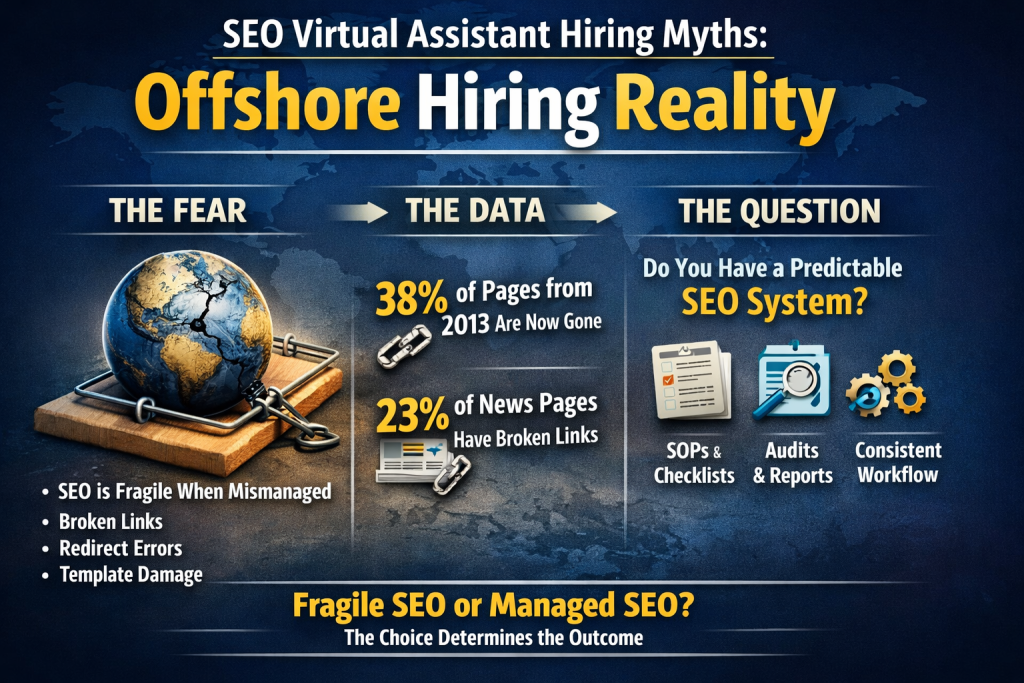
Most people don’t avoid an offshore SEO virtual assistant because they dislike global talent. They avoid it because SEO is fragile when it’s poorly managed, and delegation exposes that fragility fast. One missed redirect, one sloppy internal link change, one “quick update” that breaks a template, and the damage shows up weeks later when rankings and revenue are already sliding. The web itself is also decaying at a rate that punishes neglect. Pew Research found 38% of webpages from 2013 were no longer accessible a decade later, and 23% of news pages contained at least one broken link. If decay is normal, then “set-and-forget” SEO is not a strategy; it’s a liability.
So the right question is not “Is offshore talent risky?” It’s this: do you have a system that makes SEO work predictable, auditable, and measurable regardless of geography? Offshore hiring can be a competitive advantage when the role is designed around outputs, SOPs, and quality gates. It becomes a mess when the role is designed around vague “help with SEO” tasks and constant improvisation.
Myth 1: “Offshore means cheap, and cheap means low quality”
This myth ignores what large organizations are actually doing. Deloitte’s Global Outsourcing Survey states that 80% of executives plan to maintain or increase investment in third-party outsourcing, and 50% have used outsourced services for front-office capabilities like sales and marketing. That’s not a “cheap labor” signal. It’s a signal that outsourcing has matured into an outcome-driven delivery model, including functions closer to revenue.
The real quality determinant is not location. It’s whether you hired an operator with clear expectations, a defined tool stack, and a reporting cadence you can verify. Offshore can lower cost, but cost is not the primary benefit if you care about SEO. The primary benefit is capacity and consistency when the work is systemized.
Myth 2: “SEO is too complex to delegate to a VA”
SEO strategy is complex. SEO execution is often repeatable. Conflating the two is why people think a VA can’t help. The truth is that a massive portion of SEO value comes from operational work: content refreshes based on Search Console data, internal linking improvements, technical hygiene, and ongoing QA.
If you already know what you’re trying to achieve, the VA doesn’t need to “be the strategist.” They need to run the machine: Google Search Console (GSC) for performance and query drift, GA4 for engagement and conversion proxies, Screaming Frog for crawls and site architecture, Ahrefs or Semrush for competitor and link monitoring, and a ticketing system like Asana, Trello, or ClickUp to keep work visible. This is why good offshore SEO VAs feel “senior” even if their title says VA. They operate like an analyst with a checklist, not like a general helper.

Myth 3: “Communication will break because of time zones and distance”
Time zones only become a problem when your workflow relies on live hand-holding. If every decision requires your real-time approval, you will bottleneck SEO no matter where the VA sits. But if you define inputs and outputs clearly, time zones can become leverage. You assign work at the end of your day, and wake up to completed audits, refreshed drafts, and an issue log that is already prioritized.
The data on remote work also undermines the assumption that distance equals lower output. The U.S. Bureau of Labor Statistics found a positive association between remote work and productivity outcomes, noting that a one percentage-point increase in remote workers is associated with a 0.08 percentage-point increase in total factor productivity growth. That doesn’t mean every remote arrangement is automatically better. It means productivity is mostly a management and process design problem, not a geography problem.
Myth 4: “Offshore hiring is a security risk by default”
Security risk is real, but the root cause is almost always weak access controls, not a passport. Verizon’s 2025 DBIR highlights how credential issues remain dominant, stating that “about 88%” of breaches in basic web application attacks involved stolen credentials. That risk exists with local staff, agencies, freelancers, and founders who reuse passwords. Offshore simply forces you to confront whether your security posture is adult-grade.
The fix is boring and effective: role-based access, least privilege, MFA, separate logins, and removal of access the same day work ends. Put the VA in their own WordPress user role. Use Google’s permissions properly in Search Console and GA4. Never share the “master admin” account. Use a password manager, require MFA, and log changes so you can audit what happened if something breaks. If you don’t have these controls, you are already vulnerable.
Myth 5: “VAs can’t be accountable, so I’ll lose control”
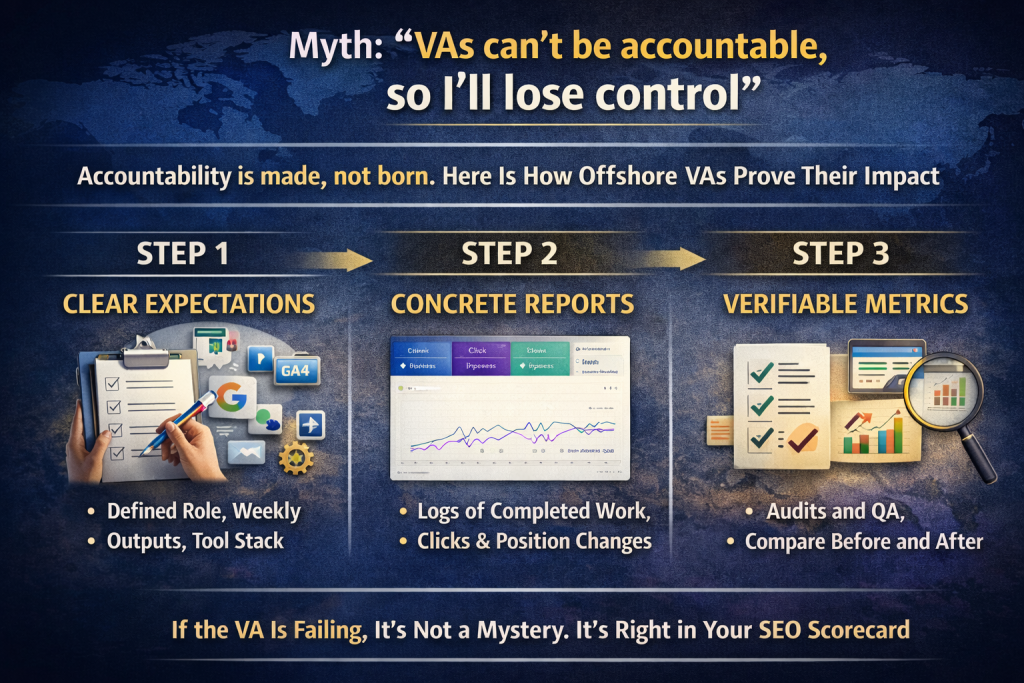
Accountability is not a personality trait. It’s a scoreboard. If you don’t measure SEO execution, you cannot manage it, and you will feel “out of control” whether the hire is offshore or in-house. The fix is to make the job auditable with artifacts: weekly logs, URL lists, crawl reports, and before/after metrics from GSC and GA4.
Google’s Search Console documentation makes this easy because it standardizes how performance is reported: clicks, impressions, CTR, and average position. A strong VA uses that data to justify priorities, not feelings. They also document changes so you can connect actions to outcomes during volatility. If your VA can’t show you a clear list of what changed this week, you don’t have an SEO system. You have activity.
The reality: offshore succeeds when you hire for systems, not tasks
The best offshore relationships in SEO look less like delegation and more like operations engineering. The VA runs repeatable workflows and you steer priorities. That division of labor is what prevents the common failure mode: founders outsourcing “SEO” as a concept instead of outsourcing specific outputs.
Here is what “best-in-class” looks like in practice.
First, the role has a defined scope. Your VA is responsible for content refresh execution, internal linking, technical QA, link integrity checks, metadata updates, and reporting. They are not responsible for inventing your business model or guessing your positioning. Second, the role has a stack. They work inside GSC, GA4, Screaming Frog, Ahrefs or Semrush, and your CMS. Third, the role has SOPs and quality gates. Every page update follows the same checklist so quality is consistent across volume.

The Semantic SEO reality: you don’t need “more content,” you need “more certainty”
Modern SEO rewards pages that reduce uncertainty for the reader. That means information gain, clearer entity coverage, and fewer “generic” paragraphs. Offshore talent can execute that well if you provide structured briefs and QA.
Your SOP should require: query intent mapping (from GSC queries), entity coverage checks (brands, features, comparisons), update verification (facts, dates, product availability), internal link improvements (cluster routes), and formatting standards (tables, bullets, scannable sections). If you do affiliate SEO, add link verification and disclosure checks into the same workflow. The VA becomes the person who turns “we should update old content” into 10 verified updates per week that you can actually trust.
The commercial truth: clicks are rarer, so quality control matters more
This is the part most hiring discussions ignore. Organic clicks are becoming harder to earn, which makes every SEO mistake more expensive. Search Engine Land reported that in March 2025, only 40.3% of U.S. Google searches resulted in an organic click, while zero-click searches rose to 27.2%. SparkToro’s research similarly found a majority of searches can end without a click. If the click is scarce, you cannot afford broken pathways, stale content, or sloppy pages that fail to convert. Offshore hiring is not the risk. The risk is running SEO without operational discipline.
How to hire offshore SEO VAs without getting burned
Start with a paid test that produces measurable artifacts. Ask for a mini technical audit using Screaming Frog, a GSC opportunity analysis, and one refreshed page with a change log. You want evidence of workflow quality, not claims.
Then interview for systems thinking. Ask: “How do you prioritize which URLs to refresh first using GSC?” Ask: “What is your process for reporting changes so we can explain performance swings?” Ask: “How do you run QA so internal links and templates don’t break at scale?” These questions reveal whether they can operate like an SEO production manager instead of a generic assistant.
Finally, set a weekly cadence. One weekly planning message, one midweek progress update, one end-of-week delivery report. Require a URL list of work completed, issues discovered, fixes applied, and a short note on what is blocked. This structure turns “offshore” into a predictable production line.
Closing: the offshore myth is emotional, the offshore reality is operational
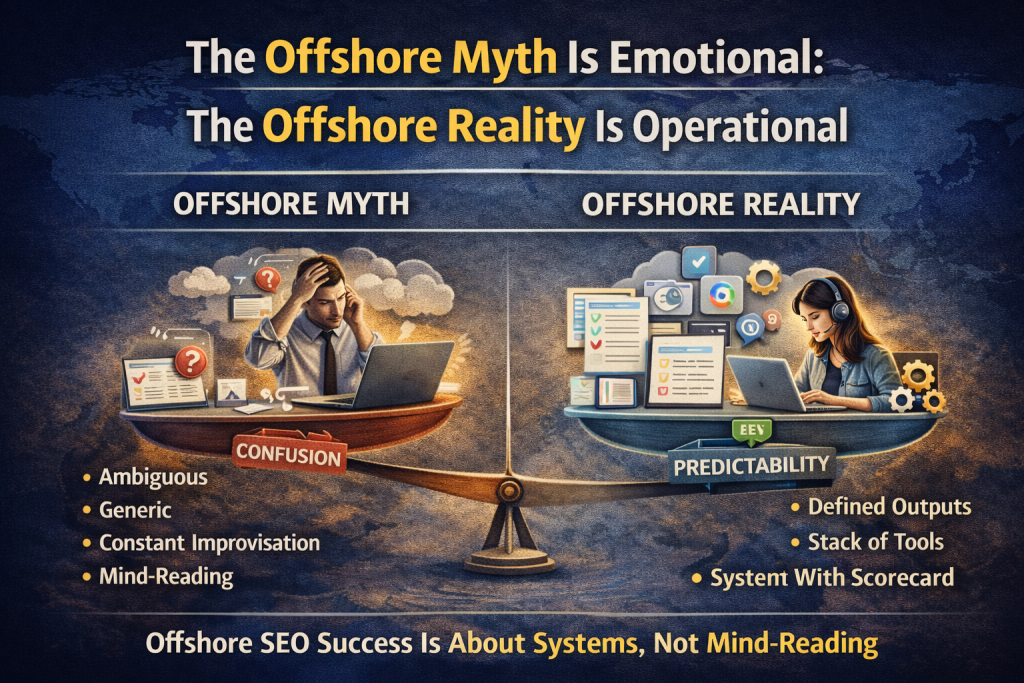
Offshore talent is not magic, and it’s not a compromise. It’s a sourcing decision. The outcome depends on whether you manage SEO like a system with SOPs, audits, and scorecards. If you hire a VA and expect mind-reading, you will be disappointed anywhere in the world. If you hire an operator and give them a defined stack, defined outputs, and a reporting cadence, offshore can become one of your strongest leverage points.
The final question is simple: do you want “help,” or do you want an SEO operating system that runs every week without you pushing it? Offshore works when you choose the second.
