

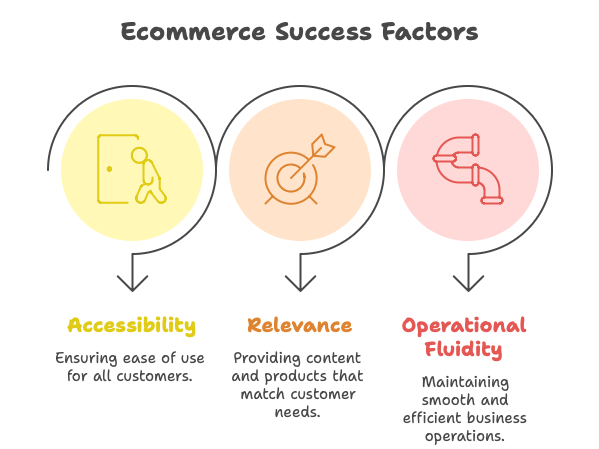
Ecommerce growth is no longer constrained by access to technology. Success is defined by execution: the ability to deliver accessibility, relevance, and operational fluidity at scale. Brands that achieve sustainable growth do not chase new software releases; they operationalize the fundamentals of the customer journey through disciplined delegation and clearly defined ownership.
Seamless Channel Integration (The Omnichannel Baseline)
Omnichannel commerce is now the minimum viable standard for modern retail. Research from McKinsey shows that omnichannel customers spend approximately 30% more per transaction and demonstrate higher lifetime value. The risk for growing brands lies not in channel expansion, but in fragmented execution that leads to pricing inconsistencies, inventory mismatches, and brand dilution.
The Operational Challenge
Synchronizing product data, pricing logic, and inventory levels across Shopify, Amazon, social commerce catalogs, and third-party marketplaces.
The Support Solution
Embedded operational talent maintains real-time alignment of listings and inventory across platforms. This cross-channel data integrity reduces customer service escalations, prevents overselling, and protects revenue that is otherwise lost to operational errors. With channel consistency established, relevance becomes the next constraint on growth.
Intelligent Personalization Requires a Feedback Loop
As a core infrastructure component, AI now drives the hyper-personalization consumers expect. Salesforce reports that more than 70% of customers expect brands to understand their individual preferences, yet automation without oversight frequently degrades the experience it is meant to improve.
The Operational Challenge
Machine learning systems lack contextual awareness of seasonal demand shifts, supply chain disruptions, and evolving brand tone, leading to irrelevant recommendations and impersonal support interactions.
The Support Solution
Human feedback loops keep automation commercially grounded. By refining chatbot logic, interpreting behavioral analytics, and managing edge cases, operational support ensures that personalization systems remain aligned with inventory realities and brand standards. Relevance, however, only delivers value if customers can discover the brand.
Visibility Is Sustained Through Maintenance, Not Launches
Organic search remains one of the highest-ROI channels in ecommerce. BrightEdge estimates that organic discovery accounts for over half of trackable ecommerce traffic. Yet search visibility is not a project it is an operational system maintained over time.
The Operational Challenge
Modern search engines reward topical authority, entity coverage, and technical consistency, all of which require continuous updates to metadata, site health monitoring, and backlink profiles.
The Support Solution
Ongoing operational support ensures regular site audits, iterative content updates aligned with shifting search intent, and disciplined management of digital PR pipelines. This shift from episodic launches to continuous maintenance preserves long-term visibility and asset value. Traffic, however, only converts into loyalty when fulfillment executes flawlessly.

Fulfillment Discipline Is a Retention Strategy
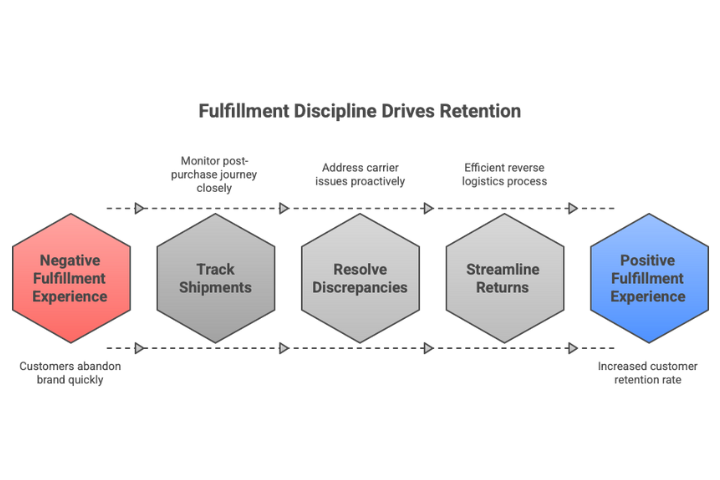
Delivery and returns represent the decisive moments of truth in ecommerce. PwC research shows that nearly one-third of customers will abandon a brand after a single negative fulfillment experience, making reliability a direct driver of retention.
The Operational Challenge
High-volume fulfillment environments are inherently fragile, requiring real-time inventory awareness, proactive shipment communication, and efficient reverse logistics.
The Support Solution
Centralized operational coordination manages the post-purchase journey by tracking shipments, resolving carrier discrepancies, and streamlining returns and exchanges. Bain & Company has demonstrated that improving retention by just 5% can increase profits by up to 95%, underscoring fulfillment’s strategic impact. Retention often enables expansion into more complex commercial relationships.
B2B Scale Depends on Account Management Precision
B2B ecommerce is rapidly converging with B2C expectations. Gartner projects that 80% of B2B sales interactions will be digital-first, with buyers demanding transparent pricing, self-service ordering, and fast fulfillment.
The Operational Challenge
Tiered pricing structures, bulk order rules, negotiated terms, and CRM accuracy introduce failure points that automation alone cannot manage.
The Support Solution
Administrative support focuses on data integrity processing bulk transactions, maintaining contract-specific pricing, and ensuring CRM records reflect commercial agreements. This reliability allows sales teams to redirect effort from order correction to relationship development and account growth.
Delegation Is Strategic Architecture
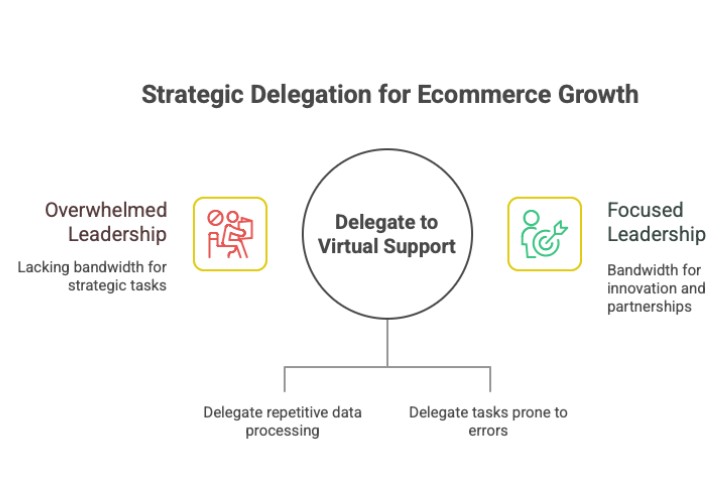
Sustainable ecommerce growth depends on a clean separation between strategic direction and daily administration. Virtual support is not a cost-reduction tactic; it is an architectural decision that stabilizes execution as complexity increases.
By delegating data-heavy, repetitive, and failure-sensitive workflows, leadership preserves the cognitive bandwidth required for product innovation, partnerships, and long-term positioning. In a market defined by speed, accuracy, and relevance, execution is the strategy and delegation is how that strategy scales.
How does a Virtual Assistant improve ecommerce SEO?
A virtual assistant improves ecommerce SEO by increasing topical authority through consistent metadata updates, recurring site audits, and internal link management. Search engines use these signals to interpret site hierarchy and relevance.
What is the difference between an ecommerce trend and an evergreen strategy?
The difference between an ecommerce trend and an evergreen strategy is duration and stability. Ecommerce trends are temporary changes in consumer behavior, such as viral social media fads. Evergreen strategies are long-term SEO and UX practices like site speed, mobile optimization, and fulfillment reliability.
Can AI-driven ecommerce personalization work without human oversight?
AI-driven ecommerce personalization does not work without human oversight. A virtual assistant is required to refine chatbot logic, align product recommendations with real-time inventory, and maintain brand voice consistency.