

Virtual assistant Sam can fix your tech problems, but not in the way the name suggests. Most people hear “virtual assistant” and picture someone resetting passwords or triaging a helpdesk queue. SAM is something different. At Aristo Sourcing, SAM stands for Stack Stabilization, Automation Engineering, and Maintenance and Monitoring: the three operational pillars of what a Tech Virtual Assistant actually owns inside a scaling business.
Most scaling businesses don’t collapse because of a bad product or weak marketing. They collapse because the operational infrastructure holding everything together quietly breaks under its own weight, and nobody owns the job of keeping it stable.
Here’s how it typically unfolds. A founder starts with Shopify, Google Workspace, and Slack. Then they add HubSpot for CRM, Klaviyo for email, and Zapier to connect them. A new helpdesk follows. Then, a reporting tool, a landing page builder, and an analytics dashboard. Productiv’s industry research shows the average scaling company now runs on 130 or more SaaS tools simultaneously, and that number keeps climbing.
Each tool works fine on its own. Together, they create a fragmented system that demands constant management, troubleshooting, and orchestration to stay functional. MuleSoft’s Connectivity Benchmark Report found that IT teams already spend 27% of their time maintaining existing integrations rather than building anything new. For small business operators with no dedicated IT function, that maintenance burden lands on whoever can be bothered to look into it—usually, the founder.
API connections break without warning—Zapier workflows loop without triggering. Plugin updates conflict with theme files. Data fails to sync between platforms, leaving a CRM full of contacts that the email tool can’t locate. None of this requires a full-stack developer to fix, but none of it belongs on a founder’s desk either.
This is the exact gap a Tech Virtual Assistant fills. Not basic IT helpdesk work. Not password resets or cable troubleshooting. A Tech VA is an operational specialist who manages, stabilizes, and orchestrates the digital infrastructure of a modern scaling business. The SAM Framework defines exactly how.

General VA vs. Virtual Assistant SAM: Understanding the Difference
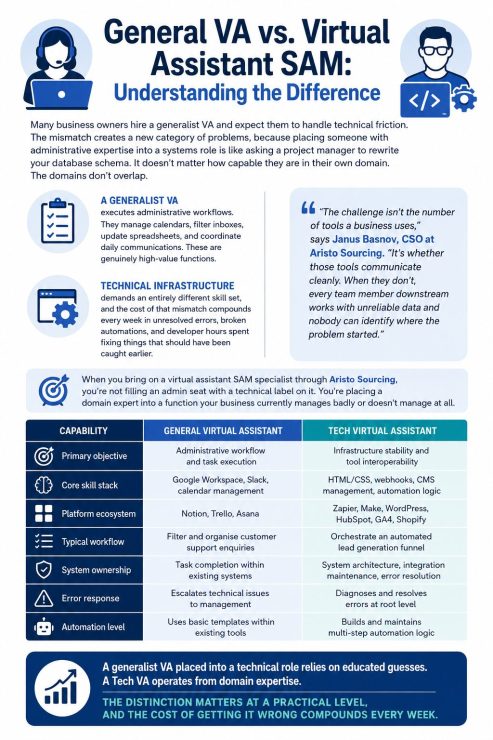
Many business owners hire a generalist VA and expect them to handle technical friction. The mismatch creates a new category of problems, because placing someone with administrative expertise into a systems role is like asking a project manager to rewrite your database schema. It doesn’t matter how capable they are in their own domain. The domains don’t overlap.
A generalist VA executes administrative workflows. They manage calendars, filter inboxes, update spreadsheets, and coordinate daily communications. These are genuinely high-value functions. Technical infrastructure demands an entirely different skill set, and the cost of that mismatch compounds every week in unresolved errors, broken automations, and developer hours spent fixing things that should have been caught earlier.
“The challenge isn’t the number of tools a business uses,” says Janus Basnov, CSO at Aristo Sourcing. “It’s whether those tools communicate cleanly. When they don’t, every team member downstream works with unreliable data and nobody can identify where the problem started.”
When you bring on a virtual assistant SAM specialist through Aristo Sourcing, you’re not filling an admin seat with a technical label on it. You’re placing a domain expert into a function your business currently manages badly or doesn’t manage at all.
| Capability | General Virtual Assistant | Tech Virtual Assistant |
|---|---|---|
| Primary objective | Administrative workflow and task execution | Infrastructure stability and tool interoperability |
| Core skill stack | Google Workspace, Slack, and calendar management | HTML/CSS, webhooks, CMS management, automation logic |
| Platform ecosystem | Notion, Trello, Asana | Zapier, Make, WordPress, HubSpot, GA4, Shopify |
| Typical workflow | Filter and organize customer support inquiries | Orchestrate an automated lead generation funnel |
| System ownership | Task completion within existing systems | System architecture, integration, maintenance, and error resolution |
| Error response | Escalates technical issues to management | Diagnoses and resolves errors at the root level |
| Automation level | Uses basic templates within existing tools | Builds and maintains multi-step automation logic |
A generalist VA placed into a technical role relies on educated guesses. A Tech VA operates from domain expertise. The distinction matters at a practical level, and the cost of getting it wrong compounds every week.
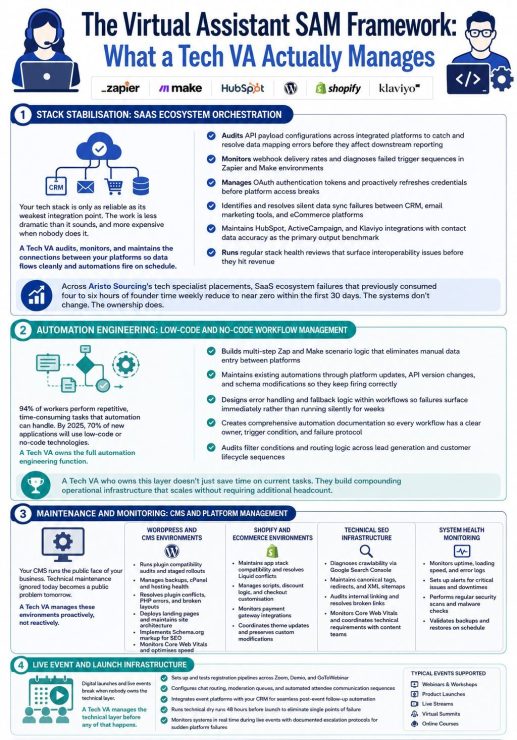
The Virtual Assistant SAM Framework: What a Tech VA Actually Manages
Stack Stabilization: SaaS Ecosystem Orchestration
Your tech stack is only as reliable as its weakest integration point. A single broken Zap in a lead routing sequence can silently fail to deliver prospects to your CRM for weeks. A misfiring webhook between Shopify and your 3PL can delay fulfillment without triggering any visible error in either platform. The work is less dramatic than it sounds, and more expensive when nobody does it.
A Tech VA audits, monitors, and maintains the connections between your platforms so data flows cleanly and automations fire on schedule.
- Audits API payload configurations across integrated platforms to catch and resolve data mapping errors before they affect downstream reporting
- Monitors webhook delivery rates and diagnoses failed trigger sequences in Zapier and Make environments.
- Manages OAuth authentication tokens and proactively refreshes credentials before platform access breaks
- Identifies and resolves silent data sync failures between CRM, email marketing tools, and eCommerce platforms
- Maintains HubSpot, ActiveCampaign, and Klaviyo integrations with contact data accuracy as the primary output benchmark
- Runs regular stack health reviews that surface interoperability issues before they hit revenue
Across Aristo Sourcing’s tech specialist placements, SaaS ecosystem failures that previously consumed four to six hours of founder time weekly reduce to near zero within the first 30 days. The systems don’t change. The ownership does.
Automation Engineering: Low-Code and No-Code Workflow Management
Modern businesses run on automation logic built inside Zapier, Make (formerly Integromat), and similar no-code platforms. These workflows handle lead routing, customer onboarding sequences, invoice generation, and reporting pipelines. When they break, operations stall. Or worse, they continue running silently with bad data flowing through them, and nobody notices until the damage surfaces in a revenue report.
Zapier’s State of Business Automation research found 94% of workers perform repetitive, time-consuming tasks that automation can handle. Gartner projects that by 2025, 70% of new applications will use low-code or no-code technologies, up from under 25% in 2020. The businesses that win in this environment aren’t the ones with the most tools. They’re the ones with someone who keeps the logic connecting those tools running reliably.
A Tech VA owns the full automation engineering function.
- Builds multi-step Zap and Make scenario logic that eliminates manual data entry between platforms
- Maintains existing automations through platform updates, API version changes, and schema modifications so they keep firing correctly
- Design error handling and fallback logic within workflows so failures surface immediately, rather than running silently for weeks.
- Creates comprehensive automation documentation so every workflow has a clear owner, trigger condition, and failure protocol
- Audits filter conditions and routing logic across lead generation and customer lifecycle sequences
A Tech VA who owns this layer doesn’t just save time on current tasks. They build compounding operational infrastructure that scales without requiring additional headcount.
Maintenance and Monitoring: CMS and Platform Management
Your CMS runs the public face of your business. WordPress, Shopify, and Webflow installations require ongoing technical maintenance that most founders ignore until something breaks publicly, usually during a campaign when the timing couldn’t be worse.
A Tech VA manages these environments proactively, not reactively.
WordPress and CMS Environments
- Runs plugin compatibility audits before major core updates and executes staged rollouts rather than applying changes directly to live environments
- Manages database backups, cPanel configurations, and hosting environment health
- Resolves plugin conflicts, generating PHP errors, white screens, or broken layouts
- Deploys landing pages, updates conversion-focused page elements, and maintains site architecture
- Implements and maintains structured data markup and Schema.org configurations for improved SEO visibility and rich result eligibility.
- Monitors Core Web Vitals, diagnoses speed degradation, and optimizes asset delivery.
Shopify and eCommerce Environments
- Maintains app stack compatibility and resolves Liquid template conflicts
- Manages Shopify scripts, discount logic, and checkout customization
- Monitors payment gateway integrations and flags reconciliation errors early
- Coordinates theme updates and ensures custom modifications survive version changes
Technical SEO Infrastructure
- Diagnoses crawlability issues via Google Search Console and resolves indexation errors
- Maintains canonical tags, redirect chains, and XML sitemap accuracy
- Audits internal linking structures and resolves broken link patterns at scale
- Monitors Core Web Vitals and coordinates page-level technical requirements with content teams
Live Event and Launch Infrastructure
Digital product launches, webinar events, and online campaigns need backend coordination that breaks when nobody owns it. Most founders discover this at the worst possible moment, when a registration pipeline fails 30 minutes before a live webinar or a checkout link stops converting during a launch window.
A Tech VA manages the technical layer before any of that happens.
- Sets up and tests registration pipelines across Zoom, Demio, and GoToWebinar
- Configures chat routing, moderation queues, and automated attendee communication sequences
- Integrates event platforms with your CRM for seamless post-event follow-up automation
- Runs technical dry runs 48 hours before launch to eliminate single points of failure
- Monitors systems in real time during live events with documented escalation protocols for sudden platform failures
Operational Security: The Trust Layer
The most common concern founders raise before placing a Tech VA is access risk. Giving a remote specialist credentials to core business systems feels exposing, and that concern is worth addressing directly rather than burying it in a terms document.
Aristo Sourcing addresses it through a structured security framework built into every placement.
The Least-Privilege Access Model
A Tech VA receives access only to the specific systems and permission levels the role requires. They access a Zapier account without touching billing data. They manage a WordPress installation without root server credentials. They maintain a Shopify store without entering financial reporting dashboards. We document every access level before day one. The rule is straightforward: grant the minimum access that allows full ownership of the assigned function, and nothing beyond it.
Encrypted Credential Management
All credentials flow through enterprise password managers, specifically 1Password or LastPass. A Tech VA never receives or stores raw master passwords. They access only what their assigned vault entry grants, and credential sharing happens through the platform’s secure sharing mechanism rather than email or chat.
Vetted Placement and Legal Framework
We run background verification, reference assessment, and binding NDA execution for every Tech VA placement before their first day of system access. We document access policies in writing, review them during onboarding, and require sign-off from both parties before any credentials change hands. This protects your intellectual property, system configurations, and proprietary automation logic regardless of how long the engagement runs.
This framework is what separates a virtual assistant SAM placement from a generic remote hire. The technical capability matters. The access controls matter just as much.
The ROI of System-First Delegation
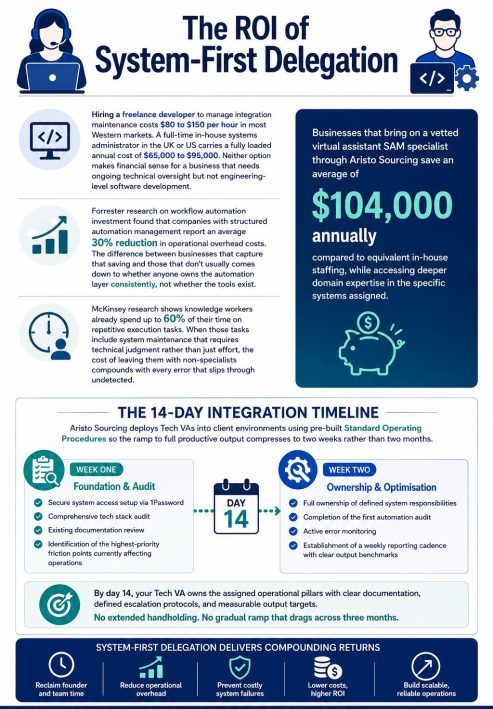
Hiring a freelance developer to manage integration maintenance costs $80 to $150 per hour in most Western markets. A full-time in-house systems administrator in the UK or US carries a fully loaded annual cost of $65,000 to $95,000. Neither option makes financial sense for a business that needs ongoing technical oversight but not engineering-level software development.
Forrester research on workflow automation investment found that companies with structured automation management report an average 30% reduction in operational overhead costs. The difference between businesses that capture that saving and those that don’t usually comes down to whether anyone owns the automation layer consistently, not whether the tools exist.
McKinsey research shows knowledge workers already spend up to 60% of their time on repetitive execution tasks when those tasks include system maintenance that requires technical judgment rather than just effort, the cost of leaving them with non-specialists compounds with every error that slips through undetected.
Businesses that bring on a vetted virtual assistant SAM specialist through Aristo Sourcing save an average of $104,000 annually compared to equivalent in-house staffing, while accessing deeper domain expertise in the specific systems assigned.
The 14-Day Integration Timeline
Aristo Sourcing deploys Tech VAs into client environments using pre-built Standard Operating Procedures, so the ramp to full productive output compresses to two weeks rather than two months.
Week one covers secure system access setup via 1Password, a comprehensive tech stack audit, existing documentation review, and identification of the highest-priority friction points currently affecting operations.
Week two covers full ownership of defined system responsibilities, completion of the first automation audit, active error monitoring, and establishment of a weekly reporting cadence with clear output benchmarks.
By day 14, your Tech VA owns the assigned operational pillars with clear documentation, defined escalation protocols, and measurable output targets. No extended handholding. No gradual ramp that drags across three months.
Stop Losing Hours to Backend Friction
Your SaaS tools cost money every month. When they stop communicating cleanly, that investment produces diminishing returns. When automations misfire silently, your data becomes unreliable. When your CMS breaks during a campaign, it costs you revenue and credibility at the moment you can least afford either.
A Tech Virtual Assistant from Aristo Sourcing manages this layer permanently and proactively. Not reactively, not after the damage is visible, but before it compounds into something expensive to reverse.
Book a strategic consultation with Aristo Sourcing today, and we’ll map the exact operational tech layer your business needs, identify the specific systems generating friction, and introduce the specialist profile that closes that gap within 14 days.
Frequently Asked Questions
What is virtual assistant SAM?
Virtual assistant SAM is Aristo Sourcing’s operational framework for deploying Tech Virtual Assistants. SAM stands for Stack Stabilization, Automation Engineering, and Maintenance and Monitoring. Each pillar maps to a distinct category of technical ownership: maintaining SaaS ecosystem integration and stability, building and managing automation logic in low-code and no-code environments, and handling ongoing CMS and platform health. Every Tech VA Aristo Sourcing place operates across all three pillars with defined responsibilities in each from day one.
What is a Tech Virtual Assistant?
A Tech Virtual Assistant is a remote specialist who manages the digital infrastructure of a scaling business. This includes SaaS platform integrations, Zapier and Make automation workflows, CMS maintenance across WordPress, Shopify, and Webflow, technical SEO infrastructure, and ongoing system error monitoring. A Tech VA operates at the intersection of IT and operations: more capable than a generalist VA in technical domains, and significantly more affordable than a developer for ongoing maintenance work.
What is the difference between a Tech VA and a general virtual assistant?
A generalist VA handles administrative workflows, including calendars, inboxes, task coordination, and data entry. A Tech VA holds domain expertise in digital systems, automation logic, and platform interoperability. Placing a generalist VA into a technical role creates operational friction because the skill sets don’t match the demands of the function. A Tech VA owns system stability and automation engineering as a primary domain, not as additional tasks picked up alongside administrative work.
What systems does a Tech Virtual Assistant manage?
Common systems include Zapier, Make, WordPress, Shopify, Webflow, HubSpot, ActiveCampaign, Klaviyo, Google Analytics 4, Google Search Console, Stripe, and various 3PL integrations. Aristo Sourcing scopes the required platform expertise before matching a candidate to ensure the Tech VA holds working knowledge of your specific tech stack before their first day.
How does Aristo Sourcing handle security when a Tech VA accesses our systems?
Aristo Sourcing implements a Least-Privilege Access Model for every placement. The VA receives access only to the specific systems and permission levels the role requires. All credentials flow through enterprise password managers (1Password or LastPass). We run background verification, reference assessment, and NDA execution before any credentials change hands. We document access policies in writing and require sign-off from both parties before system access begins.
Can a Tech Virtual Assistant manage Zapier and make automations?
Yes. Automation engineering sits at the core of what an Aristo Sourcing Tech VA does. They build new automation sequences, maintain existing workflows through API version changes, implement error handling logic, and audit filter conditions and routing logic across active scenarios. They document every automation they build or modify so ownership transfers cleanly if your team changes.
How long does it take for a Tech VA to become productive?
Aristo Sourcing Tech VAs reach full productive output within 14 days using pre-built onboarding SOPs. Week one covers system access setup, tech stack audit, and priority identification. Week two covers active ownership of defined responsibilities with daily reporting. The 14-day timeline assumes the client provides system access and any existing documentation at the start of week one.
Can a Tech VA support technical SEO?
Yes, within a defined operational scope. Aristo Sourcing Tech VAs manage technical SEO infrastructure, including Google Search Console monitoring, crawlability diagnostics, indexation error resolution, structured data markup implementation, internal link auditing, Core Web Vitals monitoring, and redirect chain management. Keyword strategy and content creation sit with a dedicated SEO VA or content specialist, not the Tech VA.