
Shared services and outsourcing are two widely used business models for improving operational efficiency and reducing administrative complexity. Shared services centralize internal business functions within the organization, while outsourcing transfers specific processes or operations to external service providers. Businesses often compare both models based on cost management, scalability, operational control, data security, workforce structure, and organizational culture.
Shared services typically provide stronger internal visibility and standardized workflows, while outsourcing offers greater flexibility and access to specialized expertise. Companies also evaluate which model better supports automation, digital transformation, and long-term growth strategies.
According to Statista, the global outsourcing market continues expanding rapidly, while Fortune Business Insights reports growing enterprise investment in shared services centers driven by AI automation, centralized operations, and process optimization initiatives.
What Are Shared Services?
Shared services are an internal business model where companies centralize common operational functions into a Shared Services Center (SSC) that supports multiple business units from one location. Instead of maintaining separate support teams across departments, organizations consolidate functions such as finance, HR, payroll, procurement, IT support, and compliance into a centralized internal structure. Unlike outsourcing, shared services remain fully controlled and managed within the organization rather than by external vendors.
This model improves operational consistency, process standardization, and cost efficiency across enterprise operations. According to Deloitte’s 2023 Global Shared Services and Outsourcing Survey, 86% of surveyed organizations either operate or are expanding Global Business Services (GBS) capabilities to improve operational efficiency and business value, demonstrating the increasing adoption of centralized shared services to optimize enterprise operations.
What Is Outsourcing?
Outsourcing is a business strategy where a company delegates specific functions, services, or operational processes to an external third-party vendor. The outsourcing provider manages staffing, workflows, technology, and service delivery independently while the client oversees performance through contracts and service-level agreements. Unlike shared services, outsourcing operates outside the organization through external vendor partnerships.
Businesses commonly outsource IT services, customer support, payroll, finance operations, data processing, cybersecurity, and back-office administration to improve efficiency and reduce operational costs. According to Statista, the global IT outsourcing market is projected to generate US$634.18 billion in revenue by 2026 and reach US$806.55 billion by 2030, growing at a compound annual growth rate (CAGR) of 6.20% from 2026 to 2030. This steady growth reflects the increasing reliance on outsourcing to access specialized expertise, improve operational efficiency, and support business scalability.
What Are The Difference Between Shared Services and Outsourcing?
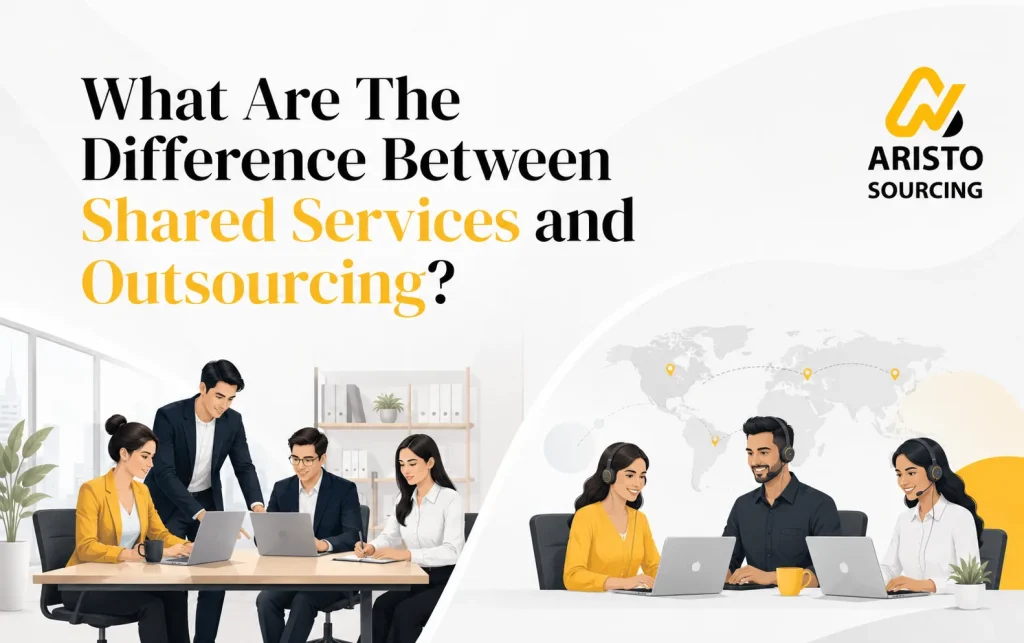
Shared services and outsourcing differ across operational structure, ownership, scalability, cost management, governance, and workforce integration. While shared services centralize functions internally, outsourcing transfers operations to external providers. The following comparison areas explain how both models differ strategically and operationally.
| Area | Shared Services | Outsourcing |
| Ownership | Internal business unit | External vendor |
| Control | Full internal control | Contract-based control |
| Governance | Corporate policies and internal SLAs | SLAs, KPIs, audits |
| Cost Model | Internal consolidation savings | Vendor-based pricing |
| Scalability | Requires internal investment | Vendor scales quickly |
| Work Culture | Same company culture | Separate vendor culture |
| Security | Data stays internal | Third-party data exposure |
| Expertise | Internal capabilities | Specialized external talent |
| Quality Management | Internal oversight | SLA-driven accountability |
| Best For | Long-term operational control | Fast scalability and flexibility |
1. Types Of Shared Services
Finance and Accounting centralize financial reporting, invoice processing, compliance management, and bookkeeping under one internal structure. This improves operational consistency and financial visibility across multiple business units.
HR and Payroll combine recruitment, payroll administration, employee onboarding, and benefits management into a shared internal workforce system. Businesses use this model to standardize people operations and reduce duplicated HR processes.
Information Technology shared services manage helpdesk operations, infrastructure support, cybersecurity, and enterprise applications from one centralized IT environment. This improves system control and technical efficiency across departments.
Procurement centralizes sourcing, purchasing, contract management, and vendor relationships to improve negotiation power and purchasing consistency. Some organizations also extend shared operational models into inventory and supply chain management.
Inventory Management shared services handle stock control, warehouse coordination, and supply chain visibility through centralized operational oversight. While shared services remain internal, businesses also use several outsourcing structures depending on operational goals and vendor relationships.
2. Types Of Outsourcing
Location-Based Outsourcing includes onshore, nearshore, and offshore outsourcing models. Businesses choose locations based on labor costs, communication efficiency, regulatory requirements, and time zone compatibility.
Relationship-Based Outsourcing includes staff augmentation, managed services, and strategic outsourcing partnerships. These models differ based on how much operational control, collaboration, and vendor involvement the client requires.
Pricing-Based Outsourcing includes fixed-price, time-and-materials, and performance-based contracts. Each pricing structure affects budgeting flexibility, operational accountability, and long-term outsourcing costs differently. Beyond outsourcing structures, businesses often compare which model delivers stronger long-term cost efficiency and operational value.
3. Cost-Effectiveness
Cost-effectiveness differs because shared services and outsourcing reduce operational expenses through different methods. Shared services lower costs through internal consolidation, process standardization, centralized management, and economies of scale across multiple departments within the organization.
Outsourcing usually reduces expenses through labor arbitrage, vendor specialization, offshore delivery models, and external operational efficiencies. Shared services often provide stronger long-term ROI through internal process control, while outsourcing may deliver faster short-term savings and scalability. Besides financial efficiency, businesses also evaluate how both models affect operational control and governance structures.
4. Control and Governance
Control and governance are structured very differently in shared services and outsourcing models. Shared services operate fully inside the organization, allowing businesses to manage workflows, policies, reporting standards, and operational decisions directly through internal leadership and corporate governance frameworks.
Outsourcing relies more on contractual governance through SLAs, KPIs, compliance clauses, and audit rights because operations are managed externally by vendors. Shared services usually provide stronger day-to-day operational visibility, while outsourcing depends heavily on reporting structures and vendor accountability mechanisms. Beyond governance differences, businesses also compare how both models handle operational growth and scalability demands.
5. Scalability
Scalability differs because shared services and outsourcing expand operational capacity through separate approaches. Shared services usually require internal hiring, infrastructure expansion, technology investment, and additional management resources when operational demand increases across business units.
Outsourcing allows vendors to scale staffing, delivery capacity, and operational support more quickly through existing infrastructure and external workforce networks. This often makes outsourcing faster and more cost-efficient for rapid growth or fluctuating workloads. While scalability improves operational flexibility, businesses must also evaluate how both models maintain service quality and accountability during expansion.
6. Quality Assurance
Quality assurance is managed differently because shared services and outsourcing follow separate operational accountability structures. Shared services maintain quality through internal management oversight, standardized workflows, corporate policies, and direct leadership supervision across centralized operational teams.
Outsourcing providers manage quality through contractual SLAs, operational KPIs, compliance audits, and financial penalties tied to service performance. Shared services often resolve quality failures internally through operational management, while outsourcing disputes may involve escalation procedures and vendor negotiations. Businesses comparing both models also evaluate which structure provides stronger long-term accountability, transparency, and operational consistency.
7. Work Culture
Work culture differs significantly because shared services operate entirely within the company’s internal organizational environment. Employees in shared services teams usually follow the same corporate values, communication style, leadership structure, and performance expectations as the rest of the organization.
Outsourcing providers operate with their own internal culture, management practices, and workforce structures, which may not always align naturally with the client’s environment. Businesses often need active communication and governance processes to maintain cultural alignment and collaboration quality. Along with workforce integration challenges, organizations also evaluate how both models affect data security and compliance management.
8. Security
Security is often stronger in shared services because business data, operational systems, and workflows remain fully inside the organization’s internal infrastructure. Companies manage security policies, access controls, compliance monitoring, and operational governance directly through enterprise security frameworks and internal IT teams.
Outsourcing introduces additional exposure because third-party vendors receive access to sensitive systems, operational data, and business processes. Security controls are usually managed through contracts, DPAs, compliance clauses, and vendor audits involving standards such as GDPR, HIPAA, and SOC 2. Since security directly impacts operational stability, businesses also compare the long-term strategic advantages of shared services structures.
9. Benefits Of Shared Services
Benefits of shared services include lower operational costs through consolidation, centralized management, and process standardization across multiple departments. Businesses also gain stronger internal visibility into workflows, operational reporting, compliance management, and enterprise-wide performance tracking through centralized support structures.
Shared services help organizations retain institutional knowledge, strengthen long-term internal capabilities, and simplify governance and audit processes. Since teams operate internally, businesses often maintain greater operational consistency and strategic alignment across departments. While shared services improve internal control, many organizations also choose outsourcing when flexibility and external expertise become higher operational priorities.
10. Benefits Of Outsourcing
Benefits of outsourcing include access to specialized expertise, faster operational deployment, and improved scalability through external vendor infrastructure. Businesses can quickly expand support functions without investing heavily in internal staffing, operational systems, or large administrative departments.
Outsourcing also provides variable cost structures that align more closely with changing business demand and operational workload. Vendors may additionally assume part of the operational risk and compliance responsibility through contractual agreements and SLAs. This allows internal teams to focus more on strategic growth, innovation, and core business activities instead of managing repetitive operational functions internally.
When To Choose Shared Services?
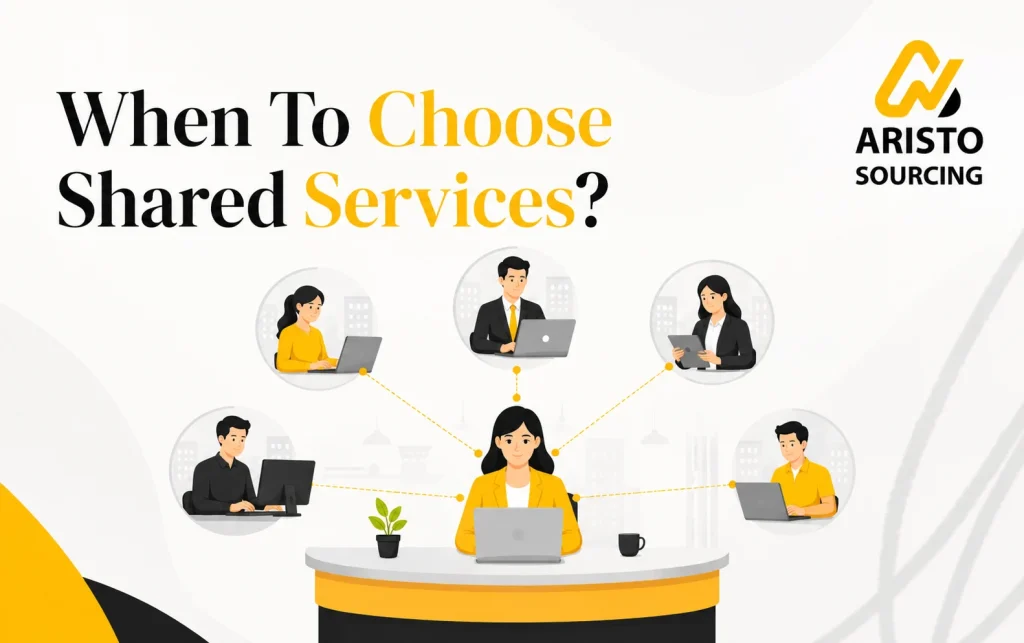
Shared services are the better choice when businesses need full internal control over operational functions that are closely connected to long-term strategy, compliance, and enterprise governance. Companies often centralize functions such as finance, HR, payroll, procurement, IT support, and compliance into a shared services center to improve operational consistency and maintain direct oversight across multiple departments or business units.
This model works best for organizations with enough operational scale to support centralized internal operations efficiently. Large enterprises and multi-business-unit organizations often use shared services to standardize workflows, reporting structures, policies, and service quality across the company. Centralization also improves operational visibility and reduces duplication of administrative tasks between departments.
Businesses additionally prefer shared services when data security, regulatory compliance, and internal process ownership are critical priorities. Since operations remain fully internal, organizations maintain greater control over sensitive information, governance policies, and operational decision-making. Shared services are also valuable when long-term capability building, workforce development, and institutional knowledge retention matter more than achieving immediate short-term outsourcing savings.

When To Choose Outsourcing?
Outsourcing is the better choice when businesses want to delegate non-core operational functions to external providers without building or managing large internal support teams. Companies commonly outsource customer support, payroll, IT services, data processing, back-office administration, and technical support functions that do not require full internal ownership or strategic control.
This model works especially well for organizations that lack the operational scale, infrastructure, or specialized expertise needed to run an internal shared services center efficiently. Outsourcing providers already maintain trained teams, operational systems, and industry expertise, allowing businesses to reduce setup costs and accelerate service deployment.
Businesses also choose outsourcing when cost reduction and speed-to-execution are higher priorities than long-term internal capability building. External vendors can quickly scale operations based on changing workload demands without forcing companies to hire permanent employees or expand internal infrastructure. Outsourcing is also highly effective for variable-demand functions where maintaining full-time internal teams would create unnecessary operational costs. In many cases, specialized vendors can deliver higher service quality, technical expertise, and operational efficiency than internal teams managing the same functions independently.
What Is The Future of Shared Services In AI Automation World?
The future of shared services is becoming increasingly driven by AI, automation, and intelligent workflow technologies. Traditional shared services centers that once depended heavily on large operational teams are evolving into technology-enabled delivery hubs focused on automation, analytics, and strategic business support.
AI and robotic process automation (RPA) are already transforming transactional functions such as finance processing, payroll administration, HR support, procurement workflows, and IT service management. Repetitive high-volume tasks like invoice processing, employee onboarding, reporting, ticket routing, and document verification are increasingly handled through automated systems instead of manual operational teams.
This shift is changing shared services from a labor-focused cost center into a strategic operational value center that supports faster decision-making, real-time analytics, and enterprise-wide process optimization. Businesses are now investing more heavily in intelligent automation platforms, cloud infrastructure, predictive analytics, and AI-assisted operational management inside shared services environments.
As automation adoption increases, workforce requirements inside shared services centers are also changing significantly. Organizations now require more employees with expertise in data analytics, AI systems, process engineering, cybersecurity, automation governance, and digital operations management. The future shared services model will likely combine human expertise with AI-driven automation to improve scalability, efficiency, compliance, and operational agility across global enterprise operations.
What Is The Future of Outsourcing In AI Automation World?
The future of outsourcing is changing rapidly as AI and automation reduce reliance on traditional labor-heavy outsourcing models. Outsourcing providers increasingly use AI, robotic process automation (RPA), and workflow automation tools to improve efficiency, reduce manual work, and lower operational costs. This shift is reducing the labor arbitrage advantage that historically fueled offshore outsourcing growth. Many vendors now offer AI implementation, automation management, cloud operations, and digital transformation services instead of purely workforce-based delivery. High-volume repetitive functions such as data processing, payroll administration, and customer support operations face the highest automation risk.
Can a Company Run Shared Services and Outsourcing at the Same Time?
A company can run shared services and outsourcing simultaneously by using a hybrid operational model that separates core and non-core business functions strategically. Organizations often keep sensitive or strategically important operations such as finance governance, compliance, and IT leadership inside shared services centers while outsourcing repetitive or highly scalable processes to external vendors. This structure allows businesses to maintain internal control over critical operations while improving flexibility and cost efficiency through outsourcing. Companies usually manage both models through centralized governance, operational reporting, and standardized performance management frameworks.
What Is Global Business Services (GBS)?
Global Business Services (GBS) is an advanced operational model that combines multiple shared services functions under one centralized global delivery organization. Unlike traditional shared services that focus on single departments, GBS integrates finance, HR, procurement, IT, analytics, compliance, and operational support into one enterprise-wide structure. The model improves process standardization, operational efficiency, automation, and global scalability across multiple business units and regions. Many organizations adopt GBS to strengthen governance, reduce operational duplication, improve cross-functional collaboration, and support enterprise-wide digital transformation and automation initiatives more effectively.
What Is IT Shared Services?
IT shared services is a centralized internal technology delivery model where a company provides IT support and infrastructure services across multiple departments through one internal operational structure. This model usually includes cybersecurity management, cloud operations, technical support, application management, and enterprise infrastructure administration. Businesses use IT shared services to improve operational consistency, reduce duplicated technology costs, strengthen governance, and standardize IT systems across the organization. Centralized IT operations also help companies improve cybersecurity oversight, automation adoption, technical support quality, and enterprise-wide digital transformation management more efficiently.