
Business Process Outsourcing (BPO) management is the process of overseeing outsourced operations, vendor relationships, service quality, and performance outcomes to ensure business goals are achieved efficiently. Effective BPO management includes workflow coordination, KPI monitoring, compliance oversight, communication management, and continuous operational improvement across outsourced functions.
Strong management practices help businesses reduce risk, maintain customer satisfaction, improve scalability, and maximize long-term outsourcing value while controlling operational costs and service performance.
The importance of BPO management continues growing as outsourcing adoption expands globally. According to Grand View Research, the global Business Process Outsourcing (BPO) market is projected to reach USD 525.23 billion by 2030, driven by increasing demand for cost-efficient, scalable, and specialized business services. According to ISG’s 2024 Market Lens™ Business Process Outsourcing Study, enterprises achieve an average 15% cost savings through business process outsourcing compared with in-house operations.
What Is BPO Management?
BPO management is the process of overseeing outsourced business operations, vendor relationships, service quality, and performance outcomes to ensure outsourcing goals are achieved effectively. It involves managing communication, workflow coordination, compliance standards, cost control, reporting systems, and service-level agreements between a business and its outsourcing provider.
Strong BPO management helps organizations maintain operational consistency, reduce risk, improve accountability, and optimize long-term outsourcing performance across functions such as customer support, IT services, finance, and back-office operations. According to the IBM Institute for Business Value, 81% of executives say their ability to differentiate depends on having the right expertise in the right roles, underscoring the importance of effective workforce and service delivery strategies.
How Does BPO Management Differ From BPO Itself?
Business Process Outsourcing (BPO) is the practice of delegating specific business functions to an external service provider, while BPO management is the process of overseeing and governing that outsourcing relationship. BPO focuses on transferring operational responsibilities such as customer support, payroll, IT services, or data processing to a third party.
In contrast, BPO management involves monitoring vendor performance, maintaining service quality, managing communication, enforcing compliance standards, tracking KPIs, and ensuring outsourcing objectives are achieved effectively. Simply put, BPO is the outsourcing arrangement itself, while BPO management is the operational discipline that ensures the outsourcing partnership delivers consistent business value and long-term performance.
What Are the Core Components of BPO Management?
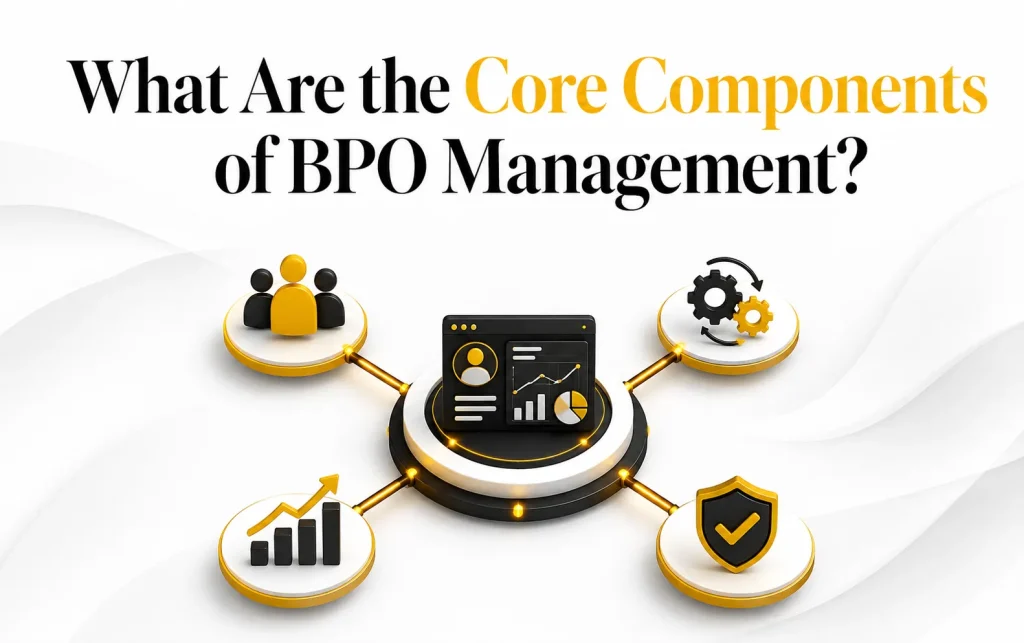
BPO management depends on multiple interconnected components that ensure outsourced operations remain efficient, compliant, scalable, and aligned with business goals. These components cover strategic planning, vendor management, operational transition, performance monitoring, quality control, workforce coordination, contract governance, and long-term risk management across outsourcing relationships.
1. Strategic Planning and Process Selection
Strategic planning in BPO management focuses on identifying which business functions should be outsourced and how outsourcing aligns with long-term operational goals. Businesses evaluate cost structures, workflow complexity, scalability needs, and internal resource limitations before selecting outsourcing candidates.
This component also involves separating core functions from non-core operations. Strategic activities tied directly to competitive advantage often remain in-house, while repetitive or process-driven tasks become outsourcing opportunities. Strong planning creates the foundation for effective vendor selection and successful onboarding processes.
2. Vendor Selection and Onboarding
Vendor selection and onboarding involve choosing outsourcing partners that match operational requirements, technical capabilities, compliance standards, and long-term business objectives. Businesses assess provider experience, pricing models, service quality, scalability, communication structure, and industry expertise before finalizing outsourcing agreements.
The onboarding phase establishes workflows, reporting structures, communication channels, and operational expectations between both parties. Proper onboarding also helps reduce transition risks and operational disruption during outsourcing implementation. Once vendors are fully integrated, businesses must focus on smooth transition management and structured knowledge transfer processes.
3. Transition and Knowledge Transfer
Transition and knowledge transfer focus on moving operational responsibilities from internal teams to outsourcing providers without disrupting business continuity. This stage includes process documentation, workflow mapping, system access setup, training sessions, and operational handover procedures.
Clear knowledge transfer reduces confusion, minimizes service interruptions, and improves long-term outsourcing efficiency. Businesses often create detailed operational guidelines and escalation procedures to support smoother collaboration between internal and outsourced teams. After transition completion, ongoing performance monitoring becomes critical for maintaining operational consistency and measurable service outcomes.
4. Performance Monitoring and KPI Tracking
Performance monitoring and KPI tracking help businesses measure whether outsourcing operations meet agreed service standards and operational goals. Common KPIs include response times, error rates, customer satisfaction, resolution speed, productivity metrics, and cost-efficiency indicators.
Regular reporting and analytics allow businesses to identify performance gaps, workflow bottlenecks, and improvement opportunities before larger operational issues develop. Continuous monitoring also strengthens accountability between businesses and outsourcing providers. Alongside performance tracking, organizations must maintain strong quality assurance and compliance management across outsourced operations.
5. Quality Assurance and Compliance
Quality assurance and compliance management ensure outsourced operations consistently meet service expectations, regulatory requirements, and internal business standards. This component includes workflow audits, compliance reviews, process evaluations, data protection controls, and service quality monitoring systems.
Businesses also monitor adherence to industry regulations such as GDPR, HIPAA, PCI-DSS, and internal governance policies to reduce operational and legal risk. Strong quality control frameworks improve customer experience, operational consistency, and vendor accountability. Beyond quality oversight, effective BPO management also depends heavily on workforce and people management strategies.
6. Workforce and People Management
Workforce and people management focus on maintaining collaboration, communication, productivity, and engagement across outsourced teams and internal stakeholders. Businesses coordinate staffing models, training programs, escalation procedures, scheduling systems, and operational responsibilities with outsourcing providers.
Strong workforce management improves team alignment, reduces communication gaps, and supports smoother operational execution across distributed service environments. Leadership teams also monitor employee performance, turnover rates, and workforce scalability to maintain service continuity during changing business demands. In addition to workforce coordination, successful outsourcing relationships require structured contract and SLA management practices.
7. Contract and SLA Management
Contract and SLA management involve defining, monitoring, and enforcing the operational agreements between businesses and outsourcing providers. Contracts establish pricing structures, scope definitions, compliance obligations, confidentiality terms, escalation procedures, and performance expectations for outsourced operations.
Service-level agreements (SLAs) define measurable standards such as response times, service availability, quality benchmarks, and reporting requirements that vendors must maintain. Proper contract management reduces disputes, strengthens accountability, and improves long-term outsourcing transparency. Alongside contractual governance, businesses must also prepare for operational risks and unexpected disruptions through contingency planning.
8. Risk Management and Contingency Planning
Risk management and contingency planning help businesses reduce operational disruptions, compliance failures, cybersecurity threats, and vendor-related service interruptions within outsourcing relationships. This component includes risk assessments, disaster recovery planning, backup workflows, cybersecurity protocols, and business continuity strategies.
Organizations also prepare contingency plans for vendor failure, system outages, geopolitical disruptions, staffing shortages, and regulatory changes that could affect outsourced operations. Proactive risk management improves operational resilience and helps businesses maintain service continuity during unexpected events. Together, these core components create the operational structure required for successful long-term BPO management.

What Are the Best Practices for Successful BPO Management?
Successful BPO management depends on structured operational practices that improve communication, reduce risk, strengthen accountability, and maintain long-term outsourcing performance. The following best practices help businesses avoid reactive problem-solving and build more stable, scalable, and efficient outsourcing relationships across vendors and operational teams.
1. Comprehensive Due Diligence
Comprehensive due diligence helps businesses evaluate outsourcing providers before entering long-term operational agreements. Companies review vendor reputation, industry experience, financial stability, compliance standards, cybersecurity capabilities, pricing models, and operational scalability during the evaluation process.
This practice reduces the risk of selecting unreliable vendors that may create service disruptions, compliance failures, or operational inefficiencies later. Proper due diligence also helps businesses identify whether a provider can support long-term strategic goals and operational growth. Once vendors are properly evaluated, businesses must establish clear contractual agreements and measurable service expectations.
2. Clear Contractual Agreements and SLAs
Clear contractual agreements and service-level agreements (SLAs) define operational responsibilities, performance expectations, pricing structures, and compliance obligations between businesses and outsourcing providers. These agreements create accountability by establishing measurable standards for response times, service quality, reporting frequency, and operational availability.
Well-structured contracts also reduce misunderstandings, prevent scope disputes, and improve transparency throughout the outsourcing relationship. Businesses often include escalation procedures, confidentiality clauses, termination conditions, and risk management requirements within outsourcing agreements. Beyond contractual governance, effective BPO management also depends heavily on regular communication and operational feedback systems.
3. Regular Communication and Feedback
Regular communication and feedback help maintain alignment between businesses and outsourcing providers throughout daily operations. Scheduled meetings, performance reviews, reporting sessions, and escalation channels improve collaboration while reducing misunderstandings across distributed operational teams.
Consistent communication also allows businesses to identify operational issues early, resolve workflow inefficiencies faster, and maintain stronger vendor accountability. Feedback systems encourage continuous service improvement while supporting long-term operational stability and customer satisfaction. In addition to communication practices, successful outsourcing relationships also require ongoing training and centralized operational knowledge management.
4. Continuous Training and Knowledge Centralization
Continuous training and knowledge centralization help outsourced teams maintain service consistency, process accuracy, and operational adaptability over time. Businesses regularly update training materials, workflow documentation, compliance guidelines, and escalation procedures to support changing operational requirements.
Centralized knowledge systems improve information accessibility across internal and outsourced teams while reducing dependency on individual employees or fragmented documentation. Ongoing training also helps outsourcing providers adapt to new technologies, service updates, and regulatory changes more efficiently. Alongside workforce preparation, businesses must also plan for operational scalability and long-term flexibility within outsourcing partnerships.
5. Scalability and Flexibility Planning
Scalability and flexibility planning help businesses prepare outsourced operations for growth, seasonal demand changes, and evolving market conditions. Companies establish adaptable staffing models, operational workflows, and resource allocation strategies that allow outsourcing providers to scale services up or down efficiently.
This planning reduces operational disruption during business expansion, product launches, or temporary workload spikes. Flexible outsourcing structures also help organizations maintain cost efficiency without overcommitting internal resources or infrastructure. In addition to scalability planning, successful BPO management increasingly depends on strong technology integration and process automation capabilities.
6. Technology Integration and Process Automation
Technology integration and process automation improve operational efficiency, reporting accuracy, and workflow consistency across outsourced business functions. Businesses often integrate cloud platforms, CRM systems, automation tools, analytics dashboards, and communication software with outsourcing operations to streamline service delivery.
Automation reduces repetitive manual tasks, minimizes processing errors, and improves response speed across customer support, finance, HR, and administrative workflows. Integrated technology systems also strengthen real-time reporting, operational visibility, and performance monitoring throughout the outsourcing relationship. Together, these best practices help businesses build more resilient, scalable, and efficient BPO management frameworks.

What Are the Benefits of Effective BPO Management?
Effective BPO management is what transforms outsourcing from a simple cost-cutting tactic into a long-term operational advantage. Strong management practices improve vendor performance, communication, scalability, service quality, and accountability while helping businesses maximize efficiency, reduce risk, and support sustainable business growth across outsourced operations.
1. Cost Reduction
Effective BPO management helps businesses control outsourcing expenses while improving operational efficiency and financial predictability. Structured oversight reduces unnecessary spending caused by poor vendor coordination, workflow inefficiencies, duplicated tasks, and hidden operational costs.
Strong management practices also improve resource allocation, vendor accountability, and service optimization across outsourced functions. Businesses that actively monitor outsourcing performance often achieve better cost efficiency without sacrificing operational quality or customer experience. Beyond financial savings, effective BPO management also allows organizations to focus more on core business functions internally.
2. Focus on Core Business Functions
Effective BPO management allows businesses to offload operational responsibilities while maintaining visibility and control over outsourced activities. Internal teams spend less time handling repetitive administrative work and more time focusing on strategic priorities such as growth, innovation, customer relationships, and competitive positioning.
Well-managed outsourcing relationships also reduce operational distractions that can slow decision-making and resource allocation internally. Leadership teams gain greater flexibility to concentrate on long-term business objectives while outsourcing providers manage routine support functions. In addition to strategic focus, strong BPO management also improves access to specialized expertise and industry knowledge.
3. Access to Specialized Expertise
Effective BPO management helps businesses fully utilize the specialized expertise available through outsourcing providers. Companies gain access to skilled professionals, industry-specific knowledge, advanced technologies, and operational best practices that may not exist internally.
Strong oversight ensures outsourcing teams remain aligned with business goals, service standards, compliance requirements, and operational expectations throughout the partnership. Businesses also benefit from faster onboarding, reduced internal training demands, and improved workflow efficiency across outsourced operations. Alongside expertise advantages, effective BPO management also strengthens operational scalability and business flexibility during changing market conditions.
4. Scalability and Flexibility
Effective BPO management improves a company’s ability to scale outsourced operations efficiently during growth periods, seasonal demand spikes, or changing business conditions. Structured operational planning allows businesses to increase or reduce outsourced capacity without major internal disruption or infrastructure expansion.
Well-managed outsourcing relationships also improve response speed, workforce adaptability, and operational continuity during fluctuating workloads. Businesses maintain greater flexibility while avoiding the fixed costs and staffing limitations associated with large internal teams. Beyond scalability benefits, effective BPO management also helps transfer certain operational and compliance risks to outsourcing providers.
5. Risk Transfer to the Provider
Effective BPO management helps businesses reduce operational, compliance, staffing, and technology-related risks by transferring specific responsibilities to outsourcing providers. Vendors often manage cybersecurity controls, compliance monitoring, disaster recovery systems, staffing continuity, and operational infrastructure within outsourced environments.
Strong governance frameworks ensure providers remain accountable for meeting contractual obligations, service standards, and regulatory requirements throughout the outsourcing relationship. Businesses still maintain oversight, but operational burdens and associated risks become more distributed across the outsourcing partnership. This risk-sharing structure improves resilience while helping organizations maintain greater operational stability during disruptions or unexpected business challenges.
What Tools and Software Support BPO Management?
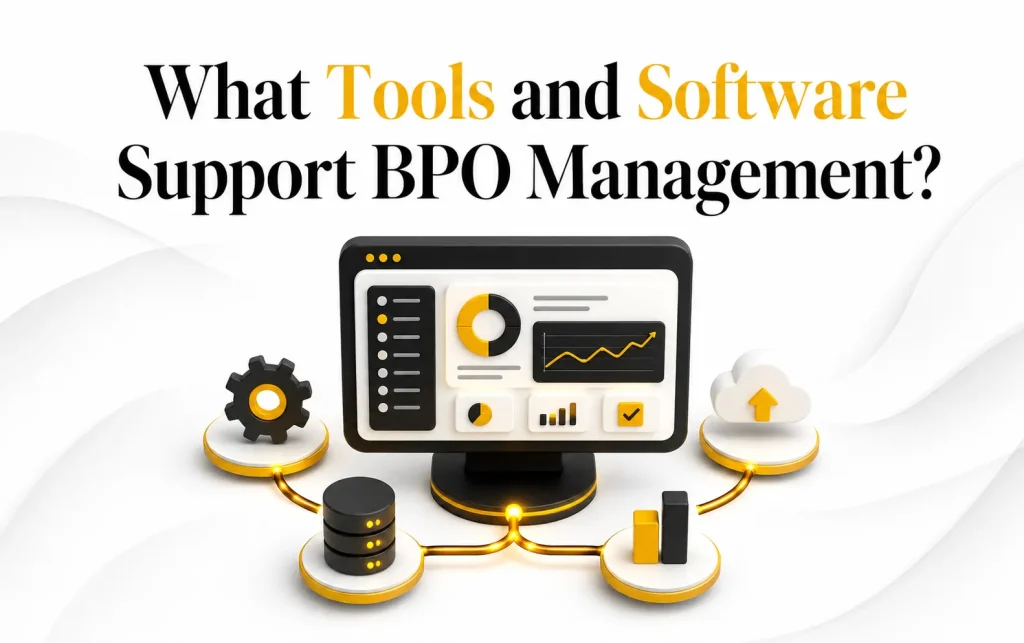
Effective BPO management relies on software platforms that improve communication, workflow visibility, reporting accuracy, automation, and operational coordination across outsourced teams. These tools help businesses monitor vendor performance, manage service delivery, strengthen compliance oversight, and maintain operational efficiency throughout the outsourcing relationship. Modern BPO environments often combine multiple technology categories to support scalability, customer experience, and process optimization across distributed operations.
Common tools and software categories used in BPO management include:
- CRM Software-Platforms like Salesforce and HubSpot help manage customer interactions, ticketing, sales pipelines, and service reporting.
- Project Management Tools-Systems such as Asana, Trello, and Jira support workflow coordination, task tracking, and operational collaboration.
- Workforce Management Software-Helps schedule staff, monitor productivity, manage attendance, and optimize staffing across outsourced teams.
- Communication Platforms-Tools like Slack, Microsoft Teams, and Zoom improve real-time communication between businesses and outsourcing providers.
- Automation and RPA Tools-Robotic Process Automation software reduces repetitive manual work and improves processing speed and accuracy.
- Analytics and Reporting Dashboards-Business intelligence platforms provide KPI tracking, operational insights, and performance monitoring.
- Cloud Collaboration Systems-Shared cloud environments improve document access, centralized knowledge management, and workflow transparency.
- Cybersecurity and Compliance Tools-Security platforms help manage data protection, access control, compliance monitoring, and threat detection.
Together, these technologies strengthen operational control, improve scalability, reduce administrative burden, and support more efficient long-term BPO management strategies. Research from MarketsandMarkets shows that automation, analytics, and cloud-based outsourcing technologies continue experiencing rapid adoption as businesses prioritize digital transformation and operational efficiency across global BPO environments.
BPO Management Software and Systems
BPO management software is a technology platform used to oversee outsourced operations, vendor performance, communication workflows, reporting, and service delivery across business processes. These systems help organizations manage KPIs, automate operational tasks, centralize documentation, monitor compliance, and improve collaboration between internal teams and outsourcing providers. Strong software integration improves operational visibility, efficiency, and long-term outsourcing control.
QA and Performance Management Platforms
QA and performance management platforms help BPOs monitor service quality, operational efficiency, and employee performance across outsourced operations. These platforms track quality scores, customer satisfaction metrics, response times, productivity KPIs, and agent performance data to identify improvement opportunities. Businesses use these systems to maintain service consistency, strengthen accountability, and improve overall operational performance through continuous monitoring and reporting.
Workforce Engagement Management Platforms
Workforce engagement management platforms are systems designed to improve workforce scheduling, forecasting, productivity, and employee engagement within BPO environments. These platforms help businesses manage operational staffing requirements while maintaining service continuity and workforce efficiency.
- Workforce scheduling and shift management
- Demand forecasting and capacity planning
- Employee engagement and productivity monitoring
- Performance tracking and workforce analytics
WEM platforms improve workforce coordination, operational flexibility, and long-term employee performance across outsourced teams.
Will AI Replace BPO?
AI is not expected to fully replace BPO because outsourcing operations still require human decision-making, emotional intelligence, relationship management, and complex problem-solving capabilities. AI increasingly automates repetitive tasks such as data processing, reporting, and basic customer support, but businesses still rely on human teams for strategic operations, customer interactions, compliance oversight, and service quality management. Instead of replacing BPO entirely, AI is reshaping how outsourcing providers improve efficiency and scalability.
Is Outsourced BPO Management Right for Your Business?
Outsourced BPO management is the right fit when businesses need operational scalability, specialized expertise, cost efficiency, or stronger process oversight without expanding internal management infrastructure. Companies with growing outsourcing operations, limited internal resources, or complex vendor relationships often benefit from external management support. Effective outsourced management also helps improve reporting, compliance monitoring, operational coordination, and long-term vendor performance across distributed business operations.