

Most people treat outsourcing like a shortcut. That mindset creates the fastest path to disappointment.
If you ask, “Is Outsourcing Right for My Business?” you don’t need hype. You need a clear test that exposes operational debt, protects your competitive edge, and tells you what to do next.
Key Takeaways
- Outsourcing scales output, not chaos. Fix the process first.
- Count the total cost of ownership (TCO), not just hourly rates.
- Outsource execution first. Keep judgment and strategy close.
- Treat outsourcing as leadership work, not a handoff.
- Use least-privilege access and role-based permissions from day one.
- Pair a human with automation using human-in-the-loop (HITL) for quality and speed.
- Start with a 30-day pilot, tight KPIs, and a clean escalation path.

Is Outsourcing Right for My Business? Why this matters now
Outsourcing now competes with two other options: in-house hiring and automation. The best choice depends on risk, speed, and what your team can actually absorb.
Two numbers explain the pressure. Professionals spend 28% of the workday reading and answering email, which drains focus and slows decisions. Meanwhile, U.S. employers carry a meaningful benefits load on top of wages, with benefits around 29.5% of employer costs in private industry.
So the question rarely sounds like “Do I like outsourcing?” It sounds like “How do I remove bottlenecks without wrecking quality?” That leads straight into the real concept most people miss.

The core concept explained clearly
Outsourcing works when you shift work, not responsibility.
That sounds subtle, but it changes everything. Harvard Business Review captured the core warning in one line: “Think outsourcing eases leadership burdens? Think again.” You can delegate tasks. You cannot delegate clarity.
Three delivery models you can choose from
- Virtual assistant (VA): A dedicated person who runs repeatable workflows inside your tools (Google Workspace, Slack, Asana, HubSpot).
- BPO (Business Process Outsourcing): A team that runs a function end-to-end (customer support, back office, finance ops), often with SLAs and managers.
- Fractional support: Senior, part-time specialists (fractional CFO, fractional marketing ops, fractional HR) who design the system and steer priorities.
The mental model that prevents expensive mistakes
Think in two buckets:
1) Utility work
Work that must happen, but never differentiates you. Examples: inbox triage, calendar coordination, data cleanup, invoice follow-ups, CRM hygiene.
2) Advantage work
Work that compounds your edge. Examples: pricing strategy, product roadmap, brand voice, key customer escalations, hiring decisions.
Outsource utility first. Keep advantage tight until you can formalize it without losing your “secret sauce.”
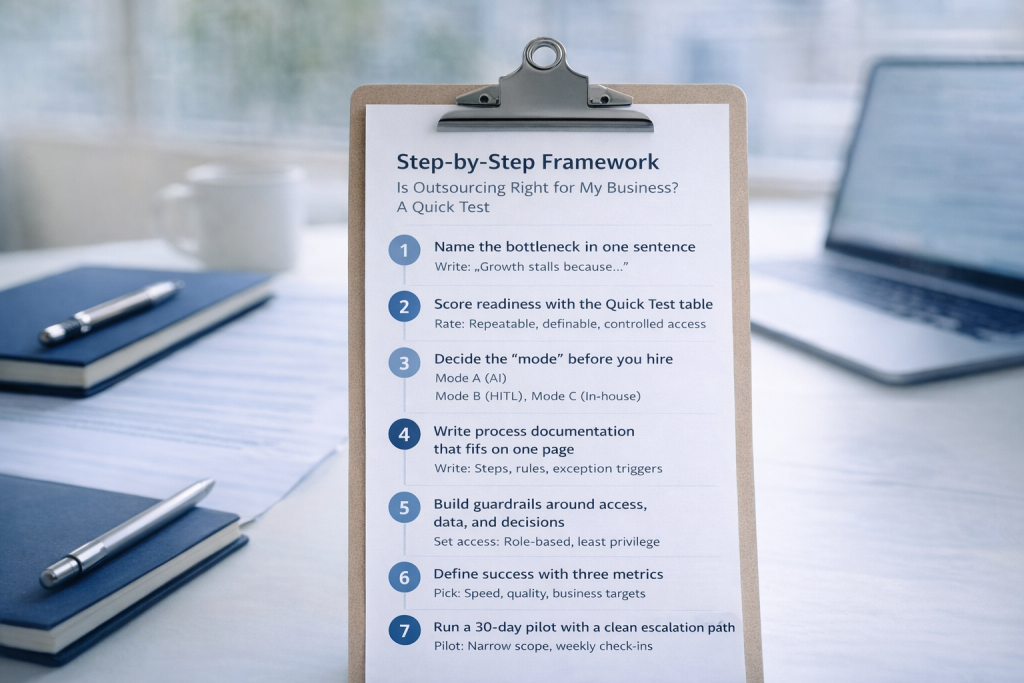
Step-by-step framework
Use this quick test in order. Each step removes guesswork and lowers risk.
Step 1: Name the bottleneck in one sentence
What to do: Write a single sentence that starts with: “Growth stalls because…”
Why it matters: Outsourcing solves constraints, not feelings. A clear bottleneck guides the role, KPIs, and tools.
Quick example: “Growth stalls because leads wait 48 hours for replies and proposals.”
Step 2: Score readiness with the Quick Test table
What to do: Score each line from 0–2. Total your score.
Why it matters: This prevents “outsourcing by desperation,” which usually multiplies noise.
Quick example: If you cannot explain “done,” you will pay for rework.
| Quick Test Signal | 0 points | 1 point | 2 points |
|---|---|---|---|
| Task repeatability | Ad hoc every time | Some repeats | Clear repeats weekly |
| Definition of “done” | Vibes | Rough checklist | Measurable output |
| Tool access setup | Shared logins | Some roles | RBAC + least privilege |
| Feedback speed | Weeks | Days | Same-day loops |
| Internal owner | Nobody | Part-time | Clear accountable owner |
| Quality tolerance | Zero errors allowed | Some errors ok | Errors detectable and fixable |
| Customer impact | High-risk | Medium | Low-risk / internal |
Score guide
- 0–5: Don’t outsource yet. Reduce complexity first.
- 6–10: Start with a micro-scope pilot.
- 11–14: You can outsource confidently with guardrails.
Step 3: Decide the “mode” before you hire
What to do: Pick one of three modes and stick to it for 30 days.
Why it matters: Most failures come from mismatched expectations, not bad talent.
Quick example: You hire a VA but expect an agency-level process redesign.
Mode A: Automation-first
Best when rules stay stable (receipt capture, scheduling reminders, basic reporting).
Mode B: Human-in-the-loop (HITL)
Best when quality needs human judgment with AI speed. NIST highlights HITL as a common strategy for managing risk, but warns that unclear oversight creates problems.
Example: A VA uses AI to draft replies, then checks facts, tone, and policy.
Mode C: In-house
Best when the work shapes product, culture, or core differentiation.
Step 4: Write process documentation that fits on one page
What to do: Create a one-page “playbook” for the task: inputs, steps, outputs, exceptions, escalation.
Why it matters: Your process documentation turns tribal knowledge into a transferable system.
Quick example: “Inbox triage” playbook: tag rules, response templates, escalation triggers, SLA targets.
Step 5: Build guardrails around access, data, and decisions
What to do: Set permissions by role, not by convenience. Use 1Password, Google Workspace roles, and app-level access controls.
Why it matters: Least-privilege access reduces blast radius when mistakes happen.
Quick example: Give “view-only” in HubSpot first. Upgrade access only after two clean weeks.
Step 6: Define success with three metrics
What to do: Choose one speed metric, one quality metric, one business metric.
Why it matters: Metrics stop scope drift and protect trust.
Quick example: Speed: response time under 4 hours. Quality: under 2% rework. Business: proposal-to-close rate rises.
Step 7: Run a 30-day pilot with a clean escalation path
What to do: Pilot a narrow scope, hold two weekly check-ins, and log issues in Asana or ClickUp.
Why it matters: You learn faster with tight loops than with big commitments.
Quick example: Week 1: execute only. Week 2: add exception handling. Week 3: add reporting. Week 4: refine.
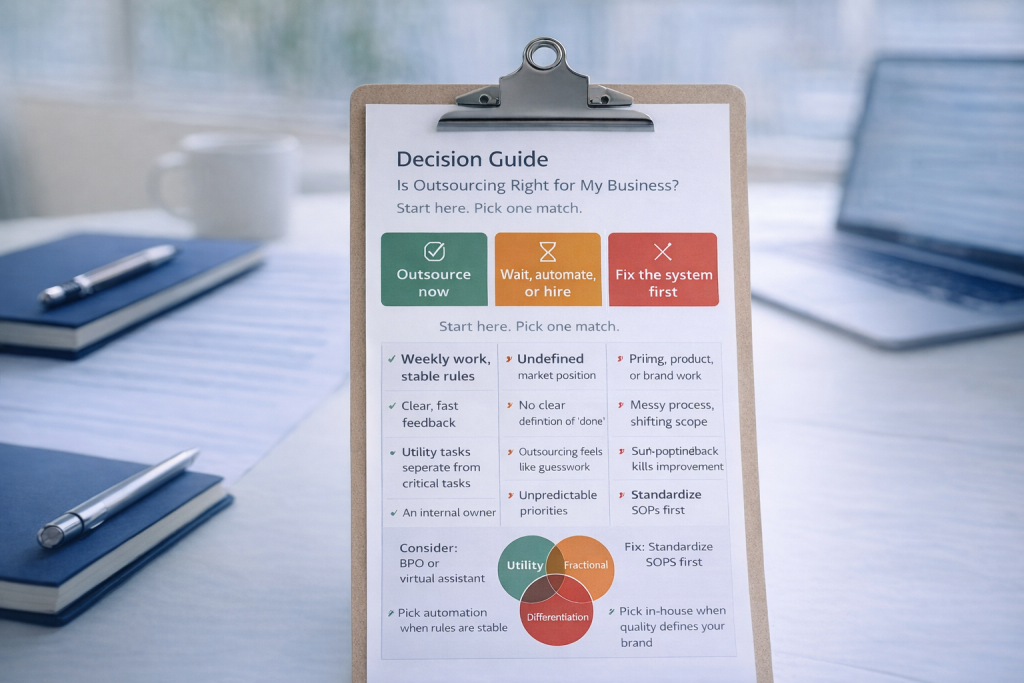
Decision guide
Outsourcing fits some businesses immediately. Others should wait, automate, or hire in-house.
Outsourcing fits you when you see these signals
- Work repeats weekly and follows rules.
- You can spot quality issues quickly.
- Someone on your team can own the outcome.
- You can respond to questions within 24 hours.
- You can separate utility work from advantage work.
Clutch reported that 83% of small businesses planned to maintain or increase spending on outsourced services, largely because they want flexibility and faster access to skills. That only helps when you manage the work like a system.
Avoid outsourcing when these conditions show up
- The task defines your market position (pricing, brand voice, product decisions).
- You cannot describe “done” without a meeting.
- You expect outsourcing to fix unclear strategy.
- You cannot provide timely feedback.
What to choose instead
- Choose automation when rules stay stable and mistakes show up fast.
- Choose fractional support when you need a senior operator to design the machine.
- Choose in-house when the work shapes culture, innovation, or customer trust.
A Harvard Business School affiliated report on global collaboration makes a sharp point: capabilities that drive top-line growth through partners differ from capabilities that drive cost reduction. In plain terms: if you chase “cheap” while you actually need “growth,” you’ll build the wrong approach.
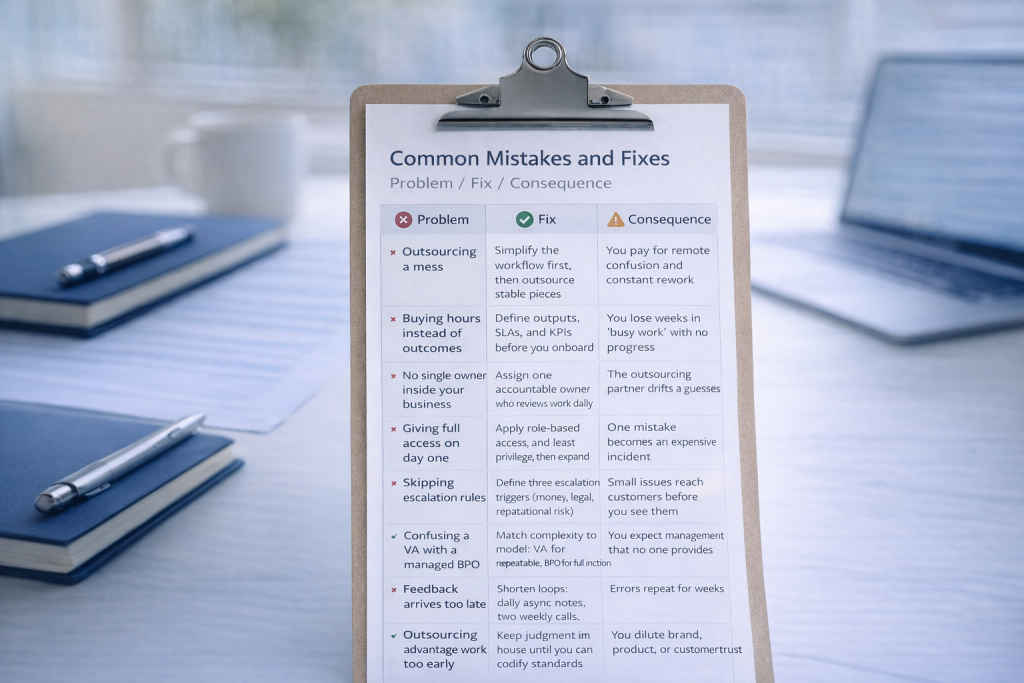
Common mistakes and fixes
- Outsourcing a mess
Fix: simplify the workflow first, then outsource the stable pieces.
Consequence: you pay for remote confusion and constant rework. - Buying hours instead of outcomes
Fix: define outputs, SLAs, and KPIs before you onboard.
Consequence: you lose weeks in “busy work” with no progress. - No single owner inside your business
Fix: assign one accountable owner who reviews work daily.
Consequence: the outsourcing partner drifts and guesses. - Giving full access on day one
Fix: apply role-based access and least privilege, then expand gradually.
Consequence: one mistake becomes an expensive incident. - Skipping the escalation rules
Fix: define three escalation triggers (money, legal, reputational risk).
Consequence: small issues reach customers before you see them. - Confusing a VA with a managed BPO team
Fix: match complexity to model: VA for repeatable workflows, BPO for end-to-end functions.
Consequence: you expect management that no one provides. - Feedback arrives too late
Fix: shorten loops: daily async notes, two weekly calls, one shared dashboard.
Consequence: errors repeat for weeks. - Outsourcing advantage work too early
Fix: keep judgment in-house until you can codify standards.
Consequence: you dilute brand, product, or customer trust.
Mini case studies
Case 1: 9-person ecommerce brand drowning in inbox
The founder answered support emails between meetings and pushed refunds late. Customers escalated on social media.
They outsourced inbox triage and templated responses using Zendesk, with a VA running HITL drafts and the founder handling exceptions. Response time dropped, refunds processed on schedule, and the founder regained two deep-work blocks per day.
Case 2: B2B agency struggling with lead follow-up
Leads arrived through HubSpot, but proposals went out days later. The team blamed “being busy,” but the real issue sat in handoffs.
They outsourced pipeline hygiene and proposal assembly. A VA updated stages, chased missing info, and prepared draft proposals for the account lead to approve. The agency didn’t outsource sales judgment. They outsourced the friction that blocked it.
Case 3: Founder considering an in-house hire for ops
The founder wanted an operations coordinator, but the true workload lived in repeatable admin plus reporting.
They ran a 30-day pilot: calendar control, invoice follow-up, and weekly KPI reporting in Google Sheets. After the pilot, they chose a dedicated VA instead of a full-time hire because the work stayed utility-heavy and predictable.
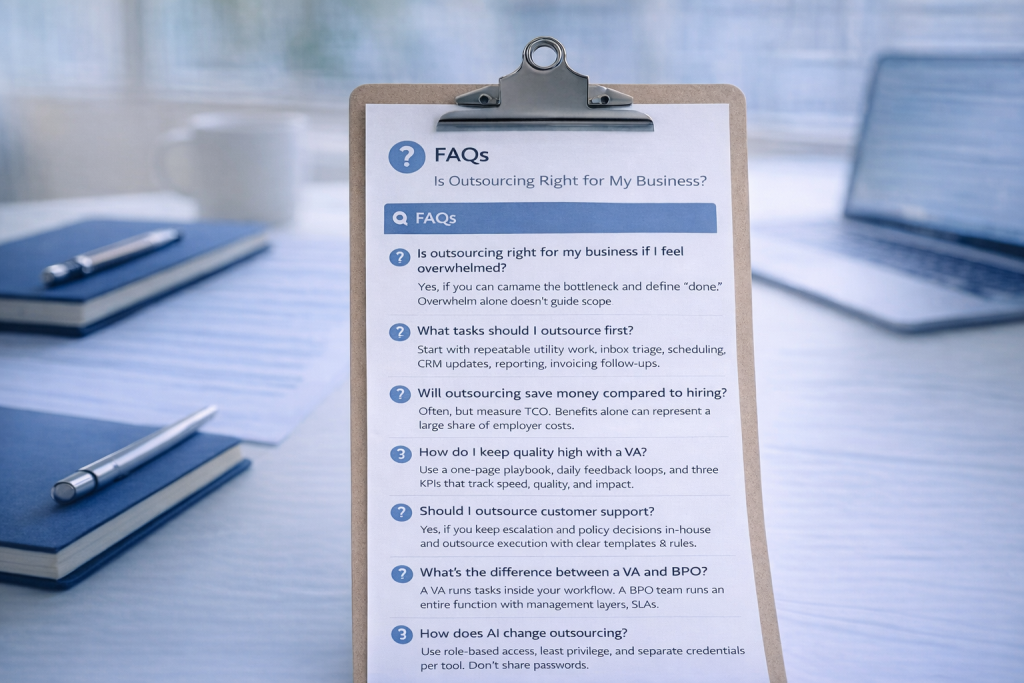
Is outsourcing right for a business if the owner feels overwhelmed?
Outsourcing is right for a business if the owner can identify a specific bottleneck and define a clear outcome. Feeling overwhelmed alone does not define the scope or suitability of outsourcing.
What tasks should a business outsource first?
Businesses should first outsource repeatable utility tasks. Examples include email triage, calendar scheduling, CRM updates, report generation, and invoice follow-ups.
Does outsourcing save money compared to hiring?
Outsourcing often saves money compared to hiring. Total cost of ownership (TCO) should be measured, as employee benefits can significantly increase internal costs.
How can a business maintain quality when using a virtual assistant?
A business can maintain quality by using a one-page playbook, establishing daily feedback loops, and tracking three key performance indicators: speed, quality, and impact.
Should a business outsource customer support?
A business should outsource customer support if it retains control over escalation and policy decisions, and provides clear templates and rule-based workflows for execution.
What is the difference between a virtual assistant and a BPO?
A virtual assistant executes tasks within an existing workflow. A BPO (Business Process Outsourcing) provider manages an entire function, including team management, SLAs, and full process control.
How does AI impact outsourcing?
AI impacts outsourcing by drafting, summarizing, and routing tasks. Human oversight remains essential for quality control, context awareness, and edge-case handling.
How can a business prevent security issues when outsourcing?
A business can prevent security issues by using role-based access, enforcing least-privilege principles, and assigning separate credentials per tool. Password sharing must be avoided.
How long does it take to see results from outsourcing?
Businesses see clarity in the first week, operational stability by the second week, and measurable improvements by the fourth week assuming the scope is narrowly defined.Next step
If your Quick Test score lands at 6 or higher, run a 30-day pilot with a dedicated VA or a managed BPO model, then measure the outcome.
Aristo Sourcing helps businesses match the right model, build clean process documentation, and hire dedicated talent from the Philippines and South Africa with practical guardrails. Book a call to explore options and book a conversation.
